Back
BackMetabolism and Cellular Respiration: Structured Study Notes for ANP College Students
Study Guide - Smart Notes
 Tailored notes based on your materials, expanded with key definitions, examples, and context.
Cellular Respiration
Overview and Storage Molecules
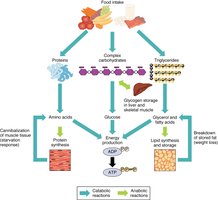
Cellular respiration is the process by which cells extract energy from fuel molecules (glucose, fatty acids, amino acids) to produce ATP. Storage molecules such as glycogen and triglycerides provide reserves for energy production.
Goal: Collect hydrogen atoms from fuel molecules and use them to generate ATP.
Storage: Glycogen (carbohydrate storage) and triglycerides (fat storage) are mobilized as needed.
Using Glucose as Fuel
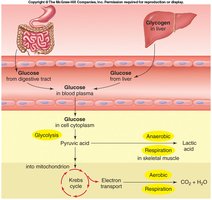
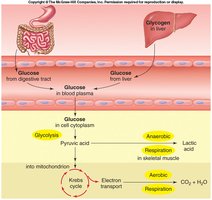
Glucose is a primary fuel for cellular respiration. The pathway taken depends on oxygen availability: glycolysis occurs first, followed by either anaerobic or aerobic processes.
Low oxygen: Anaerobic respiration (lactic acid pathway).
High oxygen: Aerobic respiration (citric acid cycle and electron transport chain).
Glycolysis
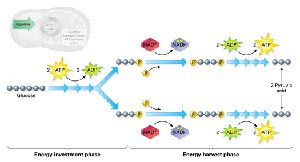
Glycolysis is the initial step in glucose metabolism, occurring in the cytosol. It partially breaks down glucose, producing pyruvate, ATP, and NADH.
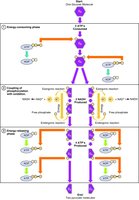
Steps: 1. Invest 2 ATP; 2. Split glucose; 3. Collect hydrogen on NAD+; 4. Generate 4 ATP; 5. End with 2 pyruvates.
Products: 2 net ATP, 2 NADH, 2 pyruvic acid molecules.
Fate of Pyruvate: Anaerobic vs. Aerobic Respiration
After glycolysis, pyruvate can enter either the lactic acid pathway (anaerobic) or the citric acid cycle (aerobic), depending on oxygen supply.
Anaerobic: Pyruvate is converted to lactic acid, yielding 2 ATP per glucose.
Aerobic: Pyruvate is converted to Acetyl CoA, enters the citric acid cycle, and proceeds to the electron transport chain.
Lactic Acid Pathway (Anaerobic Respiration)
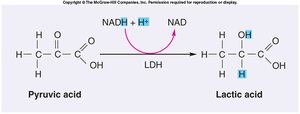
In the absence of oxygen, pyruvate is reduced to lactic acid. This pathway is used by skeletal muscle cells and red blood cells, with lactic acid transported to the liver for conversion back to glucose.
Net ATP: Only 2 ATP per glucose.
Enzyme: Lactate dehydrogenase (LDH) catalyzes the conversion.
Aerobic Respiration: Pyruvate to Acetyl CoA
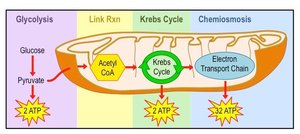
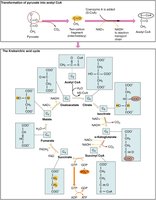
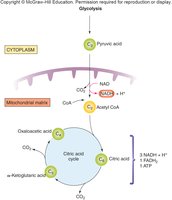
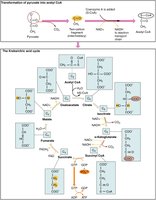
With sufficient oxygen, pyruvate is converted to Acetyl CoA, which enters the mitochondria. This step produces NADH and releases CO2 as waste.
Coenzyme A: Derived from vitamin B, it shuttles acetyl groups into the citric acid cycle.
Products: NADH, CO2, Acetyl CoA.
Citric Acid Cycle (Krebs Cycle)
The citric acid cycle breaks down Acetyl CoA into CO2, collects hydrogen atoms for the electron transport chain, and generates ATP.
Interconversion: Molecules are transformed to facilitate breakdown and energy extraction.
Products: CO2, NADH, FADH2, ATP.
Oxidative Phosphorylation: Electron Transport Chain (ETC)
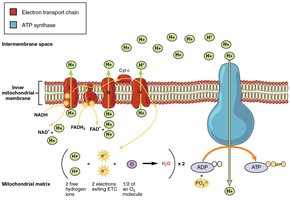
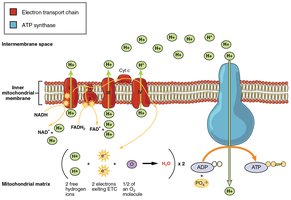
Oxidative phosphorylation uses the ETC to convert collected hydrogens into ATP. Electrons move through protein complexes, pumping protons into the intermembrane space. ATP is generated as protons flow back through ATP synthase, with oxygen as the final electron acceptor.
Hydrogen separation: Protons and electrons are separated for energy transfer.
ATP synthesis: Occurs when protons return via ATP synthase.
Oxygen: Essential as the final acceptor, forming water.
Using Fatty Acids as Fuel
Fatty acids are metabolized via beta-oxidation in the mitochondria, producing Acetyl CoA and hydrogens for the ETC. This process is strictly aerobic.
Beta-oxidation: Sequential removal of two-carbon units, forming Acetyl CoA.
Citric acid cycle: Acetyl CoA enters CAC, followed by ETC.
Using Amino Acids as Fuel
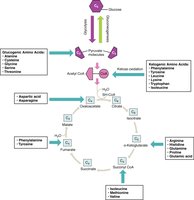
Amino acids are used for energy only when necessary. They undergo oxidative deamination to remove the amino group, producing keto acids that enter the citric acid cycle. Ammonia is converted to urea for excretion.
Oxidative deamination: Prepares amino acids for entry into CAC.
Waste: NH3 (ammonia) is converted to urea and filtered by kidneys.
Metabolic Interconversions in the Liver
Key Processes
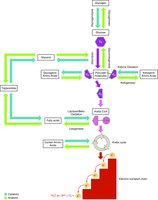
The liver is central to metabolic regulation, facilitating the interconversion of carbohydrates, fats, and proteins.
Glycogenolysis: Breakdown of glycogen to glucose.
Glycogenesis: Formation of glycogen from glucose.
Gluconeogenesis: Synthesis of glucose from non-carbohydrate sources.
Lipogenesis: Formation of lipids from other molecules.
Glucose Sparing
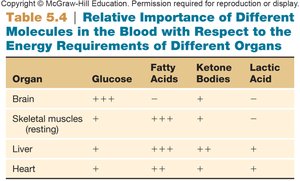
Glucose sparing refers to the body's strategy to conserve glucose for tissues that depend on it, such as the brain, by using alternative fuels like fatty acids and ketone bodies in other tissues.