 Back
BackMicroscopy: Structure, Care, and Principles of the Compound Microscope
Study Guide - Smart Notes
 Tailored notes based on your materials, expanded with key definitions, examples, and context.
Care and Structure of the Compound Microscope
Proper Handling and Maintenance
The compound microscope is a delicate and precise instrument essential for studying cells and tissues in anatomy and physiology. Proper care ensures its longevity and optimal performance.
Transport: Always carry the microscope upright, supporting the arm with one hand and the base with the other. Avoid swinging or jarring the instrument.
Cleaning: Use only grit-free lens paper in a circular motion to clean all lenses before and after use. Never use regular tissues or cloths, as these can scratch the lenses.
Focusing: Begin with the scanning objective lens (lowest power) and use the coarse adjustment knob only with this lens. Switch to higher-power lenses as needed, using the fine adjustment knob for precise focusing.
Wet Mounts: Always use a coverslip when preparing wet mounts to protect both the specimen and the objective lens.
Storage: Before storing, remove any slide from the stage, rotate the scanning objective into position, wrap the cord neatly, and cover the microscope with a dust cover or return it to its designated area.
Maintenance: Never remove microscope parts. Report any mechanical issues to your instructor.
Magnification and Resolution
Principles of Image Formation
The compound microscope uses a system of lenses to magnify specimens, allowing detailed observation of structures not visible to the naked eye.
Ocular Lens: The lens closest to the eye, typically with a magnification of 10×.
Objective Lenses: Located on a rotating nosepiece, these lenses provide varying levels of magnification (e.g., 4×, 10×, 40×, 100×).
Image Formation: The objective lens creates a real image of the specimen, which is then magnified by the ocular lens to produce the virtual image seen by the observer.
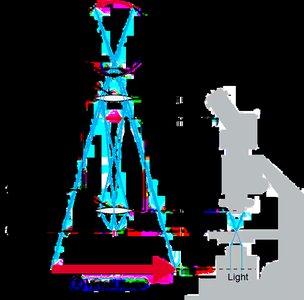
Total Magnification
The total magnification (TM) of a specimen is calculated by multiplying the magnification power of the ocular lens by that of the objective lens in use.
Formula:
Example: If the ocular lens is 10× and the objective lens is 45×, then total magnification.
Resolution (Resolving Power)
Resolution is the ability of the microscope to distinguish two points as separate entities. It is a critical factor in the clarity of the image.
Human Eye: Can resolve objects about 100 μm apart.
Compound Microscope: Under ideal conditions, can resolve objects as close as 0.2 μm apart.
Limitation: Objects closer than 0.2 μm appear as a single fused image.
Factors Affecting Resolution: The amount and properties of visible light entering the microscope. More light generally increases resolution.
Objective Aperture: As magnification increases, the aperture size decreases, allowing less light to enter. Therefore, higher magnifications often require increased light intensity for optimal resolution.
Summary Table: Key Features of the Compound Microscope
Component | Function |
|---|---|
Ocular Lens | Magnifies the real image to produce the virtual image |
Objective Lens | Magnifies the specimen to produce the real image |
Coarse Adjustment | Brings specimen into general focus (use only with scanning lens) |
Fine Adjustment | Sharpens the focus for higher-power objectives |
Stage | Holds the slide in position |
Light Source | Illuminates the specimen |
Additional info: Mastery of microscope use is foundational for laboratory work in anatomy and physiology, especially for the study of cells (Ch. 3) and tissues (Ch. 4).
