 Back
BackMini-Textbook Study Guide: The Endocrine System in Human Anatomy & Physiology
Study Guide - Smart Notes
 Tailored notes based on your materials, expanded with key definitions, examples, and context.
The Endocrine System: Overview and Principles
Introduction to the Endocrine System
The endocrine system is a major regulatory system of the human body, working alongside the nervous system to maintain homeostasis and coordinate physiological functions. It consists of glands and specialized cells that secrete hormones, which are chemical messengers transported by the bloodstream to target tissues.
Endocrine glands secrete hormones directly into the blood.
Hormones regulate processes such as growth, metabolism, reproduction, and stress responses.
Homeostasis is maintained by feedback mechanisms involving hormone secretion and action.
Types of Chemical Signaling
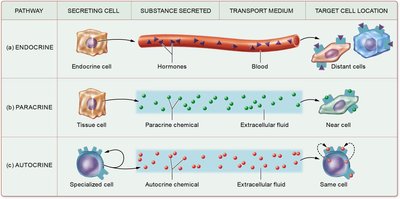
Chemical signaling in the body occurs via endocrine, paracrine, and autocrine pathways, each differing in the location and method of target cell interaction.
Endocrine signaling: Hormones are secreted into the blood and act on distant target cells.
Paracrine signaling: Chemicals act on nearby cells within the same tissue.
Autocrine signaling: Chemicals act on the same cell that secreted them.
Pathway | Secreting Cell | Substance Secreted | Transport Medium | Target Cell Location |
|---|---|---|---|---|
Endocrine | Endocrine cell | Hormones | Blood | Distant cells |
Paracrine | Tissue cell | Paracrine chemical | Extracellular fluid | Near cell |
Autocrine | Specialized cell | Autocrine chemical | Extracellular fluid | Same cell |
Comparison of Nervous and Endocrine Systems
Similarities and Differences
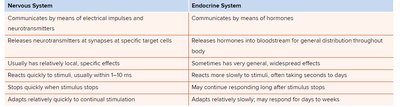
Both systems are essential for internal communication and regulation, but they differ in their mechanisms, speed, and effects.
Nervous system: Uses electrical impulses and neurotransmitters; rapid, targeted, and short-lived responses.
Endocrine system: Uses hormones; slower, widespread, and longer-lasting effects.
Nervous System | Endocrine System |
|---|---|
Electrical impulses & neurotransmitters | Hormones |
Local, specific effects | General, widespread effects |
Rapid response (milliseconds) | Slower response (seconds to days) |
Stops quickly | Continues after stimulus stops |
Adapts quickly | Adapts slowly |
Hormone Secretion and Distribution
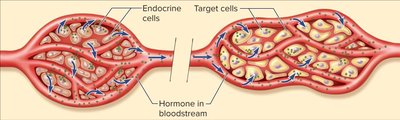
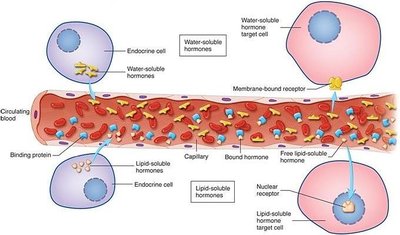
Hormones are secreted by endocrine cells and distributed throughout the body via the bloodstream, allowing them to reach distant target cells.
Hormones diffuse from capillaries into interstitial fluid and bind to receptors on target cells.
Water-soluble hormones travel freely in plasma; lipid-soluble hormones require carrier proteins.
Amplitude vs Frequency Modulation
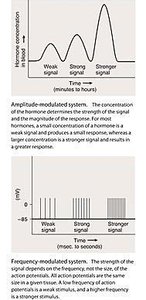
Hormonal signals can be modulated by amplitude (concentration) or frequency (rate of release), affecting the strength and duration of the response.
Amplitude-modulated: Higher hormone concentration produces a stronger response.
Frequency-modulated: Increased frequency of nerve impulses produces a stronger signal.
Homeostasis and Endocrine Regulation
Purpose of the Endocrine System
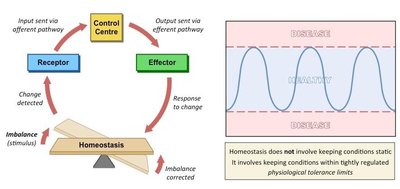
The endocrine system maintains homeostasis by regulating physiological variables within tightly controlled limits. It responds to changes in the internal environment and corrects imbalances.
Homeostasis involves dynamic balance, not static conditions.
Feedback loops (negative and positive) are central to endocrine regulation.
Endocrine vs Exocrine Glands
Definitions and Examples
Endocrine glands secrete hormones internally, while exocrine glands release substances through ducts to external surfaces or hollow organs.
Endocrine: Hormones (e.g., insulin, thyroid hormone) into blood.
Exocrine: Saliva, sweat, digestive enzymes into ducts.
Chemical Classes of Hormones
Hormone Types and Properties
Hormones are classified by their chemical structure, which determines their solubility and mechanism of action.
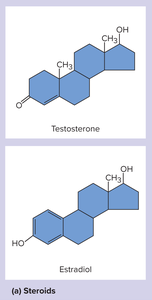
Steroids/lipids: Hydrophobic, derived from cholesterol (e.g., testosterone, estradiol).
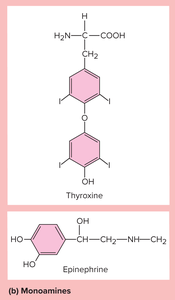
Amino acid derivatives (monoamines): Hydrophilic or hydrophobic (e.g., thyroxine, epinephrine).
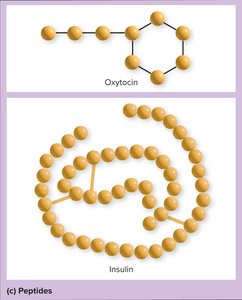
Proteins/peptides: Hydrophilic, composed of amino acid chains (e.g., oxytocin, insulin).
Hormone Transport and Distribution
Mechanisms of Hormone Transport
Hormones are transported in the blood, with water-soluble hormones dissolving freely and lipid-soluble hormones requiring carrier proteins.
Water-soluble hormones bind to membrane receptors.
Lipid-soluble hormones bind to nuclear receptors inside target cells.
Hormone Receptors and Modes of Action
Receptor Types and Locations
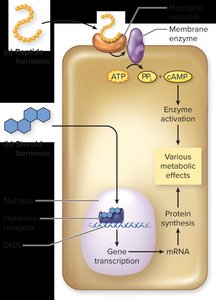
Hormones exert their effects by binding to specific receptors on or within target cells. The location and type of receptor depend on the hormone's solubility.
Membrane-bound receptors: Bind hydrophilic hormones (proteins, peptides, catecholamines).
Nuclear/intracellular receptors: Bind hydrophobic hormones (steroids, thyroid hormones).
Mechanism of Hormone Action: Membrane Receptors
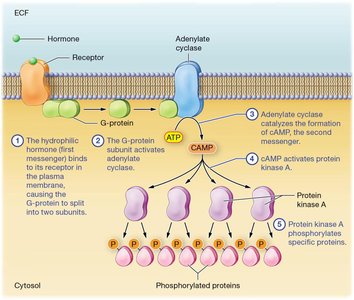
Hydrophilic hormones bind to membrane receptors, activating second messenger systems such as cAMP, leading to phosphorylation of proteins and cellular responses.
Activation of G proteins and adenylate cyclase.
Opening of ion channels (e.g., Ca++).
Phosphorylation of intracellular proteins.
Mechanism of Hormone Action: Nuclear Receptors
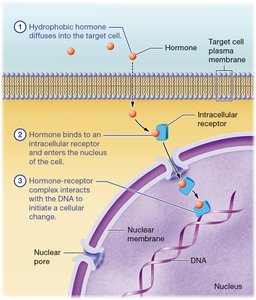
Lipid-soluble hormones diffuse into cells, bind to intracellular receptors, and regulate gene expression by activating transcription and translation.
Hormone-receptor complex activates specific genes.
Protein synthesis produces the cellular response.
Examples: Estrogen, testosterone, cortisol, thyroid hormones.
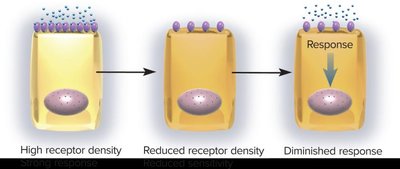
Changes in Receptor Number
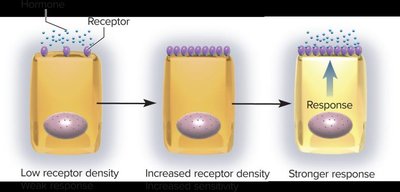
Cells can regulate their sensitivity to hormones by altering receptor density.
Down-regulation: Decreased receptor synthesis after exposure to hormone.
Up-regulation: Increased receptor synthesis, enhancing sensitivity.
Example: FSH increases LH receptors in ovarian cells, promoting ovulation.
Patterns of Hormone Secretion
Types of Hormone Regulation
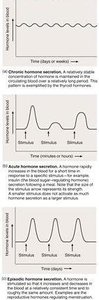
Hormone secretion can be chronic, acute, or episodic, depending on physiological needs.
Chronic: Constant concentration (e.g., thyroid hormone).
Acute: Rapid increase in response to stimulus (e.g., epinephrine).
Episodic: Cyclic rise and fall (e.g., female reproductive hormones).
Regulation of Hormone Production and Release
Stimuli for Hormone Release
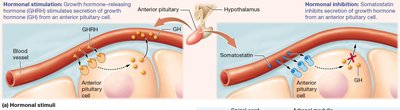
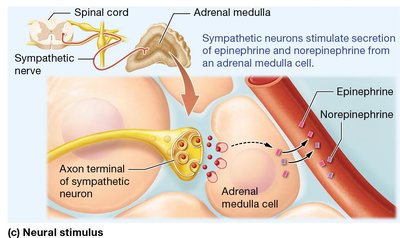
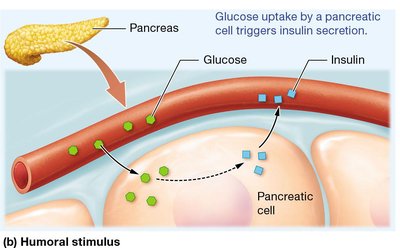
Hormone secretion is regulated by hormonal, humoral, and neural stimuli.
Hormonal: Releasing/inhibiting hormones from hypothalamus and tropic hormones from pituitary.
Humoral: Changes in blood levels of ions or nutrients (e.g., glucose, calcium).
Neural: Nervous system signals (e.g., sympathetic stimulation of adrenal medulla).
Feedback Loops
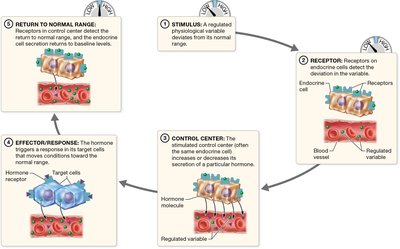
Negative and positive feedback loops regulate hormone levels, maintaining homeostasis.
Negative feedback: Hormone secretion decreases as the regulated variable returns to normal.
Positive feedback: Hormone secretion increases in response to a stimulus (less common).
Hormone Interactions
Types of Hormone Interactions
Hormones can interact synergistically, permissively, or antagonistically to regulate physiological processes.
Synergistic: Combined effect greater than individual effects (e.g., FSH and testosterone).
Permissive: One hormone enables another to act (e.g., progesterone and estrogen).
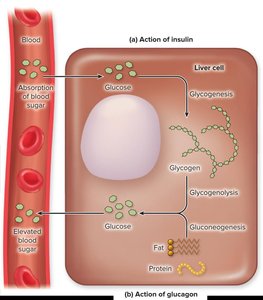
Antagonistic: Opposing effects (e.g., insulin and glucagon).
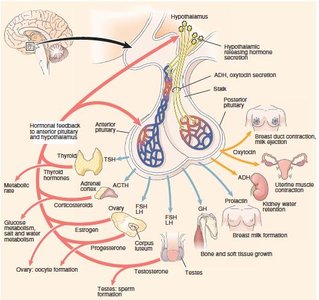
Summary Table: Endocrine System Study Checklist
Location and anatomy of glands
Regulation and consequences of hypo/hypersecretion
Hormones released and their targets
Physiological responses
Hypothalamus and Pituitary Gland
Anatomical and Functional Relationships
The hypothalamus and pituitary gland are central to endocrine regulation, controlling the release of many hormones that affect other glands and tissues.
Hypothalamus: Produces releasing and inhibiting hormones targeting the anterior pituitary.
Posterior pituitary: Stores and releases hormones produced by the hypothalamus (e.g., ADH, oxytocin).
Anterior pituitary: Produces tropic hormones that regulate other endocrine glands.
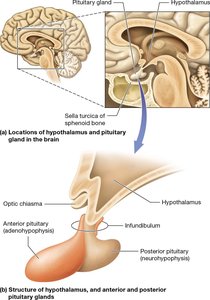
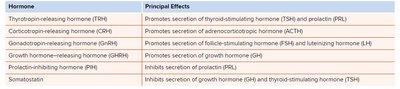
Hypothalamic Hormones and Pituitary Regulation
Hormone | Principal Effects |
|---|---|
Thyrotropin-releasing hormone (TRH) | Promotes secretion of TSH and prolactin |
Corticotropin-releasing hormone (CRH) | Promotes secretion of ACTH |
Gonadotropin-releasing hormone (GnRH) | Promotes secretion of FSH and LH |
Growth hormone-releasing hormone (GHRH) | Promotes secretion of GH |
Prolactin-inhibiting hormone (PIH) | Inhibits secretion of prolactin |
Somatostatin | Inhibits secretion of GH and TSH |
Additional info:
This study guide covers the foundational concepts of the endocrine system, including hormone types, mechanisms of action, regulation, and interactions. It is suitable for exam preparation in an Anatomy & Physiology college course.
