 Back
BackNeurotransmitters: Structure, Synthesis, and Degradation
Study Guide - Smart Notes
 Tailored notes based on your materials, expanded with key definitions, examples, and context.
Neurotransmitters: Structure, Synthesis, and Degradation
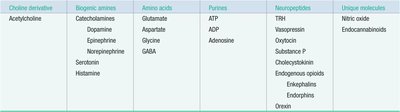
Overview of Neurotransmitter Classes
Neurotransmitters are chemical messengers that transmit signals across synapses in the nervous system. They are classified into several major groups based on their chemical structure and function.
Choline derivatives: Acetylcholine
Biogenic amines: Catecholamines (dopamine, epinephrine, norepinephrine), serotonin, histamine
Amino acids: Glutamate, aspartate, glycine, GABA
Purines: ATP, ADP, adenosine
Neuropeptides: TRH, vasopressin, oxytocin, substance P, cholecystokinin, endogenous opioids (enkephalins, endorphins), orexin
Unique molecules: Nitric oxide, endocannabinoids
Acetylcholine
Synthesis, Release, and Degradation
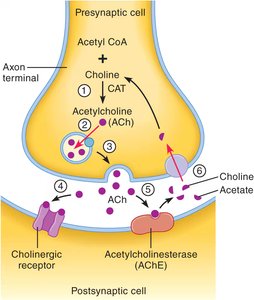
Acetylcholine (ACh) is the most abundant neurotransmitter in the peripheral nervous system and is found in both the somatic and autonomic branches. It is synthesized in the cytosol of axon terminals from acetyl CoA and choline, catalyzed by the enzyme choline acetyltransferase (CAT):
Synthesis equation:
Acetyl CoA is produced during the catabolism of lipids, carbohydrates, and proteins, and is present in nearly all cells.
Choline is primarily obtained from the diet and transported into neurons via active transport.
Once synthesized, acetylcholine is stored in synaptic vesicles until an action potential triggers its release by exocytosis.
After release, acetylcholine binds to cholinergic receptors or is degraded by acetylcholinesterase (AChE):
Degradation equation:
Choline is recycled by reuptake into the presynaptic cell; acetate diffuses away.
Cholinergic Receptors
Acetylcholine acts on two main types of receptors:
Nicotinic cholinergic receptors: Ionotropic receptors that open ion channels for Na+ and K+, producing a fast excitatory postsynaptic potential (EPSP).
Muscarinic cholinergic receptors: Metabotropic receptors coupled to G proteins, which can open/close ion channels or activate/inhibit enzymes, leading to slower, diverse effects.
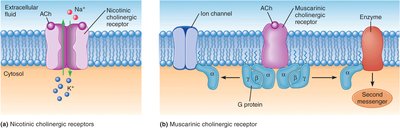
Key Concept: The effect of a neurotransmitter depends on the receptor and its signal transduction mechanism, not just the chemical messenger itself.
Biogenic Amines
Types and Functions
Biogenic amines are derived from amino acids and include catecholamines (dopamine, norepinephrine, epinephrine), serotonin, and histamine. Catecholamines contain a catechol group and are synthesized and packaged into synaptic vesicles. Dopamine and norepinephrine are primarily CNS neurotransmitters, while epinephrine is mainly a hormone released from the adrenal medulla.
Receptors: Epinephrine and norepinephrine bind to adrenergic receptors (alpha1, alpha2, beta1, beta2, beta3); dopamine binds to dopaminergic receptors.
Signal transduction: Catecholamines typically act via G protein-coupled receptors and second messenger systems, producing slower responses.
Autoreceptors: Many neurons possess autoreceptors to modulate their own neurotransmitter release.
Degradation: Catecholamines are degraded by monoamine oxidase (MAO) and catechol-O-methyltransferase (COMT).
Clinical Connection: Treating Depression
Monoamine oxidase inhibitors (MAOIs): Inhibit MAO, increasing norepinephrine and serotonin in the synaptic cleft.
Selective serotonin reuptake inhibitors (SSRIs): Inhibit serotonin reuptake, increasing its synaptic concentration (e.g., fluoxetine, paroxetine).
Tricyclic antidepressants: Affect adrenergic and serotonergic synapses, though mechanisms are less understood.
Limitations: Therapeutic effects are delayed; mechanisms are not fully understood.
Serotonin and Histamine
Serotonin: Found in the CNS, especially the brainstem; regulates sleep and emotions.
Histamine: Functions as a neurotransmitter in the CNS, mainly in the hypothalamus; also involved in immune responses.
Amino Acid Neurotransmitters
Excitatory and Inhibitory Amino Acids
Amino acid neurotransmitters are the most abundant in the CNS. Glutamate and aspartate are released at excitatory synapses, while glycine and GABA are released at inhibitory synapses.
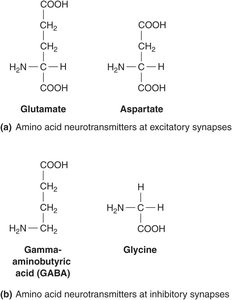
Glutamate: Main excitatory neurotransmitter; acts on AMPA, NMDA, and kainate receptors. AMPA/kainate produce fast EPSPs via Na+ influx; NMDA allows Ca2+ influx, acting as a second messenger.
GABA: Main inhibitory neurotransmitter; acts on GABAA (ionotropic, Cl- channels), GABAB (metabotropic), and GABAC receptors.
Glycine: Also inhibitory, especially in the spinal cord.
Clinical Connection: GABAergic Agents in Anxiety and Sleep Disorders
Benzodiazepines: Enhance GABAA receptor activity, reducing anxiety and CNS activity at low doses; can be stimulatory at high doses.
Sleep aids (e.g., zolpidem): Bind to specific GABAA receptor subtypes, producing sedative effects.
Alcohol: Enhances GABAergic transmission, depressing CNS activity. Combined use with other GABAergic drugs can be dangerous due to synergistic effects.

Purines
ATP and Related Compounds as Neurotransmitters
ATP, ADP, and adenosine function as neurotransmitters in the CNS, PNS, and enteric nervous system. They are stored in synaptic vesicles and released by exocytosis. Adenosine is generated extracellularly from ATP.
Purinergic receptors: P2X (ionotropic, cation channels; activated by ATP/ADP) and P2Y (metabotropic, G protein-coupled; activated by ATP, ADP, adenosine).
Adenosine-specific receptors: A1 and A2.
Degradation: Nucleotidases degrade ATP/ADP; adenosine deaminase degrades adenosine.
Neuropeptides
Synthesis and Function
Neuropeptides are short chains of amino acids synthesized in the cell body, packaged in the Golgi apparatus, and transported to axon terminals. They often act as neuromodulators and are released with small-molecule neurotransmitters.
Examples: TRH, vasopressin, oxytocin, substance P, cholecystokinin, endogenous opioids (enkephalins, endorphins), orexin.
Release: Requires higher frequency of action potentials than small neurotransmitters.
Receptors: Often metabotropic, modulating postsynaptic responses.
Unique Neurotransmitters
Nitric Oxide and Endocannabinoids
Nitric oxide (NO): A gaseous neurotransmitter synthesized on demand by nitric oxide synthetase. It diffuses freely across membranes and acts on intracellular targets, not surface receptors. It is short-lived and degrades spontaneously.
Endocannabinoids: Lipid-derived messengers (e.g., anandamide, 2-AG) produced from membrane phospholipids in response to increased cytosolic Ca2+. They act on CB1 receptors (metabotropic) in the CNS. THC, the active component of cannabis, also targets CB1 receptors.
Summary Table: Classes of Neurotransmitters
Choline derivative | Biogenic amines | Amino acids | Purines | Neuropeptides | Unique molecules |
|---|---|---|---|---|---|
Acetylcholine | Catecholamines (dopamine, epinephrine, norepinephrine), serotonin, histamine | Glutamate, aspartate, glycine, GABA | ATP, ADP, adenosine | TRH, vasopressin, oxytocin, substance P, cholecystokinin, endogenous opioids (enkephalins, endorphins), orexin | Nitric oxide, endocannabinoids |
