 Back
BackNeurotransmitters, Synaptic Transmission, and Neural Integration
Study Guide - Smart Notes
 Tailored notes based on your materials, expanded with key definitions, examples, and context.
Neurotransmitters: Structure, Synthesis, and Degradation
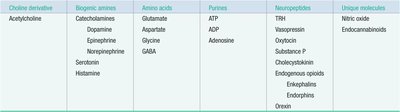
Overview of Neurotransmitter Classes
Neurotransmitters are chemical messengers that transmit signals across synapses in the nervous system. They are classified into several major groups based on their chemical structure and function.
Choline derivative | Biogenic amines | Amino acids | Purines | Neuropeptides | Unique molecules |
|---|---|---|---|---|---|
Acetylcholine | Catecholamines (Dopamine, Epinephrine, Norepinephrine), Serotonin, Histamine | Glutamate, Aspartate, Glycine, GABA | ATP, ADP, Adenosine | TRH, Vasopressin, Oxytocin, Substance P, Cholecystokinin, Endogenous opioids (Enkephalins, Endorphins), Orexin | Nitric oxide, Endocannabinoids |
Acetylcholine (ACh)
Synthesis, Release, and Degradation
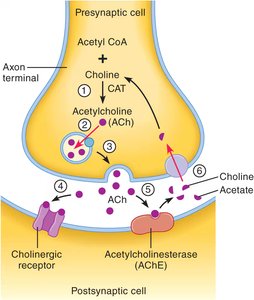
Acetylcholine is the most abundant neurotransmitter in the peripheral nervous system and is found in both the somatic and autonomic branches. It is synthesized in the axon terminal cytosol from acetyl CoA and choline, catalyzed by choline acetyltransferase (CAT):
Synthesis: Acetyl CoA + Choline (via CAT) → Acetylcholine + CoA
Storage: ACh is stored in synaptic vesicles until released by exocytosis, triggered by an action potential.
Degradation: Acetylcholinesterase (AChE) breaks down ACh into acetate and choline in the synaptic cleft. Choline is recycled by active transport into the presynaptic neuron.
Cholinergic Receptors
Nicotinic receptors: Ionotropic, ligand-gated channels that allow Na+ and K+ movement, producing a fast excitatory postsynaptic potential (EPSP). Found at neuromuscular junctions and some CNS regions.
Muscarinic receptors: Metabotropic, G protein-coupled receptors that can open/close ion channels or activate second messenger systems, producing slower, diverse effects. Found in effector organs of the autonomic nervous system and CNS.
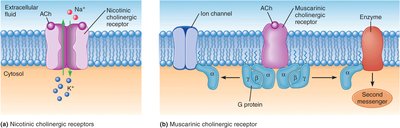
Key Concept: The effect of a neurotransmitter depends on the receptor and its signal transduction mechanism, not the transmitter itself.
Biogenic Amines
Catecholamines and Other Amines
Biogenic amines are derived from amino acids and include catecholamines (dopamine, norepinephrine, epinephrine), serotonin, and histamine. Catecholamines are synthesized from tyrosine and act via G protein-coupled receptors (adrenergic and dopaminergic receptors).
Adrenergic receptors: Alpha (α) and beta (β) subtypes, with different affinities for norepinephrine and epinephrine.
Degradation: Monoamine oxidase (MAO) and catechol-O-methyltransferase (COMT) degrade catecholamines in the synaptic cleft and presynaptic terminals.
Serotonin: Regulates mood and sleep; targeted by antidepressants such as SSRIs.
Histamine: Functions as a neurotransmitter in the CNS, especially the hypothalamus.
Clinical Connection: Treating Depression
Monoamine oxidase inhibitors (MAOIs): Inhibit breakdown of norepinephrine and serotonin, increasing their synaptic concentration.
Selective serotonin reuptake inhibitors (SSRIs): Block serotonin reuptake, increasing its synaptic availability.
Tricyclic antidepressants: Affect adrenergic and serotonergic synapses, though mechanisms are less understood.
Amino Acid Neurotransmitters
Excitatory and Inhibitory Amino Acids
Amino acid neurotransmitters are the most abundant in the CNS.
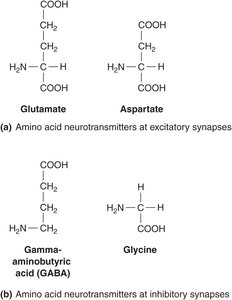
Excitatory: Glutamate and aspartate (bind to AMPA, NMDA, and kainate receptors; glutamate is the most common excitatory neurotransmitter).
Inhibitory: GABA and glycine (GABA binds to GABAA, GABAB, and GABAC receptors; glycine acts mainly in the spinal cord).
Clinical Connection: GABAergic Agents
Benzodiazepines (e.g., Valium): Enhance GABAA receptor activity, reducing anxiety and CNS activity.
Alcohol: Also enhances GABAA receptor activity, leading to CNS depression.
Sleep aids (e.g., zolpidem): Bind to specific GABAA receptor subtypes, promoting sedation.

Purines
ATP and Related Compounds
ATP, ADP, and adenosine act as neurotransmitters, especially in the enteric nervous system. Purinergic receptors include:
P2X: Ionotropic, cation channels (excitatory).
P2Y: Metabotropic, G protein-coupled (modulatory effects).
Adenosine receptors: Bind adenosine specifically.
Purines are degraded by nucleotidases and adenosine deaminase.
Neuropeptides
Synthesis and Function
Neuropeptides are short chains of amino acids synthesized in the cell body, packaged in dense core vesicles, and transported to axon terminals. They often act as neuromodulators and are co-released with small neurotransmitters.
Examples: TRH, vasopressin, oxytocin, substance P, cholecystokinin, endogenous opioids (enkephalins, endorphins), orexin.
Orexin: Regulates sleep-wake cycles; potential target for narcolepsy treatment.
Unique Neurotransmitters
Nitric Oxide and Endocannabinoids
Nitric oxide (NO): A gaseous neurotransmitter synthesized on demand and diffuses to target cells, altering protein activity without binding to surface receptors. It is rapidly degraded.
Endocannabinoids: Lipid-derived messengers (e.g., anandamide, 2-AG) that act on CB1 receptors in the CNS. They modulate neurotransmission and are targets of THC (cannabis).
Synaptic Transmission
Electrical Synapses
Electrical synapses connect neurons via gap junctions, allowing direct ion flow and rapid, bidirectional communication. Found in the retina, cortex, and brainstem for synchronizing activity.
Chemical Synapses
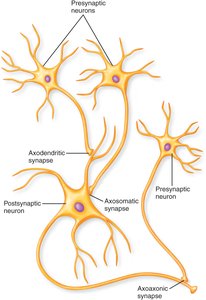
Most synapses are chemical, involving neurotransmitter release from a presynaptic neuron to a postsynaptic cell. Types of synapses include axodendritic, axosomatic, and axoaxonic.
Mechanism of Neurotransmitter Release
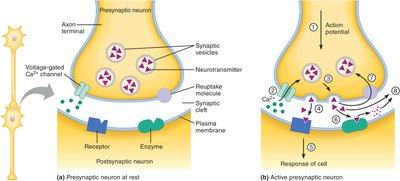
Action potential arrives at axon terminal, opening voltage-gated Ca2+ channels.
Ca2+ influx triggers exocytosis of synaptic vesicles, releasing neurotransmitter into the synaptic cleft.
Neurotransmitter binds to postsynaptic receptors, inducing a response.
Termination: Neurotransmitter is degraded, reuptaken, or diffuses away.
Signal Transduction at Chemical Synapses
Ionotropic vs. Metabotropic Receptors
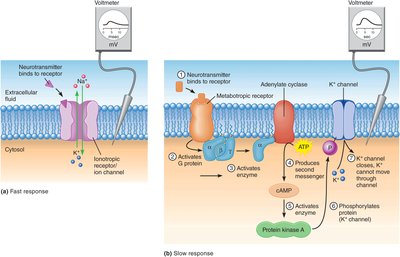
Ionotropic (channel-linked): Fast, direct opening of ion channels (e.g., nicotinic ACh receptors).
Metabotropic (G protein-coupled): Slow, indirect effects via G proteins and second messengers (e.g., muscarinic ACh receptors).
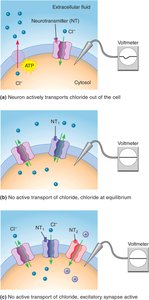
Excitatory and Inhibitory Synapses
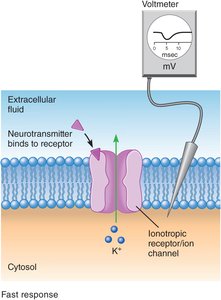
Excitatory synapses: Cause depolarization (EPSP), often via Na+ influx.
Inhibitory synapses: Cause hyperpolarization (IPSP), often via K+ efflux or Cl- influx.
Neural Integration
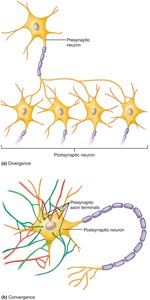
Divergence and Convergence
Divergence: One neuron communicates with multiple postsynaptic neurons.
Convergence: One neuron receives input from multiple presynaptic neurons.
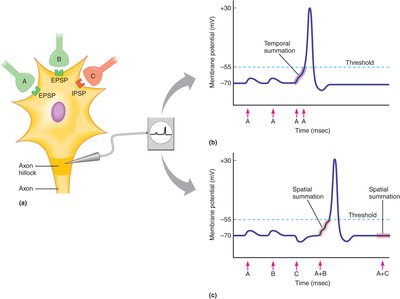
Summation of Postsynaptic Potentials
Temporal summation: Multiple signals from one synapse in rapid succession sum together.
Spatial summation: Signals from different synapses occurring simultaneously sum together.
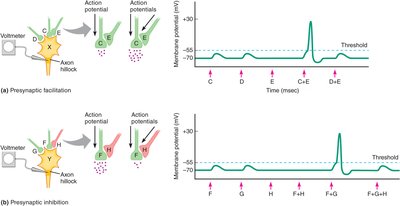
Presynaptic Modulation
Presynaptic facilitation: A modulatory neuron increases neurotransmitter release from another presynaptic neuron, enhancing the postsynaptic response.
Presynaptic inhibition: A modulatory neuron decreases neurotransmitter release, reducing the postsynaptic response.
Occurs at axoaxonic synapses and affects only the specific synapse involved.
Summary Table: Major Neurotransmitter Classes and Examples
Class | Examples | Main Functions |
|---|---|---|
Choline derivative | Acetylcholine | Muscle activation, autonomic functions |
Biogenic amines | Dopamine, Norepinephrine, Epinephrine, Serotonin, Histamine | Mood, arousal, autonomic regulation |
Amino acids | Glutamate, Aspartate, GABA, Glycine | Excitation/inhibition in CNS |
Purines | ATP, ADP, Adenosine | Neuromodulation, enteric nervous system |
Neuropeptides | Substance P, Endorphins, Enkephalins, Orexin | Pain modulation, stress, arousal |
Unique molecules | Nitric oxide, Endocannabinoids | Retrograde signaling, neuromodulation |
