 Back
BackPhysiology of Circulation: Blood Flow, Pressure, and Resistance
Study Guide - Smart Notes
 Tailored notes based on your materials, expanded with key definitions, examples, and context.
The Cardiovascular System: Blood Vessels – Physiology of Circulation
Blood Flow, Pressure, and Resistance
This section explores the fundamental principles governing blood movement through the vascular system, focusing on the relationships among blood flow, pressure, and resistance.
Blood Flow: The volume of blood moving through a vessel, organ, or the entire circulation per unit time (ml/min). For the entire vascular system, it is equivalent to cardiac output (CO). Blood flow is relatively constant at rest but varies at the organ level based on metabolic needs.
Blood Pressure (BP): The force per unit area exerted by blood on the wall of a blood vessel, measured in mm Hg. Systemic arterial BP is typically measured in large arteries near the heart. The pressure gradient drives blood from higher to lower pressure areas.
Resistance (Peripheral Resistance): The opposition to blood flow, primarily due to friction between blood and vessel walls. Major sources include blood viscosity, total vessel length, and vessel diameter.
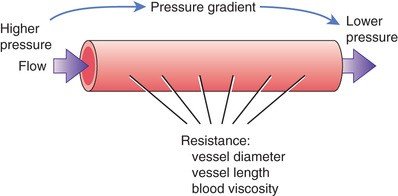
Determinants of Peripheral Resistance
Peripheral resistance is mainly influenced by three factors:
Blood Viscosity: The thickness or stickiness of blood, determined by the concentration of formed elements and plasma proteins. Increased viscosity raises resistance.
Total Blood Vessel Length: The longer the vessel, the greater the resistance encountered.
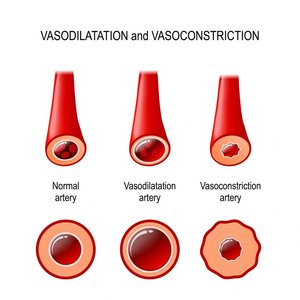
Blood Vessel Diameter: The most significant and variable factor. Resistance varies inversely with the fourth power of the vessel radius (). Small changes in diameter cause large changes in resistance.
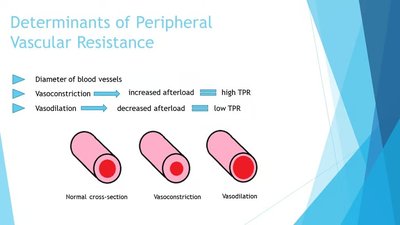
Example: If the radius of a vessel doubles, resistance drops to 1/16 of its original value.
Obstacles such as fatty plaques (atherosclerosis) or abrupt changes in diameter can cause turbulent flow, increasing resistance.

Relationship Between Flow, Pressure, and Resistance
Blood flow (F) is directly proportional to the pressure gradient (ΔP) and inversely proportional to resistance (R):
Resistance is the most important factor influencing local blood flow because vessel diameter can change rapidly.
Systemic Blood Pressure
Pressure Changes in the Systemic Circulation
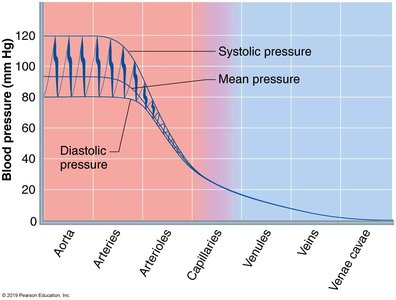
The heart's pumping action generates blood flow, and pressure results when flow is opposed by resistance. Systemic pressure is highest in the aorta and declines throughout the pathway, with the steepest drop in the arterioles.
Arterial Blood Pressure
Arterial BP is determined by:
Elasticity (compliance) of arteries near the heart
Volume of blood forced into them at any time
Blood pressure near the heart is pulsatile, rising and falling with each heartbeat.
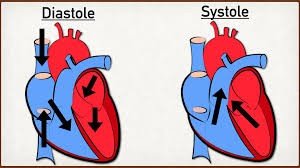
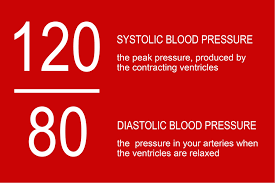
Systolic Pressure: Pressure during ventricular contraction (average 120 mm Hg in adults).
Diastolic Pressure: Lowest aortic pressure during heart relaxation (rest).
Pulse Pressure: Difference between systolic and diastolic pressures.
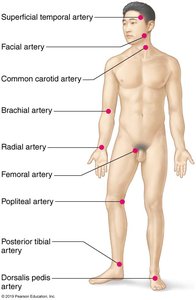
Pulse: Throbbing of arteries due to pulse pressure, palpable at certain body sites.
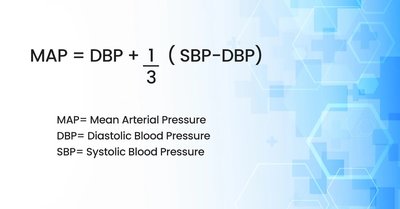
Mean Arterial Pressure (MAP)
MAP is the pressure that propels blood to tissues. It is not a simple average because the heart spends more time in diastole. MAP is calculated as:
Both pulse pressure and MAP decline with increasing distance from the heart.
Clinical Monitoring of Circulatory Efficiency
Vital Signs: Pulse, blood pressure, respiratory rate, and body temperature.
Pulse Points: Sites where arteries are close to the body surface and pulse can be palpated (e.g., radial, carotid, femoral arteries).
Measuring Blood Pressure
Systemic arterial BP is measured indirectly using a sphygmomanometer:
Wrap cuff around arm above the elbow.
Increase cuff pressure above systolic BP in the brachial artery.
Release pressure slowly and listen for Korotkoff sounds with a stethoscope.

Capillary and Venous 000iBlood Pressure
Capillary BP: Ranges from ~35 mm Hg at the start to ~17 mm Hg at the end of the capillary bed. Low pressure prevents capillary rupture and allows for filtration.
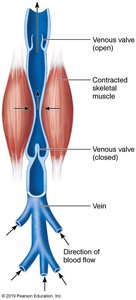
Venous BP: Low and steady (about 15 mm Hg), requiring adaptations for venous return:
Muscular pump: Skeletal muscle contractions "milk" blood toward the heart.
Respiratory pump: Pressure changes during breathing move blood toward the heart.
Sympathetic venoconstriction: Smooth muscle constriction pushes blood toward the heart.
Regulation of Blood Pressure
Major Factors Affecting Blood Pressure
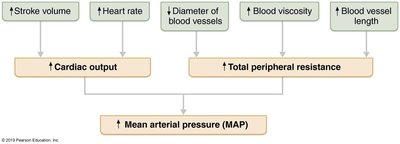
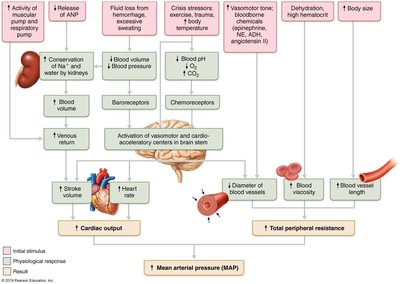
Blood pressure is regulated by the heart, blood vessels, and kidneys, under brain supervision. The three main factors are:
Cardiac Output (CO)
Peripheral Resistance (PR)
Blood Volume
Blood pressure varies directly with CO, PR, and blood volume:
Since , then:
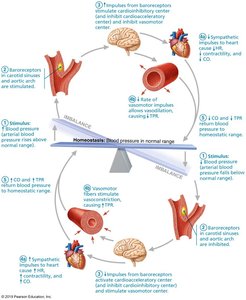
Short-Term Regulation: Neural Controls
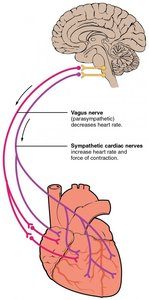
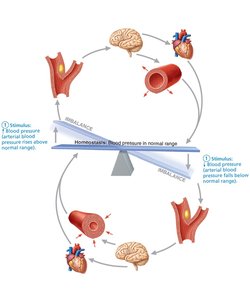
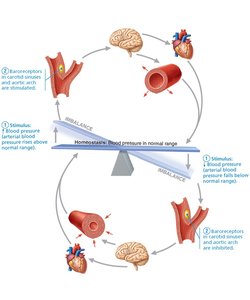
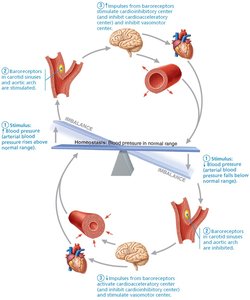
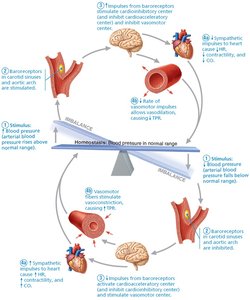
Neural mechanisms regulate peripheral resistance and blood distribution via reflex arcs involving the cardiovascular center (medulla), baroreceptors, chemoreceptors, and higher brain centers.
Baroreceptor Reflexes: Located in carotid sinuses, aortic arch, and large arteries. Respond to changes in BP by adjusting vessel diameter and heart rate.
Chemoreceptor Reflexes: Detect changes in CO2, pH, and O2 to adjust BP accordingly.
Higher Brain Centers: Hypothalamus and cortex can modify BP during stress, exercise, or temperature changes.
Short-Term Regulation: Hormonal Controls
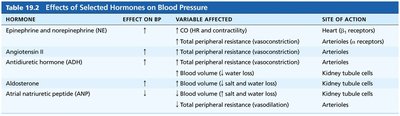
Hormones regulate BP by altering peripheral resistance or blood volume. Key hormones include:
Epinephrine and norepinephrine (increase CO and vasoconstriction)
Angiotensin II (vasoconstriction)
Antidiuretic hormone (ADH, vasoconstriction at high levels)
Atrial natriuretic peptide (ANP, decreases BP by reducing blood volume)
Hormone | Effect on BP | Variable Affected | Site of Action |
|---|---|---|---|
Epinephrine and norepinephrine | ↑ | CO (HR and contractility) | Heart (β1 receptors) |
Angiotensin II | ↑ | Total peripheral resistance (vasoconstriction) | Arterioles |
Antidiuretic hormone (ADH) | ↑ | Total peripheral resistance (vasoconstriction) | Arterioles |
Aldosterone | ↑ | Blood volume (salt and water loss) | Kidney tubule cells |
Atrial natriuretic peptide (ANP) | ↓ | Blood volume (salt and water loss) | Kidney tubule cells |
Long-Term Regulation: Renal Mechanisms
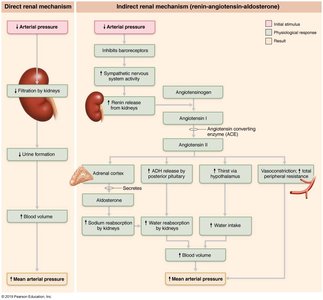
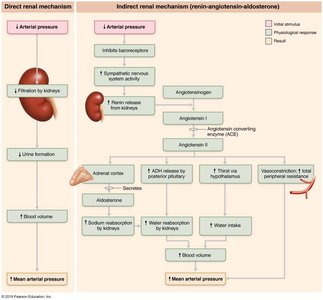
Long-term BP regulation is achieved by the kidneys, which control blood volume via two mechanisms:
Direct Renal Mechanism: Alters blood volume independently of hormones. Increased BP leads to more urine formation; decreased BP causes water conservation.
Indirect Renal Mechanism (Renin-Angiotensin-Aldosterone): Decreased BP triggers renin release, leading to angiotensin II formation, which increases BP by vasoconstriction, stimulating aldosterone and ADH release, and triggering thirst.
Summary of Blood Pressure Regulation
The goal is to maintain BP high enough for adequate tissue perfusion but not so high as to damage vessels. Both short-term (neural and hormonal) and long-term (renal) mechanisms interact to achieve homeostasis.
Homeostatic Imbalances in Blood Pressure
Hypertension
Defined as sustained arterial pressure of 140/90 mm Hg or higher.
Primary hypertension (90% of cases) has no identifiable cause; risk factors include heredity, diet, obesity, age, diabetes, stress, and smoking.
Secondary hypertension is due to identifiable disorders (e.g., kidney disease, endocrine disorders).
Prolonged hypertension can lead to heart failure, vascular disease, renal failure, and stroke.
Hypotension
Low blood pressure below 90/60 mm Hg.
Usually not a concern unless it causes inadequate tissue perfusion.
Types include orthostatic (upon standing), chronic (nutritional or endocrine causes), and acute (circulatory shock).
Circulatory Shock
Occurs when blood vessels are inadequately filled and cannot circulate blood normally.
Types: Hypovolemic (blood loss), vascular (extreme vasodilation), and cardiogenic (heart failure).
Additional info: This summary covers the physiology of circulation, focusing on blood flow, pressure, resistance, and regulatory mechanisms, as outlined in a typical college-level anatomy and physiology curriculum.
