 Back
BackPhysiology of Circulation: Flow, Pressure, and Resistance
Study Guide - Smart Notes
 Tailored notes based on your materials, expanded with key definitions, examples, and context.
Flow, Pressure, and Resistance
Definitions and Relationships
The physiology of circulation involves understanding how blood flows through vessels, the pressure it exerts, and the resistance it encounters. These factors are fundamental to cardiovascular function and tissue perfusion.
Blood Flow: The volume of blood moving through a vessel, organ, or the entire circulation in a given period (ml/min). For the whole vascular system, it equals cardiac output (CO).
Blood Pressure (BP): The force per unit area exerted on the vessel wall by blood, measured in mm Hg. Systemic arterial BP is typically measured in large arteries near the heart.
Resistance (Peripheral Resistance): The opposition to blood flow, mainly due to friction with vessel walls. It is influenced by blood viscosity, vessel length, and vessel diameter.
Relationship: Blood flow (F) is directly proportional to the pressure gradient (ΔP) and inversely proportional to resistance (R):
Resistance is most affected by vessel diameter, which can change frequently, especially in arterioles.

Example: The milkshake and straws analogy demonstrates how a narrower straw (smaller diameter) increases resistance, making it harder to drink, similar to how blood vessel diameter affects blood flow.
Systemic Blood Pressure
Pressure Changes Throughout Circulation
Blood pressure is highest in the aorta and decreases as blood moves through the systemic circulation, with the steepest drop occurring in the arterioles. This decline is essential for proper tissue perfusion and prevents damage to delicate capillaries.
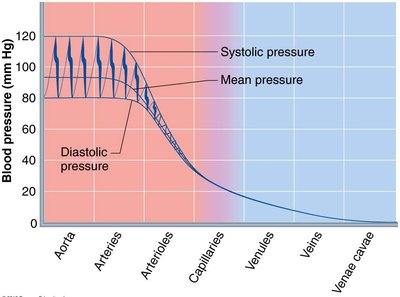
Example: The graph shows systolic, diastolic, and mean pressures across vessel types, highlighting the pulsatile nature near the heart and steady decline toward the veins.
Arterial Blood Pressure
Factors and Measurement
Arterial blood pressure is determined by the elasticity of arteries and the volume of blood forced into them. It is pulsatile near the heart, rising and falling with each heartbeat.
Systolic Pressure: Pressure during ventricular contraction (average 120 mm Hg).
Diastolic Pressure: Lowest pressure when the heart is at rest.
Pulse Pressure: Difference between systolic and diastolic pressure.
Mean Arterial Pressure (MAP): The pressure that propels blood to tissues, calculated as:
Vital signs include pulse and blood pressure, which are clinically monitored at various body sites.
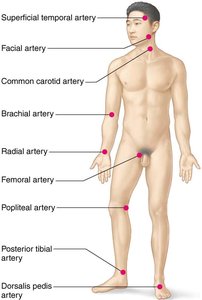
Example: The diagram shows key arteries for pulse measurement, such as the radial, carotid, and femoral arteries.
Venous Blood Pressure and Venous Return
Mechanisms Supporting Venous Return
Venous blood pressure is low and changes little during the cardiac cycle. Several mechanisms aid venous return:
Muscular Pump: Skeletal muscle contractions "milk" blood toward the heart, with valves preventing backflow.
Respiratory Pump: Breathing changes thoracic and abdominal pressures, moving blood toward the heart.
Sympathetic Venoconstriction: Smooth muscle constriction pushes blood back toward the heart.
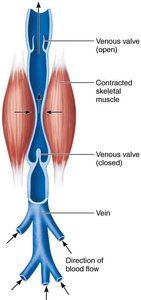
Example: The muscular pump diagram illustrates how muscle contractions and venous valves facilitate blood flow in veins.
Regulation of Blood Pressure
Main Factors and Equations
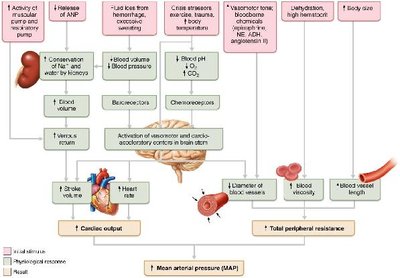
Blood pressure is regulated by cardiac output (CO), peripheral resistance (PR), and blood volume. The relationship is:
Where:
CO (Cardiac Output): (Stroke Volume × Heart Rate)
R (Resistance): Mainly affected by vessel diameter
Anything that increases SV, HR, or R will increase MAP.
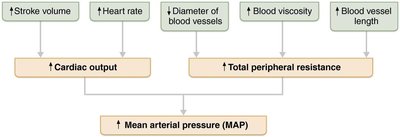
Example: The flowchart summarizes how stroke volume, heart rate, vessel diameter, viscosity, and length affect MAP.
Short-Term Regulation: Neural Controls
Neural Mechanisms and Reflex Arcs
Neural controls regulate blood pressure via reflex arcs involving the cardiovascular center, baroreceptors, chemoreceptors, and higher brain centers.
Baroreceptor Reflexes: Located in carotid sinuses, aortic arch, and large arteries. They respond to changes in MAP by adjusting vessel diameter and cardiac output.
Vasodilation/Venodilation: Decreases resistance and venous return, lowering MAP.
Decreased Cardiac Output: Reduces heart rate and contractility, lowering MAP.
Reflex Vasoconstriction: Increases CO and BP when MAP is low.
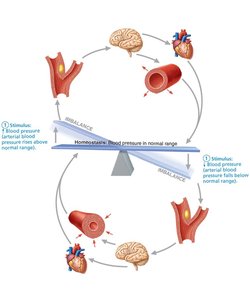
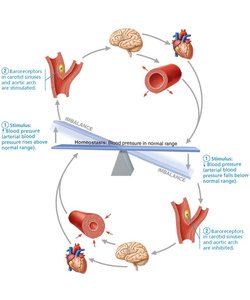
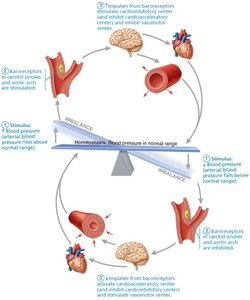
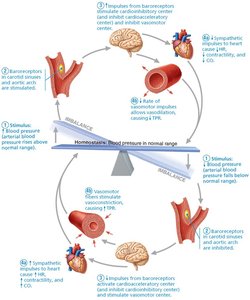
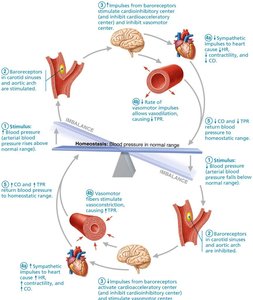
Example: The series of diagrams illustrate the baroreceptor reflexes in response to blood pressure changes, showing the feedback mechanisms for homeostasis.
Short-Term Regulation: Hormonal Controls
Hormones Affecting Blood Pressure
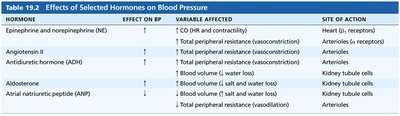
Hormones regulate blood pressure by altering peripheral resistance or blood volume. Key hormones include:
Epinephrine and Norepinephrine: Increase CO and vasoconstriction.
Angiotensin II: Stimulates vasoconstriction.
ADH: Causes vasoconstriction at high levels.
Atrial Natriuretic Peptide (ANP): Decreases BP by reducing blood volume.
Hormone | Effect on BP | Variable Affected | Site of Action |
|---|---|---|---|
Epinephrine/Norepinephrine | ↑ | CO (HR and contractility) | Heart (β receptors) |
Angiotensin II | ↑ | Total peripheral resistance (vasoconstriction) | Arterioles (α receptors) |
ADH | ↑ | Total peripheral resistance (vasoconstriction) | Arterioles |
Aldosterone | ↑ | Blood volume (salt and water retention) | Kidney tubule cells |
ANP | ↓ | Blood volume (salt and water loss) | Kidney tubule cells |
Long-Term Regulation: Renal Mechanisms
Direct and Indirect Renal Regulation
Long-term blood pressure regulation is achieved by altering blood volume via the kidneys:
Direct Renal Mechanism: Increased BP causes more urine formation, reducing blood volume and BP. Decreased BP causes water conservation, raising BP.
Indirect Renal Mechanism (Renin-Angiotensin-Aldosterone): Decreased BP triggers renin release, leading to angiotensin II formation, which increases BP by vasoconstriction, aldosterone secretion, ADH release, and stimulating thirst.
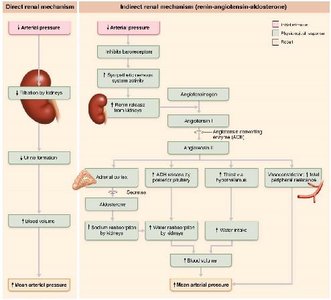
Example: The flowcharts show how the kidneys regulate blood pressure through direct urine formation and the hormonal renin-angiotensin-aldosterone pathway.
Summary of Blood Pressure Regulation
Homeostatic Balance
The goal is to maintain blood pressure high enough for adequate tissue perfusion but not so high as to damage vessels. Both short-term and long-term mechanisms work together to achieve this balance.
Homeostatic Imbalances in Blood Pressure
Hypertension, Hypotension, and Shock
Blood pressure can be transiently elevated or lowered due to various factors. Chronic imbalances can lead to serious health issues:
Hypertension: Sustained BP ≥ 140/90 mm Hg. Major risk for heart failure, stroke, and renal disease. Primary hypertension has no identifiable cause; secondary hypertension is due to specific disorders.
Hypotension: BP below 90/60 mm Hg. Usually benign unless it causes inadequate tissue perfusion. Types include orthostatic, chronic, and acute hypotension.
Circulatory Shock: Blood vessels inadequately fill and cannot circulate blood normally, leading to hypovolemic, vascular, or cardiogenic shock.
Additional info: These notes expand on the original slides by providing definitions, equations, and clinical context for each concept, ensuring a comprehensive and self-contained study guide for exam preparation.
