Back
BackRespiratory System: Pressure, Gas Exchange, and Pathophysiology
Study Guide - Smart Notes
 Tailored notes based on your materials, expanded with key definitions, examples, and context.
Pressure and Flow in Respiration
Atmospheric Pressure and Boyle’s Law
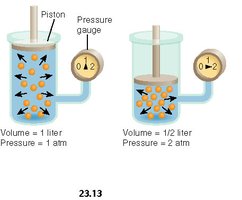
The process of respiration is fundamentally driven by differences in atmospheric pressure. Boyle’s Law states that the pressure of a gas is inversely proportional to its volume, provided the temperature is constant. This principle is essential for understanding how air moves in and out of the lungs during breathing.
Atmospheric pressure (1 atm) is equivalent to 760 mmHg at sea level.
When the volume of the thoracic cavity increases, the pressure inside decreases, allowing air to flow in (inspiration).
When the volume decreases, the pressure increases, pushing air out (expiration).
Equation:
The Respiratory Cycle
Mechanics of Breathing
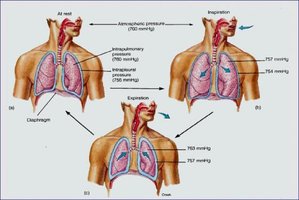
The respiratory cycle consists of inspiration and expiration, regulated by pressure gradients between the atmosphere and the lungs. During inspiration, the diaphragm contracts and the thoracic cavity expands, reducing intrapulmonary pressure and drawing air in. During expiration, the diaphragm relaxes, the thoracic cavity volume decreases, and air is expelled.
Inspiration: Intrapulmonary pressure drops below atmospheric pressure.
Expiration: Intrapulmonary pressure rises above atmospheric pressure.
Air flows down its pressure gradient.
Pneumothorax and Atelectasis
Pathophysiology of Collapsed Lung
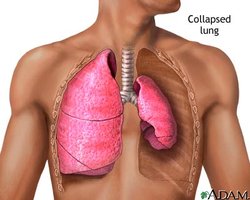
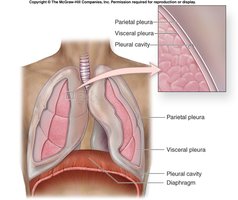
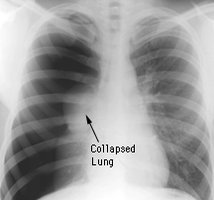
Pneumothorax is the presence of air in the pleural cavity, often due to trauma. This disrupts the pressure balance, causing the lung to recoil and collapse. Atelectasis refers to the collapse of part or all of a lung, which can result from obstruction or loss of pressure.
Pneumothorax: Air enters the pleural space, equalizing pressure and causing lung collapse.
Atelectasis: Collapse of lung tissue due to obstruction or loss of pressure.
Respiratory Volumes and Capacities
Factors Affecting Lung Function
Lung volumes and capacities are influenced by age, exercise, body size, and disease. Restrictive disorders reduce lung compliance and vital capacity, while obstructive disorders interfere with airflow, making expiration more difficult.
Age: Decreases lung compliance and weakens respiratory muscles.
Exercise: Maintains respiratory muscle strength.
Body size: Larger individuals have larger lungs.
Restrictive disorders: Lower compliance and vital capacity (e.g., fibrosis).
Obstructive disorders: Increased resistance to airflow (e.g., asthma, COPD).
Composition of Air and Alveolar Air
Partial Pressures of Gases
The air we breathe is a mixture of gases, each exerting a partial pressure. The composition of alveolar air differs from atmospheric air due to humidification and mixing with residual air.
Atmospheric air: PN2 ~ 80%, PO2 ~ 20%, PCO2 ~ 0.04%, PH2O ~ 0.5%
Alveolar air: PN2 ~ 75%, PO2 ~ 14%, PCO2 ~ 5%, PH2O ~ 6%

Gas Diffusion and Exchange
Principles of Gas Exchange
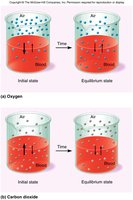
Gases diffuse across the respiratory membrane down their concentration gradients. Oxygen moves from alveoli to blood, while carbon dioxide moves from blood to alveoli.
Diffusion: Movement of gases from high to low partial pressure.
Respiratory membrane: Thin barrier for efficient gas exchange.
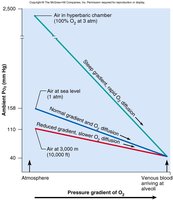
Different Concentration Gradients
The rate of gas exchange depends on the steepness of the concentration gradients for oxygen and carbon dioxide between alveolar air and blood.
Steeper gradients result in faster diffusion.
High altitude or lung disease can reduce the gradient and slow gas exchange.


Oxygen Transport
Hemoglobin and Oxygen Saturation
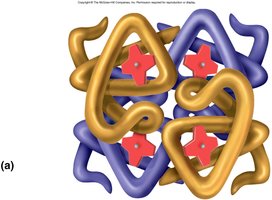
Oxygen is primarily transported in the blood bound to hemoglobin. Each hemoglobin molecule can bind up to four oxygen molecules. The percentage of hemoglobin saturated with oxygen is called oxygen saturation.
Oxyhemoglobin (HbO2): Hemoglobin bound to oxygen.
Deoxyhemoglobin (HHb): Hemoglobin not bound to oxygen.
Saturation: Proportion of hemoglobin binding sites occupied by oxygen.
Carbon Dioxide Transport
Forms of CO2 Transport
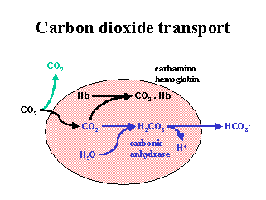
Carbon dioxide is transported in the blood in three main forms: as bicarbonate ions (after conversion to carbonic acid), bound to hemoglobin (carbaminohemoglobin), and dissolved in plasma.
90%: As bicarbonate ions (HCO3-) via the reaction:
5%: Bound to hemoglobin (HbCO2).
5%: Dissolved in plasma.
Systemic Gas Exchange
Oxygen and Carbon Dioxide Exchange in Tissues
At the systemic capillaries, oxygen is unloaded from hemoglobin and diffuses into tissues, while carbon dioxide produced by cellular metabolism diffuses into the blood for transport to the lungs.
O2 unloading: Hemoglobin releases oxygen to tissues.
CO2 loading: Carbon dioxide enters the blood from tissues.
Oxygen Dissociation: Effects of Temperature and pH
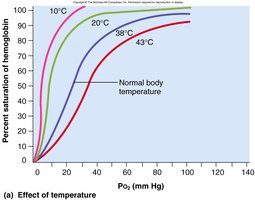
Temperature
Active tissues generate heat, which increases the release of oxygen from hemoglobin (rightward shift of the dissociation curve).
Higher temperature = more O2 released.
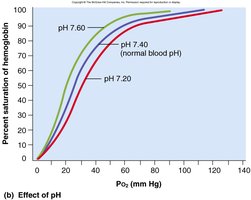
pH (Bohr Effect)
The Bohr effect describes how increased CO2 and decreased pH (more acidic) in active tissues promote oxygen release from hemoglobin.
Lower pH (more acidic) = more O2 released.
Blood Chemistry and Respiratory Rhythm
Regulation of Breathing
The rate and depth of breathing are adjusted to maintain normal blood levels of pH, PCO2, and PO2. Chemoreceptors in the brain and arteries detect changes and stimulate the respiratory centers accordingly.
Normal values: pH = 7.4 ± 0.05, PCO2 = 41 mmHg, PO2 = 95 mmHg.
Acidosis and Alkalosis
Acidosis (low blood pH) is often caused by excess CO2 (hypercapnia), leading to increased H+ in the cerebrospinal fluid and stimulating hyperventilation. Alkalosis (high blood pH) is caused by low CO2 (hypocapnia), leading to hypoventilation to restore normal pH.
Acidosis: pH < 7.35, stimulates increased breathing.
Alkalosis: pH > 7.45, stimulates decreased breathing.
Hypoxia and Oxygen Deficiency
Types and Causes of Hypoxia
Hypoxia is a deficiency of oxygen in the tissues. It can result from various causes, including poor circulation (ischemic), anemia, metabolic poisons (histotoxic), or inadequate pulmonary gas exchange (hypoxemic).
Ischemic hypoxia: Inadequate blood flow.
Anemic hypoxia: Low hemoglobin or red blood cells.
Histotoxic hypoxia: Cells unable to use oxygen (e.g., cyanide poisoning).
Hypoxemic hypoxia: Low arterial PO2 (e.g., high altitude, lung disease).
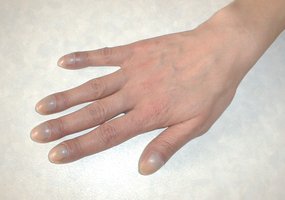
Cyanosis: Bluish discoloration due to low oxygen.
Carbon Monoxide Poisoning
Mechanism and Effects
Carbon monoxide (CO) is a colorless, odorless gas that binds hemoglobin with much higher affinity than oxygen, preventing oxygen transport. Even moderate exposure can cause symptoms, while high levels can be fatal.
Sources: Engine exhaust, furnaces, space heaters.
Symptoms: Shortness of breath, nausea, dizziness, light-headedness, death at high levels.
Oxygen Excess (Hyperoxia) and Decompression Illness
Oxygen Toxicity
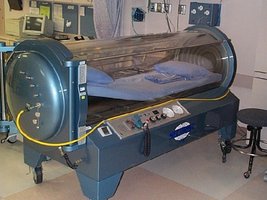
Breathing pure oxygen at high pressures (hyperoxia) can generate free radicals, damage tissues, and cause seizures or death. Hyperbaric oxygen therapy is used in some medical treatments but can be dangerous if not controlled.
Decompression Illness (The Bends)
When divers ascend too quickly, dissolved gases (mainly nitrogen) form bubbles in the blood and tissues, causing pain and potentially life-threatening complications. Treatment involves recompression in a hyperbaric chamber.
Prevention: Ascend slowly after diving.

Chronic Obstructive Pulmonary Disease (COPD)
Asthma
Asthma is characterized by bronchoconstriction triggered by allergens, leading to blocked airflow and difficulty breathing.
Emphysema
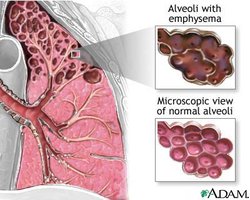
Emphysema involves the breakdown of alveolar walls, reducing the surface area for gas exchange. The lungs become less elastic and more rigid, leading to hypoxemia, hypercapnia, and respiratory acidosis.
Chronic Bronchitis
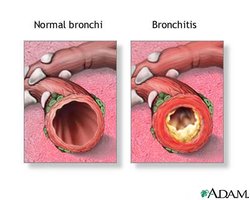
Chronic bronchitis is marked by immobilized cilia, increased mucus production, and chronic infection, often due to smoking.
Smoking and Lung Cancer
Effects of Smoking
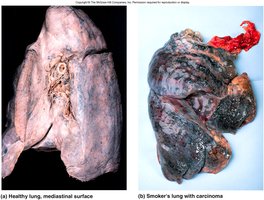
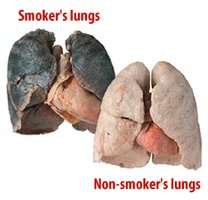
Lung cancer is the leading cause of cancer death, with smoking as the most significant risk factor. Smoking damages lung tissue, increases mucus production, and impairs ciliary function, leading to chronic disease and malignancy.