 Back
BackSkeletal System: Osseous Tissue & Bone Structure
Study Guide - Smart Notes
 Tailored notes based on your materials, expanded with key definitions, examples, and context.
Skeletal System: Osseous Tissue & Bone Structure
Introduction
The skeletal system provides the structural framework for the human body, supports movement, protects internal organs, stores minerals, and produces blood cells. This chapter explores the structure, function, and physiology of bones and osseous tissue, as well as the processes of bone development, remodeling, and repair.
Major Functions of the Skeletal System
Structural Support: Provides the rigid framework that supports the body and maintains its shape.
Mineral and Lipid Storage: Stores calcium, phosphate, and lipids in yellow bone marrow.
Blood Cell Production: Hematopoiesis occurs in red bone marrow, producing red and white blood cells and platelets.
Protection: Shields vital organs such as the brain, heart, and lungs.
Leverage: Acts as levers for muscles to produce movement.
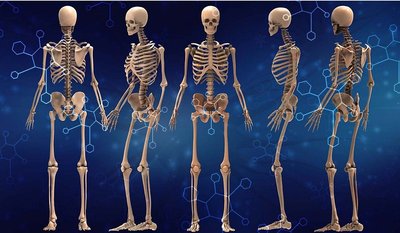

Bone (Osseous) Tissue: Structure and Cells
Bone Cells
Bone tissue contains four main types of cells, each with distinct functions in bone formation, maintenance, and remodeling.
Osteocytes: Mature bone cells that maintain the bone matrix and reside in lacunae. They communicate via canaliculi and help repair damaged bone.
Osteoblasts: Immature bone cells responsible for bone formation (osteogenesis). They secrete osteoid, the organic matrix that later becomes calcified.
Osteoprogenitor (Osteogenic) Cells: Stem cells located in the endosteum and periosteum that divide to produce osteoblasts. They play a role in bone growth and fracture repair.
Osteoclasts: Large, multinucleate cells derived from monocytes. They break down bone matrix (osteolysis) by secreting acids and enzymes, releasing stored minerals.




Bone Matrix and Tissue Organization
Bone Matrix
Mineral Component: Two-thirds of bone matrix is hydroxyapatite, a crystalline structure of calcium phosphate and calcium hydroxide:
Organic Component: One-third is collagen fibers, providing tensile strength and flexibility.
Bone Tissue Organization
Compact Bone: Dense outer layer composed of osteons (Haversian systems). Osteocytes are arranged in concentric lamellae around a central canal containing blood vessels.
Spongy Bone (Cancellous Bone): Consists of trabeculae, a network of bony spines with spaces filled by red or yellow bone marrow. Lacks osteons; nutrients diffuse through canaliculi.

Bone Coverings
Periosteum: Outer covering of bone (except at joints), consisting of an outer fibrous layer and an inner cellular layer. Functions in isolation, nourishment, and repair.
Endosteum: Thin membrane lining the medullary cavity and internal bone surfaces. Contains osteoblasts, osteoclasts, and osteoprogenitor cells; active in bone growth and repair.
Classification of Bones
By Shape
Sutural Bones: Small, irregular bones between skull bones.
Irregular Bones: Complex shapes (e.g., vertebrae, coxal bones).
Short Bones: Small and thick, nearly equal in length and width (e.g., wrist, ankle).
Flat Bones: Thin, parallel surfaces (e.g., skull, sternum, ribs, scapulae).
Long Bones: Longer than wide (e.g., humerus, femur, fingers, toes).
Sesamoid Bones: Small, flat bones embedded in tendons (e.g., patella).

By Internal Tissue Organization
Compact Bone: Dense, smooth outer layer.
Spongy Bone: Honeycomb structure of trabeculae.
Bone Markings
Bones have characteristic surface markings for attachment, articulation, and passage of nerves and blood vessels. Examples include crests, spines, lines, sulci, processes, and foramina.
Structure of Long and Flat Bones
Diaphysis: Shaft, composed of compact bone surrounding the medullary cavity.
Epiphysis: Ends of the bone, mostly spongy bone covered by compact bone.
Metaphysis: Region where diaphysis and epiphysis meet.
Flat Bones: Spongy bone (diploë) sandwiched between two layers of compact bone.
Bone Formation and Growth
Ossification
Ossification: Process of replacing other tissues with bone tissue.
Calcification: Deposition of calcium salts, necessary for ossification.
Types of Ossification
Endochondral Ossification: Bone replaces a hyaline cartilage model. Most bones (e.g., long bones) form this way.
Intramembranous Ossification: Bone develops directly from mesenchyme or fibrous connective tissue (e.g., flat bones of the skull, mandible, clavicle).
Bone Growth
Interstitial Growth: Bone lengthening at the epiphyseal plate.
Appositional Growth: Bone thickening by addition of bone matrix to the surface.
Bone Remodeling and Homeostasis
Bone is continuously remodeled through deposition by osteoblasts and resorption by osteoclasts.
Balance between these activities maintains bone strength and mineral homeostasis.
Effects of Exercise, Nutrition, and Hormones
Exercise: Stimulates bone remodeling and increases bone density.
Nutrition: Adequate intake of calcium, phosphate, magnesium, fluoride, iron, manganese, and vitamins (C, A, K, B12, D3) is essential for bone health.
Hormones: Growth hormone, thyroxine, estrogen, androgen, calcitonin, parathyroid hormone, and calcitriol regulate bone growth and calcium metabolism.
Calcium Homeostasis
Calcium is the most abundant mineral in the body, with 99% stored in bones.
Calcium homeostasis is regulated by dietary intake, excretion, and bone remodeling.
Parathyroid Hormone (PTH): Increases blood calcium by stimulating osteoclasts, increasing intestinal absorption, and reducing renal excretion.
Calcitonin: Decreases blood calcium by inhibiting osteoclasts, reducing intestinal absorption, and increasing renal excretion.
Fractures and Bone Repair
Types of Fractures
Fracture Type | Description |
|---|---|
Comminuted | Bone fragments into three or more pieces; common in older adults. |
Compression | Bone is crushed; common in porous bones. |
Greenstick | Bone breaks incompletely; one side breaks, the other bends (common in children). |
Epiphyseal | Epiphysis separates from diaphysis along the epiphyseal plate. |
Fracture Repair Stages
Hematoma Formation: Blood clot forms at the fracture site.
Fibrocartilaginous Callus Formation: Callus stabilizes the break; cells from periosteum and endosteum migrate to the site.
Bony Callus Formation: Osteoblasts replace cartilage with spongy bone.
Bone Remodeling: Osteoblasts and osteoclasts remodel the bone, restoring its original shape.
Aging and Bone Disorders
Osteopenia: Reduced bone mass, common after age 30-40; more pronounced in women.
Osteoporosis: Severe bone loss, increased risk of fractures; affects 29% of women and 18% of men over 45.
Osteomalacia/Rickets: Bone softening due to calcium or vitamin D deficiency.
Osteogenesis Imperfecta: Brittle bone disease caused by collagen defects.
Key Terms and Concepts
Osteogenesis: Bone formation by osteoblasts.
Osteolysis: Bone resorption by osteoclasts.
Osteopenia: Reduced bone mass.
Osteoporosis: Excessively porous bone.
Osteomalacia: Soft bones due to inadequate mineralization.
