Back
Starling Forces and Formation of Interstitial Fluid
Study Guide - Smart Notes
 Tailored notes based on your materials, expanded with key definitions, examples, and context.
Starling Forces and Fluid Exchange
Introduction to Starling Forces
The Starling forces are fundamental to understanding the movement of fluids across capillary walls, which is essential for maintaining the balance of body fluids. These forces regulate the formation of interstitial fluid (ISF) and are crucial in both normal physiology and clinical medicine.
Starling Forces: The balance between hydrostatic and oncotic pressures in the capillaries and interstitium.
Clinical Relevance: Abnormalities in these forces can lead to edema and other fluid imbalance disorders.
Barriers Separating Body Fluid Compartments
Body fluids are separated by specific barriers that regulate their movement and composition.
Plasma and ISF: Separated by blood vessel walls.
ECF and ICF: Separated by cell membranes.
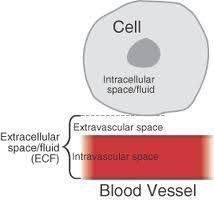
Formation of Interstitial Fluid (ISF)
Interstitial fluid is formed by the filtration of plasma through capillary walls, driven by Starling forces.
Diffusion: Movement of small molecules (O2, glucose, CO2) across capillary walls.
Filtration: Movement of water and solutes driven by pressure gradients.
Starling Forces: Four main forces: capillary hydrostatic pressure, interstitial hydrostatic pressure, capillary oncotic pressure, interstitial oncotic pressure.
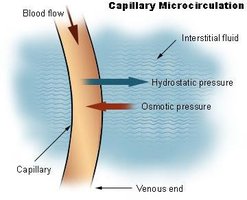
Definitions of Key Terms
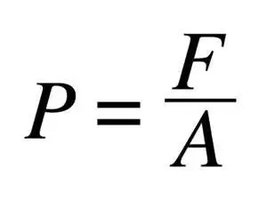
Hydrostatic Pressure: The force exerted by a fluid against the wall of its container.
Osmotic/Oncotic Pressure: The pressure exerted by proteins (mainly albumin) in plasma, pulling water into the vascular space.
Equilibration Between Interstitial Fluid and Capillary Fluid
The capillary wall acts as a semi-permeable membrane, allowing selective movement of fluids and solutes.
Transport Mechanisms: Diffusion and filtration.
Balance of Forces: Determines the rate and direction of fluid movement.
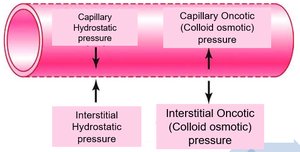
Summary Table of Starling Forces
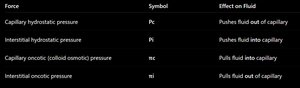
The following table summarizes the four Starling forces and their effects on fluid movement:
Force | Symbol | Effect on Fluid |
|---|---|---|
Capillary hydrostatic pressure | Pc | Pushes fluid out of capillary |
Interstitial hydrostatic pressure | Pi | Pushes fluid into capillary |
Capillary oncotic (colloid osmotic) pressure | πc | Pulls fluid into capillary |
Interstitial oncotic pressure | πi | Pulls fluid out of capillary |
Hydrostatic Pressure Gradient
The hydrostatic pressure gradient tends to expel fluid from the capillary into the interstitial space.
Formula: Hydrostatic pressure inside capillary minus hydrostatic pressure of ISF.
Effect: Pushes fluid away from the capillary.
Dependence: Higher blood volume increases hydrostatic pressure.
Osmotic/Oncotic Pressure Gradient
The osmotic/oncotic pressure gradient tends to retain fluid within the capillary.
Formula: Colloid osmotic pressure of plasma minus colloid osmotic pressure of ISF.
Effect: Pulls fluid toward the capillary.
Source: Mainly due to plasma proteins (albumin).
Mathematical Expression of Fluid Movement
Fluid movement across the capillary wall is determined by the following equation:
Equation:
Kf: Capillary filtration coefficient (permeability and surface area).
Capillary Filtration Coefficient (Kf)
The capillary filtration coefficient reflects how easily fluid can pass through the capillary wall.
High Kf: Leaky capillary, lots of fluid movement.
Low Kf: Tight capillary, little fluid movement.
Direction of Flow: Kf does not determine direction, only ease of movement.
Fluid Movement Along the Capillary
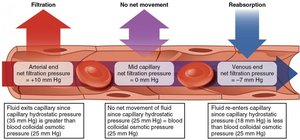
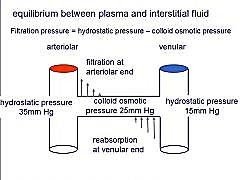
Fluid movement varies along the length of the capillary, with filtration at the arteriolar end and reabsorption at the venular end.
Arteriolar End: Outward movement due to higher hydrostatic pressure.
Venular End: Inward movement due to higher oncotic pressure.
Daily Filtration: About 24 L of fluid filtered per day; 85% reabsorbed, remainder returns via lymphatics.
Calculation Examples
At the arteriolar end:
Fluid movement: (Outward)
At the venular end:
Fluid movement: (Inward)
Factors Affecting ISF Volume
The volume of interstitial fluid is determined by several factors:
Starling Forces
Capillary Filtration Coefficient (Kf)
Lymph Flow
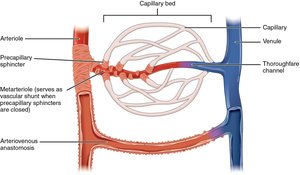
Precapillary vs Postcapillary Resistance: Precapillary constriction reduces filtration; postcapillary constriction increases filtration.
Arterial/Venous Pressure: Elevations increase capillary pressure and filtration.
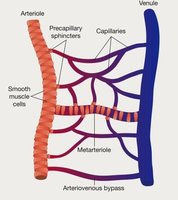
Precapillary vs Postcapillary Resistance
Resistance in arterioles and venules affects the rate of filtration and reabsorption.
Precapillary Constriction: Reduces filtration.
Postcapillary Constriction: Increases filtration.
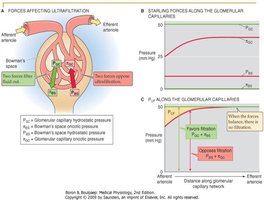
Starling Forces and Urine Formation
Starling forces also play a role in the formation of urine in the kidneys, particularly in glomerular filtration.
Glomerular Capillaries: Filtration is driven by hydrostatic and oncotic pressures.
Clinical Relevance: Alterations in these forces can affect kidney function and fluid balance.
Recommended Reading
Ross & Wilson Anatomy and Physiology in Health and Illness
Ganong's Review of Medical Physiology
Guyton and Hall Textbook of Medical Physiology