 Back
BackStudy Guide: Bones and Bone Tissue (ANP College Course)
Study Guide - Smart Notes
 Tailored notes based on your materials, expanded with key definitions, examples, and context.
Q1. What is bone, and what are its major functions?
Background
Topic: Introduction to Bone and Skeletal Tissue
This question tests your understanding of the basic definition of bone as a tissue and the primary functions of the skeletal system.
Key Terms:
Bone: A dynamic, living connective tissue that responds to its environment.
Skeletal System: Composed of bones and associated tissues.
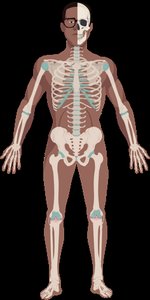
Major Functions: Support, protection, movement (levers), storage, and blood cell production.
Step-by-Step Guidance
Recall that bone is a type of connective tissue, not just a hard structure.
List the five major functions of bone: support, protection, movement, storage, and blood cell production.
Think about examples for each function (e.g., skull for protection, femur for support and acting as a lever).
Consider how bone stores substances like calcium and triglycerides, and produces blood cells in marrow.
Try solving on your own before revealing the answer!
Final Answer:
Bone is a living, dynamic connective tissue that forms the skeleton. Its major functions are: support, protection, movement (as levers), storage of minerals and fat, and production of blood cells.
Each function is essential for maintaining the body's structure, protecting organs, enabling movement, storing important substances, and producing blood cells.
Q2. For each bone below, state whether the primary function is support (S), protection (P), or acting as a lever (L).
Background
Topic: Functional Classification of Bones
This question tests your ability to identify the main function of specific bones based on their location and role in the body.
Key Terms:
Support: Bones that provide structural framework.
Protection: Bones that shield vital organs.
Lever: Bones that facilitate movement by acting as levers for muscles.

Step-by-Step Guidance
Review the function of each bone listed (phalanges, mandible, vertebrae, ribs, parietal bones, humerus).
Think about the anatomical location and what each bone primarily does (e.g., ribs protect organs, humerus acts as a lever).
Assign the function(s) to each bone, noting that some bones may serve more than one function.
Use your knowledge of skeletal anatomy to justify your choices.
Try solving on your own before revealing the answer!
Final Answer:
Phalanges: Lever; Mandible: Protection and Lever; Vertebrae: Support and Protection; Ribs: Protection; Parietal bones: Protection; Humerus: Lever.
Each bone's function is determined by its anatomical role and location.
Q3. Which substances are stored in bones?
Background
Topic: Bone Storage Functions
This question tests your knowledge of the substances stored in bone tissue, such as minerals and fats.
Key Terms:
Triglycerides: Stored in yellow marrow.
Calcium: Stored in the bone matrix.

Step-by-Step Guidance
Recall that bones store minerals and fats.
Identify which substances are stored in the bone matrix (calcium) and which are stored in marrow (triglycerides).
Eliminate options that do not fit (e.g., blood is produced, not stored).
Choose the correct pair based on your understanding of bone physiology.
Try solving on your own before revealing the answer!
Final Answer:
Triglycerides and calcium are stored in bones. Triglycerides are stored in yellow marrow, and calcium is stored in the bone matrix.
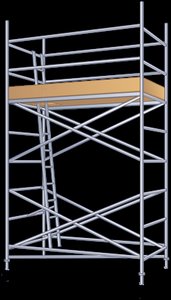
Q4. Explain the analogy: Spongy bone and compact bone are sometimes compared to scaffolding and a brick or concrete wall.
Background
Topic: Structural Arrangement of Bone
This question tests your understanding of the differences between spongy bone and compact bone, and how their structures relate to their functions.
Key Terms:
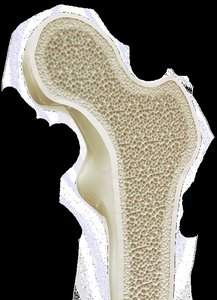
Spongy Bone: Lightweight, porous, found in the interior of bones.
Compact Bone: Dense, strong, forms the outer layer of bones.

Step-by-Step Guidance
Think about how scaffolding is lightweight and provides support without being solid.
Compare this to spongy bone, which has a network of trabeculae and spaces for marrow.
Brick or concrete walls are solid and strong, similar to compact bone, which provides strength and protection.
Explain how each structure's arrangement relates to its function in the skeleton.
Try solving on your own before revealing the answer!
Final Answer:
Spongy bone is like scaffolding—lightweight and supportive, with spaces for marrow. Compact bone is like a brick wall—dense and strong, providing protection and structure.
Q5. If a person’s spongy bone were all replaced by compact bone, how may that affect the function of their bones and skeleton?
Background
Topic: Bone Structure and Function
This question tests your understanding of the functional consequences of bone structure changes.
Key Terms:
Spongy Bone: Reduces weight, contains marrow.
Compact Bone: Provides strength and hardness.
Step-by-Step Guidance
Consider the role of spongy bone in reducing bone weight and providing space for marrow.
Think about how compact bone increases strength but also weight.
Predict the effects on bone function, such as increased heaviness and decreased marrow space.
Reflect on how this change could impact movement and blood cell production.
Try solving on your own before revealing the answer!
Final Answer:
The skeleton would be stronger but heavier, and there would be less room for marrow, potentially affecting blood cell production and joint function.
