 Back
BackStudy Guide: Cell Structure and Membrane Transport (ANP College Level)
Study Guide - Smart Notes
 Tailored notes based on your materials, expanded with key definitions, examples, and context.
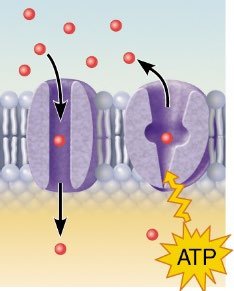
Q1. What function of a membrane protein is illustrated below?
Background
Topic: Membrane Transport Proteins
This question is testing your understanding of how membrane proteins facilitate the movement of substances across the plasma membrane, specifically focusing on active transport mechanisms.
Key Terms and Concepts:
Active Transport: The movement of molecules across a membrane from a region of lower concentration to a region of higher concentration, requiring energy (usually ATP).
ATP (Adenosine Triphosphate): The energy currency of the cell, used to power active transport.
Transport Protein: A membrane protein that assists in moving substances across the cell membrane.
Step-by-Step Guidance
Observe the diagram: It shows a membrane protein embedded in the plasma membrane, with molecules moving through it.
Notice the presence of ATP: The diagram indicates that ATP is being used, which suggests the process is active transport rather than passive.
Identify the direction of movement: The molecules are moving against their concentration gradient (from low to high concentration), which is characteristic of active transport.
Recognize the role of the protein: The membrane protein is acting as a pump, using energy from ATP to move molecules across the membrane.
Try solving on your own before revealing the answer!
Final Answer: Active transport (specifically, a membrane protein acting as a pump)
This membrane protein is facilitating active transport, using ATP to move molecules against their concentration gradient. This is a key function of certain membrane proteins, such as the sodium-potassium pump.
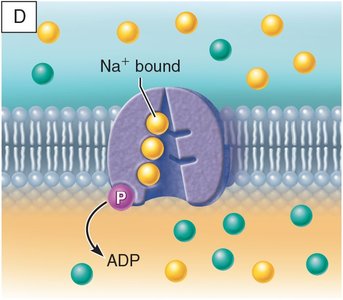
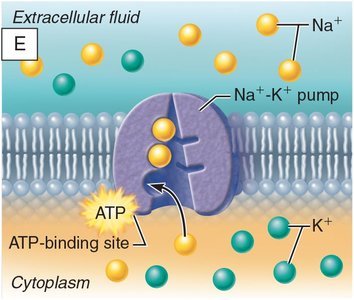
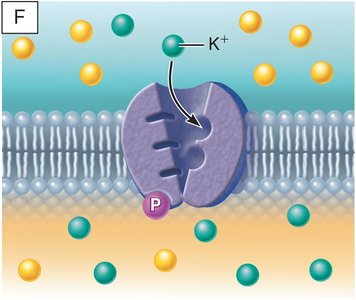
Q2. Write the letters for each step of the sodium-potassium pump in order from start to finish.
Background
Topic: Sodium-Potassium Pump (Na+/K+ ATPase)
This question is testing your understanding of the sequence of events in the sodium-potassium pump, a primary active transport mechanism that maintains cellular ion gradients.
Key Terms and Concepts:
Sodium-Potassium Pump: A membrane protein that uses ATP to exchange sodium and potassium ions across the cell membrane.
ATP: Provides energy for the pump to function.
Ion Gradient: The difference in concentration of ions across the membrane.
Step-by-Step Guidance
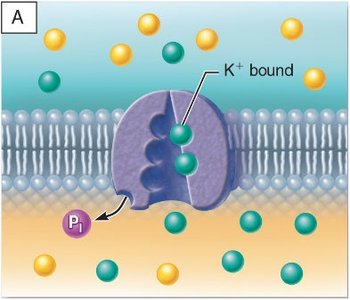
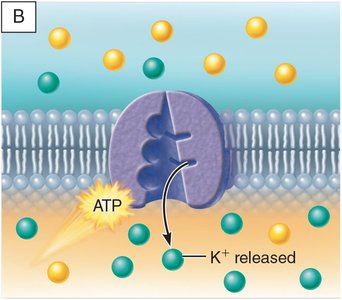
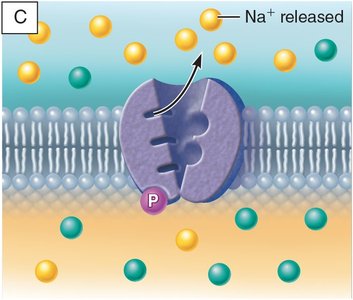
Review the images: Each image represents a step in the sodium-potassium pump cycle. Pay attention to which ions are bound or released, and when ATP is used.
Identify the starting point: The pump typically begins with sodium ions binding to the protein on the cytoplasmic side.
Follow the sequence: ATP is hydrolyzed, causing a conformational change in the protein and allowing sodium ions to be released outside the cell.
Potassium ions then bind to the protein from the extracellular side, and the phosphate group is released, returning the protein to its original shape and releasing potassium ions inside the cell.
Try solving on your own before revealing the answer!
Final Answer: The correct order is E, D, C, F, A, B
This sequence follows the binding and release of sodium and potassium ions, as well as the use of ATP and phosphate, in the sodium-potassium pump cycle.
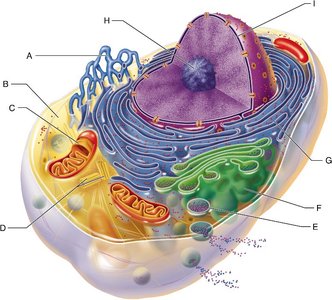
Q3. Identify each of the structures indicated (A–I) for the generalized cell.
Background
Topic: Cell Structure and Organelles
This question is testing your ability to recognize and name the major organelles and structures within a typical eukaryotic cell.
Key Terms and Concepts:
Organelles: Specialized structures within the cell that perform distinct functions (e.g., mitochondria, Golgi apparatus, endoplasmic reticulum).
Nucleus: The control center of the cell, containing genetic material.
Cytoplasm: The fluid and organelles outside the nucleus.
Step-by-Step Guidance
Examine the diagram: Each label (A–I) points to a specific structure within the cell.
Recall the appearance and location of major organelles: For example, mitochondria are often depicted as oval structures with internal folds, while the nucleus is a large, central structure.
Match each label to the correct organelle or structure based on its shape, position, and features.
Use your textbook or lecture notes to confirm the identity of each structure if needed.
Try solving on your own before revealing the answer!
Final Answer: (A) Rough ER, (B) Mitochondria, (C) Smooth ER, (D) Lysosome, (E) Golgi apparatus, (F) Peroxisome, (G) Cytosol, (H) Nucleus, (I) Nucleolus
Each label corresponds to a major organelle or structure in the cell, as depicted in the diagram.
