 Back
BackStudy Guide: Nervous System Physiology and Muscle Contraction (ANP)
Study Guide - Smart Notes
 Tailored notes based on your materials, expanded with key definitions, examples, and context.
Q1. Explain how muscle fibers are stimulated to contract by describing the events that occur at the neuromuscular junction.
Background
Topic: Neuromuscular Junction & Muscle Contraction
This question tests your understanding of how a nerve impulse leads to muscle contraction, focusing on the communication between a motor neuron and a muscle fiber.
Key Terms and Concepts:
Neuromuscular junction (NMJ)
Motor neuron
Synaptic cleft
Acetylcholine (ACh)
Muscle action potential
Step-by-Step Guidance
When an action potential reaches the axon terminal of a motor neuron, voltage-gated calcium channels open, allowing to enter the terminal.
The influx of causes synaptic vesicles to fuse with the presynaptic membrane and release acetylcholine (ACh) into the synaptic cleft.
ACh diffuses across the synaptic cleft and binds to receptors on the motor end plate of the muscle fiber.
This binding opens chemically gated ion channels, allowing to enter the muscle cell, generating an end plate potential.
Try solving on your own before revealing the answer!
Q2. Describe end plate potential.
Background
Topic: Synaptic Transmission at the NMJ
This question focuses on the electrical changes that occur in the muscle fiber membrane after ACh binds to its receptors.
Key Terms:
End plate potential (EPP)
Depolarization
Ion movement ( influx, efflux)
Step-by-Step Guidance
When ACh binds to its receptors, chemically gated channels open, allowing to flow in and to flow out.
The influx of is greater than the efflux of , causing a local depolarization called the end plate potential.
If the EPP reaches threshold, it triggers an action potential in the muscle fiber.
Try solving on your own before revealing the answer!
Q3. Which voltage-gated channel is found along the axon terminal of a motor neuron?
Background
Topic: Synaptic Transmission
This question tests your knowledge of the types of ion channels involved in neurotransmitter release at the NMJ.
Key Terms:
Voltage-gated calcium channels
Axon terminal
Step-by-Step Guidance
Recall that neurotransmitter release is triggered by an influx of a specific ion when an action potential arrives at the axon terminal.
Identify which voltage-gated channel allows this ion to enter the terminal, leading to vesicle fusion and neurotransmitter release.
Try solving on your own before revealing the answer!
Q4. Which neurotransmitter is found in the synaptic cleft of a motor neuron?
Background
Topic: Neurotransmitters at the NMJ
This question asks you to recall the main neurotransmitter responsible for muscle contraction at the neuromuscular junction.
Key Terms:
Acetylcholine (ACh)
Synaptic cleft
Step-by-Step Guidance
Think about the neurotransmitter released by motor neurons to stimulate skeletal muscle fibers.
Recall the name of the molecule that binds to receptors on the muscle cell membrane.
Try solving on your own before revealing the answer!
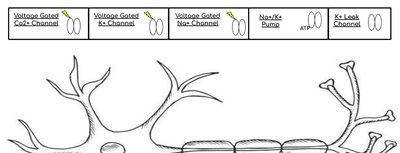
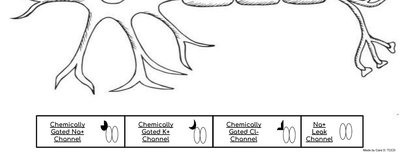
Q5. Identify the types of membrane ion channels, their role, and where they are found in a neuron.
Background
Topic: Neuronal Membrane Channels
This question tests your understanding of the different types of ion channels in neurons and their specific locations and functions.
Key Terms and Types:
Voltage-gated channels (Na+, K+, Ca2+)
Chemically gated (ligand-gated) channels
Leak channels
Na+/K+ pump
Step-by-Step Guidance
List the main types of ion channels found in neurons and describe their general function (e.g., initiating action potentials, maintaining resting potential).
Identify where each type is typically located (e.g., dendrites, axon hillock, axon, axon terminal).
Explain the role of each channel in neuronal signaling.
Try solving on your own before revealing the answer!
Q6. Define resting membrane potential and describe how it is generated.
Background
Topic: Resting Membrane Potential
This question focuses on the electrical charge difference across the neuronal membrane at rest and the mechanisms that establish it.
Key Terms and Formulas:
Resting membrane potential (RMP)
Na+/K+ ATPase pump
Leak channels
Typical value: mV
Step-by-Step Guidance
Define what is meant by the resting membrane potential and its typical value in neurons.
Describe the role of the Na+/K+ pump in maintaining ion gradients across the membrane.
Explain how leak channels contribute to the resting potential, especially for K+.
Try solving on your own before revealing the answer!
Q7. Explain the differences in ionic composition of a neuron cell body. Where is Na+ and K+ heavily concentrated?
Background
Topic: Ionic Gradients in Neurons
This question tests your understanding of the distribution of major ions inside and outside the neuron.
Key Terms:
Na+ (sodium)
K+ (potassium)
Intracellular vs. extracellular concentration
Step-by-Step Guidance
Recall which ion is more concentrated inside the neuron and which is more concentrated outside.
Explain how the Na+/K+ pump helps maintain these gradients.
Try solving on your own before revealing the answer!
Q8. List the channels/pumps that maintain resting membrane potential.
Background
Topic: Maintenance of Resting Potential
This question asks you to identify the specific proteins responsible for maintaining the resting membrane potential in neurons.
Key Terms:
Na+/K+ ATPase pump
K+ leak channels
Na+ leak channels
Step-by-Step Guidance
List the main channels and pumps involved in maintaining the resting membrane potential.
Briefly describe the function of each (e.g., which ions they move and in which direction).
Try solving on your own before revealing the answer!
Q9. For an open channel, what factors determine in which direction ions will move through that channel?
Background
Topic: Ion Movement Across Membranes
This question tests your understanding of the forces that drive ion movement across the neuronal membrane.
Key Terms:
Electrochemical gradient
Concentration gradient
Electrical gradient
Step-by-Step Guidance
Define the two main forces that influence ion movement: concentration gradient and electrical gradient.
Explain how the combination of these forces (the electrochemical gradient) determines the direction of ion flow.
Try solving on your own before revealing the answer!
Q10. Compare and contrast graded potentials and action potentials.
Background
Topic: Types of Electrical Signals in Neurons
This question asks you to distinguish between two types of changes in membrane potential.
Key Terms:
Graded potential
Action potential
Amplitude, duration, propagation
Step-by-Step Guidance
Define graded potentials and action potentials, including where they occur in the neuron.
Compare their characteristics: amplitude, duration, ability to propagate, and whether they are all-or-none.
Explain how one can trigger the other.
Try solving on your own before revealing the answer!
Q11. Describe depolarization and hyperpolarization.
Background
Topic: Changes in Membrane Potential
This question focuses on the meaning of these two terms and what causes them in neurons.
Key Terms:
Depolarization
Hyperpolarization
Ion movement
Step-by-Step Guidance
Define depolarization and describe what happens to the membrane potential during this process.
Define hyperpolarization and describe how it differs from depolarization.
Identify which ions are typically involved in each process.
Try solving on your own before revealing the answer!
Q12. What determines the size of a graded potential?
Background
Topic: Graded Potentials
This question tests your understanding of what factors influence the magnitude of graded potentials in neurons.
Key Terms:
Stimulus strength
Ion channel opening
Step-by-Step Guidance
Explain how the strength of the stimulus affects the size of the graded potential.
Discuss the role of the number of open ion channels.
Try solving on your own before revealing the answer!
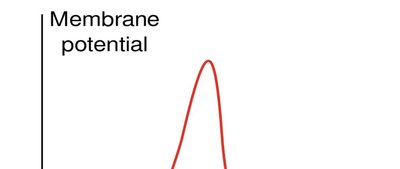
Q13. Explain how action potentials are generated and propagated along neurons. (include which gates are used and when they are open/closed, the direction of flow of ions, and threshold voltage)
Background
Topic: Action Potential Generation and Propagation
This question asks you to describe the sequence of events during an action potential and how it travels along the axon.
Key Terms and Steps:
Threshold voltage (about mV)
Voltage-gated Na+ and K+ channels
Depolarization, repolarization, hyperpolarization
Step-by-Step Guidance
When the membrane potential reaches threshold, voltage-gated Na+ channels open, allowing Na+ to rush into the cell (depolarization).
At the peak, Na+ channels inactivate and voltage-gated K+ channels open, allowing K+ to exit the cell (repolarization).
Hyperpolarization occurs as K+ channels remain open briefly after repolarization.
The action potential propagates as the depolarization triggers adjacent voltage-gated Na+ channels to open.
Try solving on your own before revealing the answer!
Q14. Define absolute and relative refractory periods.
Background
Topic: Action Potential Refractory Periods
This question tests your understanding of the periods during which a neuron cannot or is less likely to fire another action potential.
Key Terms:
Absolute refractory period
Relative refractory period
Step-by-Step Guidance
Define the absolute refractory period and explain why no action potential can be generated during this time.
Define the relative refractory period and describe what is required to generate another action potential during this phase.
Try solving on your own before revealing the answer!
Q15. List the factors that contribute to conduction velocity.
Background
Topic: Action Potential Conduction
This question asks you to identify what influences the speed at which action potentials travel along axons.
Key Terms:
Axon diameter
Myelination
Temperature
Step-by-Step Guidance
List the main factors that affect conduction velocity in neurons.
Explain how each factor influences the speed of action potential propagation.
Try solving on your own before revealing the answer!
Q16. Define saltatory conduction and explain how it differs from continuous conduction.
Background
Topic: Action Potential Propagation
This question focuses on the difference between how action potentials travel in myelinated vs. unmyelinated axons.
Key Terms:
Saltatory conduction
Nodes of Ranvier
Continuous conduction
Step-by-Step Guidance
Define saltatory conduction and describe how action potentials "jump" from node to node in myelinated axons.
Contrast this with continuous conduction in unmyelinated axons.
Try solving on your own before revealing the answer!
