 Back
BackThe Cell: Plasma Membrane Transport and Cell Cycle/Mitosis
Study Guide - Smart Notes
 Tailored notes based on your materials, expanded with key definitions, examples, and context.
The Cell: Structure and Function
Cytoplasm and Plasma Membrane
The cell is the basic structural and functional unit of life. It consists of cytoplasm—which includes the cytosol and organelles—enclosed by a plasma membrane. The cytoplasm is the site of most cellular activities, while the plasma membrane regulates the movement of substances into and out of the cell.
Cytoplasm: Composed of cytosol (fluid portion) and organelles (specialized structures).
Plasma Membrane: A selectively permeable barrier composed of phospholipids, proteins (integral and peripheral), glycolipids, and sterols (e.g., cholesterol).
The Phospholipid Bilayer
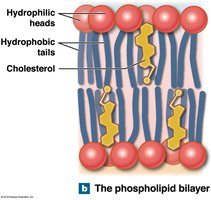
The plasma membrane is primarily made up of a phospholipid bilayer. This structure is essential for membrane function and selective permeability.
Phospholipids: Have hydrophilic (water-attracting) heads and hydrophobic (water-repelling) tails.
Cholesterol: A lipid that increases membrane rigidity and stability.
The bilayer's chemistry allows some substances to pass freely while restricting others, making the membrane selectively permeable.
Membrane Transport Mechanisms
Passive Processes
Passive transport does not require cellular energy (ATP). Substances move down their concentration gradients.
Diffusion: Movement of molecules from high to low concentration.
Osmosis: Diffusion of water across a selectively permeable membrane.
Facilitated Diffusion: Movement of solutes across the membrane via carrier proteins.
Active Processes
Active transport requires energy (usually ATP) to move substances against their concentration gradients.
Active Transport: Carrier proteins transport chemicals against their gradient.
Endocytosis: Uptake of extracellular materials into the cell via vesicles. Types include:
Pinocytosis: "Cell drinking"—ingestion of fluid.
Phagocytosis: "Cell eating"—ingestion of large particles.
Receptor-mediated endocytosis: Specific uptake of molecules via receptor binding.
Exocytosis: Ejection of materials from the cell via vesicles.
The Nucleus and Genetic Material
Nucleus Structure and Function
The nucleus is the control center of the cell, containing DNA. The form of DNA varies depending on the cell's state:
Chromatin: Loose DNA in non-dividing cells, associated with histone proteins (nucleosomes contain 8 histones each).
Chromosomes: Condensed DNA in dividing cells.
The Cell Cycle and Mitosis
Phases of the Cell Cycle
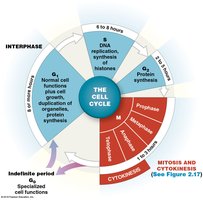
The cell cycle describes the sequence of events in the life of a cell, including growth, DNA replication, and division. Not all cells divide; some remain in a specialized state (G0).
Interphase: The period of cell growth and DNA replication, divided into three phases:
G1 phase: Cell growth and normal functions.
S phase: DNA replication and synthesis of histones.
G2 phase: Protein synthesis and preparation for division.
G0 phase: Indefinite period of specialized cell function (non-dividing state).
Mitosis: Nuclear Division
Mitosis is the process by which replicated DNA is equally distributed to two identical daughter cells. It consists of four main phases, often remembered by the acronym PMAT:
Prophase: Chromatin condenses into chromosomes; sister chromatids join; spindle fibers attach at kinetochores; nuclear envelope disintegrates.
Metaphase: Chromosomes align at the metaphase plate (center of the cell).
Anaphase: Sister chromatids are pulled apart toward opposite poles; each is now called a daughter chromosome.
Telophase: Chromosomes decondense back into chromatin; nuclear envelope reforms.
Cytokinesis is the division of the cytoplasm, beginning in late anaphase and continuing through telophase, resulting in two separate cells.
Summary Table: Membrane Transport Processes
Process | Energy Required? | Direction | Example |
|---|---|---|---|
Diffusion | No | High to Low | Oxygen entering cells |
Osmosis | No | High to Low (water) | Water absorption in kidneys |
Facilitated Diffusion | No | High to Low | Glucose transport into cells |
Active Transport | Yes (ATP) | Low to High | Sodium-potassium pump |
Endocytosis | Yes (ATP) | Into cell | Phagocytosis by white blood cells |
Exocytosis | Yes (ATP) | Out of cell | Secretion of hormones |
Additional info: Table entries inferred and expanded for clarity and completeness.
