 Back
BackThe Cell: Structure, Function, and Membrane Transport
Study Guide - Smart Notes
 Tailored notes based on your materials, expanded with key definitions, examples, and context.
The Cell
Basic Processes of Cells
Cells are the fundamental units of life, carrying out essential processes to maintain homeostasis and support the organism. These processes include metabolism, transport, communication, and reproduction.
Cell metabolism: The sum of all chemical reactions in a cell, necessary for maintaining life.
Transport of substances: Movement of molecules produced or ingested by the cell to various destinations.
Communication: Cells interact with their environment and other cells to coordinate activities.
Cell reproduction: Essential for growth, development, and replacement of old or damaged cells.
Overview of Cell Structure
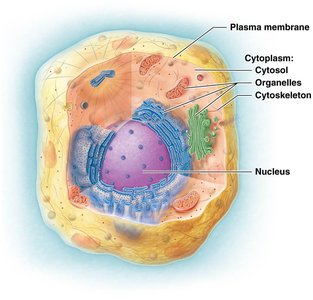
Most animal cells share three basic components: the plasma membrane, cytoplasm, and nucleus. Each component plays a critical role in cell function and organization.
Plasma membrane: Provides structural support, communication, regulates transport, and identifies the cell. It separates the intracellular fluid (ICF) from the extracellular fluid (ECF).
Cytoplasm: Contains cytosol (intracellular fluid), organelles (specialized structures with specific functions), and the cytoskeleton (protein filaments for support and movement).
Nucleus: Houses most of the cell’s DNA and is the primary site for RNA synthesis. DNA and RNA direct organelle functions by coding for and synthesizing proteins.
Cell Size and Diversity
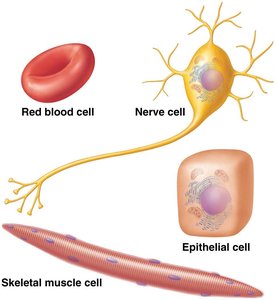
Cells vary widely in size and structure, reflecting the structure-function principle: a cell’s form is closely related to its function. Examples include red blood cells, nerve cells, epithelial cells, and skeletal muscle cells.
Red blood cells: Specialized for oxygen transport.
Nerve cells: Specialized for communication and signal transmission.
Epithelial cells: Specialized for protection and absorption.
Skeletal muscle cells: Specialized for contraction and movement.
Plasma Membrane Structure
The Phospholipid Bilayer
The plasma membrane is primarily composed of a phospholipid bilayer, which forms a selective barrier between the cell and its environment.
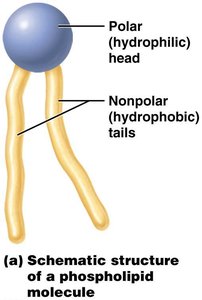
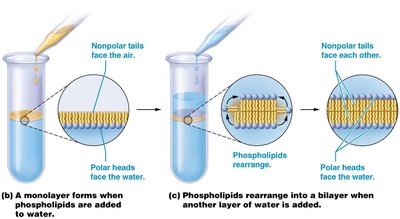
Phospholipids: Each molecule has a hydrophilic (water-loving) phosphate head and two hydrophobic (water-fearing) fatty acid tails.
In water, phospholipids arrange themselves so that the hydrophobic tails face inward, shielded from water, while the hydrophilic heads face outward.
The Fluid Mosaic Model
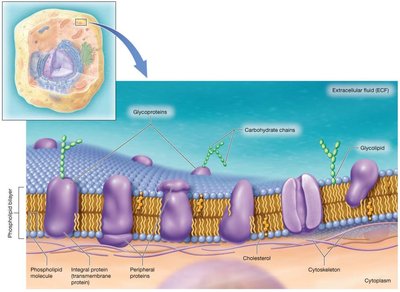
The plasma membrane is described by the fluid mosaic model, which emphasizes its dynamic nature and the diversity of its components.
Fluidity: Components of the membrane move laterally, allowing flexibility and the ability to self-heal.
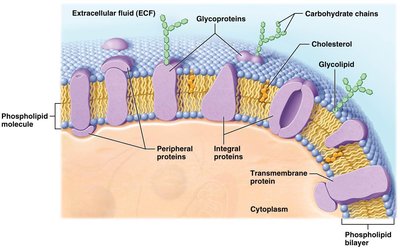
Mosaic: The membrane contains proteins, cholesterol, glycolipids, and glycoproteins interspersed within the phospholipid bilayer.
Membrane Proteins and Other Components
Membrane proteins perform a variety of functions, including transport, communication, and structural support. Other components such as cholesterol and carbohydrates contribute to membrane stability and cell recognition.
Integral proteins: Span the membrane and are involved in transport and signaling.
Peripheral proteins: Attached to the membrane surface, providing support and facilitating communication.
Cholesterol: Stabilizes membrane fluidity during temperature changes.
Glycolipids and glycoproteins: Involved in cell recognition and immune response.
Functions of Membrane Proteins
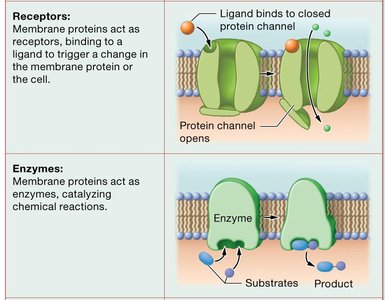
Receptors: Bind ligands and trigger cellular responses.
Enzymes: Catalyze chemical reactions at the membrane surface.
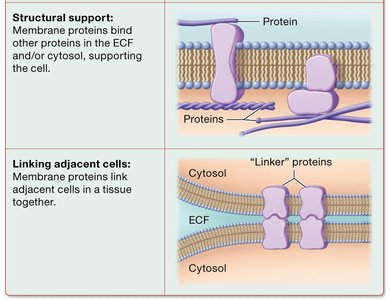
Structural support: Bind to cytoskeleton or extracellular matrix for stability.
Linking adjacent cells: Form junctions between neighboring cells.
Transport Across the Plasma Membrane
Passive Transport
Passive transport does not require energy and relies on concentration gradients to move substances across the membrane.
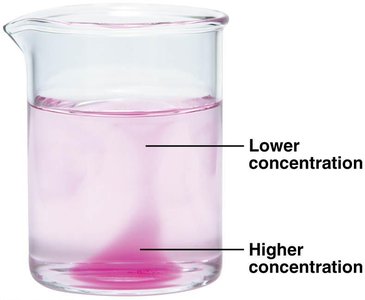
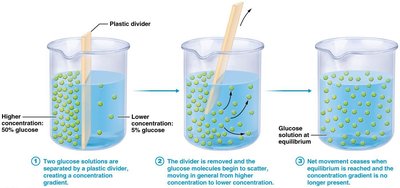
Diffusion: Movement of solute molecules from an area of higher concentration to lower concentration until equilibrium is reached.
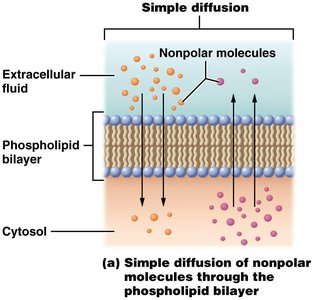
Simple diffusion: Nonpolar molecules (e.g., oxygen, carbon dioxide) pass directly through the phospholipid bilayer.
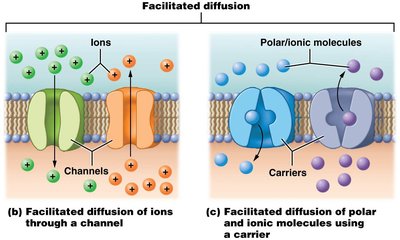
Facilitated diffusion: Polar or charged molecules (e.g., ions, glucose) cross the membrane with the help of carrier or channel proteins.
Osmosis
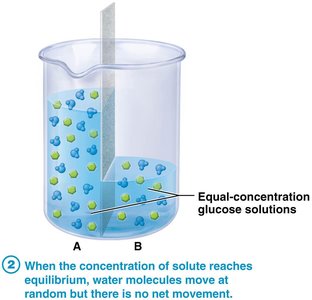
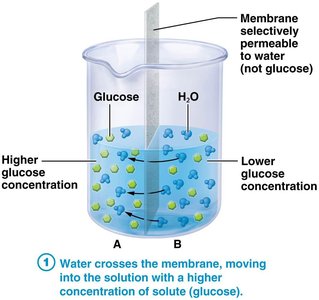
Osmosis is the movement of water across a selectively permeable membrane from a region of lower solute concentration to higher solute concentration. Water moves through aquaporins or between phospholipids.
Osmotic pressure: The force exerted by solute molecules that drives water movement until equilibrium is reached.
Tonicity
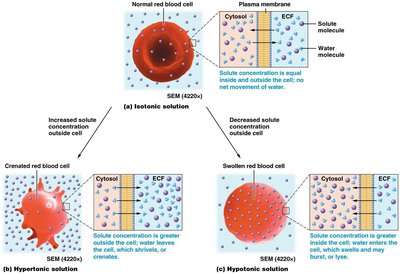
Tonicity describes the effect of extracellular fluid (ECF) on cell volume:
Isotonic solution: Solute concentration is equal inside and outside the cell; no net water movement.
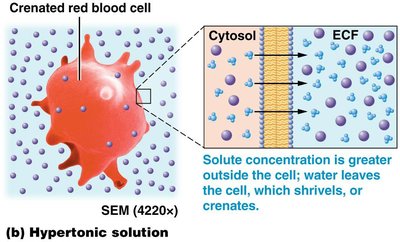
Hypertonic solution: ECF has higher solute concentration; water leaves the cell, causing it to shrink (crenate).
Hypotonic solution: ECF has lower solute concentration; water enters the cell, causing it to swell and possibly lyse (burst).
Active Transport
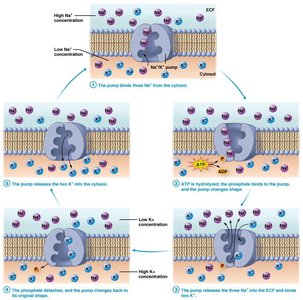
Active transport requires energy (ATP) to move substances against their concentration gradients. This process is essential for maintaining cellular homeostasis.
Pumps: Carrier proteins that use ATP to transport ions (e.g., Na+/K+ pump).

Vesicular Transport
Large molecules and particles are transported via vesicles, which are small membrane-bound sacs. This process also requires ATP.
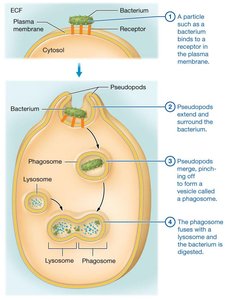
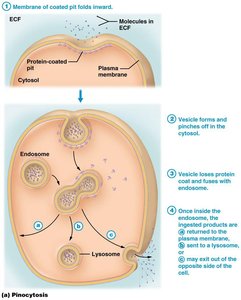
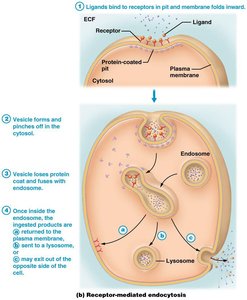
Endocytosis: Uptake of materials into the cell via vesicles.
Phagocytosis: "Cell eating"; ingestion of large particles by phagocytes.
Pinocytosis: "Cell drinking"; uptake of fluid droplets.
Receptor-mediated endocytosis: Specific molecules are taken in after binding to receptors.
Exocytosis: Release of substances from the cell as vesicles fuse with the plasma membrane.
Transcytosis: Transport of substances across the cell via a combination of endocytosis and exocytosis.
 *Additional info: The above content covers the structure and function of the cell, plasma membrane, and mechanisms of membrane transport, which are foundational topics in anatomy and physiology (ANP) college courses.*
