 Back
BackThe Cell: Structure, Function, and Physiology
Study Guide - Smart Notes
 Tailored notes based on your materials, expanded with key definitions, examples, and context.
The Cell
Introduction to the Cell
The cell is the basic unit of life, responsible for carrying out all vital processes that sustain living organisms. Every cell contains a plasma membrane, cytoplasm, organelles, and a nucleus (in eukaryotic cells). Understanding cell structure and function is fundamental to the study of anatomy and physiology.
Metabolism: The sum of all chemical reactions that keep a cell alive.
Plasma Membrane: The outer boundary of the cell that regulates what enters and exits.
Cytoplasm: Everything inside the cell except the nucleus, including cytosol and organelles.
Organelle: Specialized structures within the cell that perform specific functions.
Nucleus: The control center of the cell containing DNA.
Structure of the Plasma Membrane
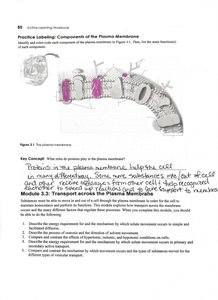
Plasma Membrane Composition and Function
The plasma membrane is a selectively permeable barrier composed mainly of a phospholipid bilayer with embedded proteins, cholesterol, and carbohydrates. It maintains the internal environment of the cell and mediates communication and transport between the cell and its surroundings.
Phospholipid Bilayer: Provides the basic structure, with hydrophilic heads facing outward and hydrophobic tails inward.
Proteins: Serve as channels, carriers, receptors, and enzymes.
Cholesterol: Stabilizes membrane fluidity.
Carbohydrates: Involved in cell recognition and signaling.
Key Terms Related to Membrane Transport
Term | Definition |
|---|---|
Selectively permeable | Allows some substances through but not others |
Concentration gradient | Difference in concentration between two areas |
Simple diffusion | Molecules move from high to low concentration |
Facilitated diffusion | Movement through transport proteins in the membrane |
Osmosis | Movement of water across a membrane |
Tonicity | Ability of a solution to make a cell gain or lose water |
Primary active transport | Uses ATP to move substances against their gradient |
Secondary active transport | Uses energy stored in ion gradients |
Endocytosis | Cell takes in large particles |
Exocytosis | Cell releases materials outside |
Transport Across the Plasma Membrane
Passive Transport
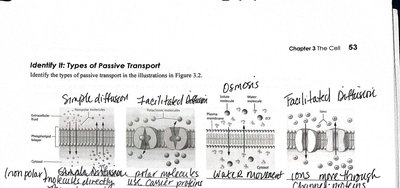
Passive transport does not require energy (ATP) and moves substances from areas of high to low concentration. Types include simple diffusion, facilitated diffusion, and osmosis.
Simple Diffusion: Nonpolar molecules move directly through the membrane.
Facilitated Diffusion: Polar molecules and ions move via protein channels or carriers.
Osmosis: Water moves across the membrane toward higher solute concentration.
Active Transport
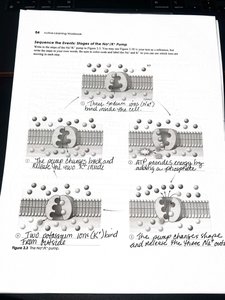
Active transport requires energy (usually ATP) to move substances against their concentration gradients. Examples include the sodium-potassium pump and bulk transport mechanisms such as endocytosis and exocytosis.
Primary Active Transport: Direct use of ATP to transport molecules (e.g., Na+/K+ pump).
Secondary Active Transport: Uses energy from ion gradients created by primary active transport.
Endocytosis: Cell engulfs large particles or liquids.
Exocytosis: Cell expels materials using vesicles.
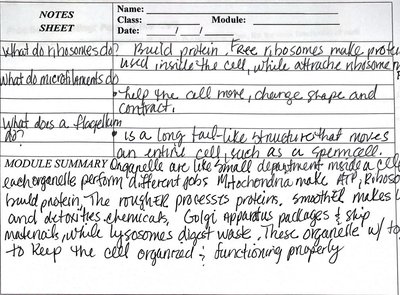
Cytoplasmic Organelles
Major Organelles and Their Functions
Organelles are specialized structures within the cytoplasm that perform distinct cellular functions. They help maintain cellular organization and efficiency.
Mitochondria: Produce ATP through cellular respiration.
Ribosomes: Synthesize proteins; can be free in cytosol or bound to rough ER.
Endoplasmic Reticulum (ER): Rough ER processes proteins; smooth ER synthesizes lipids and detoxifies chemicals.
Golgi Apparatus: Modifies, packages, and ships proteins and lipids.
Lysosomes: Digest waste and cellular debris.
Peroxisomes: Break down fatty acids and detoxify harmful substances.
The Endomembrane System
Function and Components
The endomembrane system is a group of organelles that work together to modify, package, and transport lipids and proteins. It includes the nuclear envelope, endoplasmic reticulum, Golgi apparatus, lysosomes, and vesicles.
Organizes and directs the synthesis, processing, and transport of cellular products.
Vesicles carry molecules between organelles and to/from the cell membrane.
The Cytoskeleton
Structure and Function
The cytoskeleton is a network of protein fibers that provides structural support, maintains cell shape, and enables movement. It consists of microfilaments, intermediate filaments, and microtubules.
Cytoskeletal Element | Main Function |
|---|---|
Microfilaments | Thin protein fibers; help cells move and keep shape |
Intermediate filaments | Rope-like; provide strength and support |
Microtubules | Hollow tubes; transport organelles, cell division |
Centrioles | Organize microtubules for cell division |
Cilia | Short, hair-like projections; move substances |
Flagella | Long, whip-like projections; move the entire cell |
The Nucleus
Structure and Function
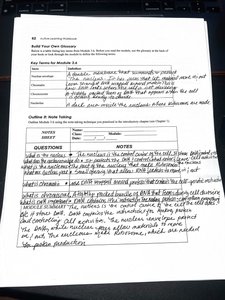
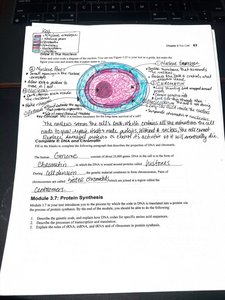
The nucleus is the control center of the cell, containing genetic material (DNA) and directing all cellular activities. It is surrounded by a double membrane called the nuclear envelope, which contains nuclear pores for transport.
Nucleolus: Site of ribosome synthesis.
Chromatin: DNA and associated proteins in a relaxed state.
Chromosomes: Condensed DNA visible during cell division.
Protein Synthesis
Overview of Protein Synthesis
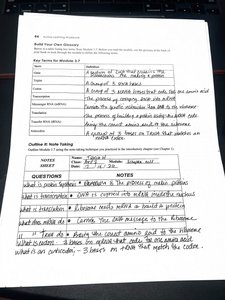
Protein synthesis involves two main steps: transcription and translation. During transcription, a messenger RNA (mRNA) copy of a gene is made in the nucleus. During translation, the mRNA is read by ribosomes in the cytoplasm to assemble amino acids into a protein.
Transcription: DNA is copied into mRNA in the nucleus.
Translation: mRNA is decoded by ribosomes to build a protein.
tRNA: Transfers amino acids to the ribosome, matching codons with anticodons.
Genetic Code and Mutations
The genetic code is the set of rules by which information encoded in DNA is translated into proteins. Mutations are changes in the DNA sequence that can affect protein structure and function.
Codon: A sequence of three nucleotides in mRNA that codes for a specific amino acid.
Anticodon: A sequence of three nucleotides in tRNA that pairs with a codon.
Mutation: Any change in the DNA sequence; can be silent, missense, or nonsense.
Summary Table: Types of Membrane Transport
Type | Energy Required? | Direction | Example |
|---|---|---|---|
Simple Diffusion | No | High to Low | Oxygen, CO2 |
Facilitated Diffusion | No | High to Low | Glucose, ions |
Osmosis | No | Water movement | Water |
Primary Active Transport | Yes (ATP) | Low to High | Na+/K+ pump |
Secondary Active Transport | Yes (ion gradient) | Low to High | Glucose/Na+ cotransport |
Endocytosis | Yes (ATP) | Into cell | Phagocytosis |
Exocytosis | Yes (ATP) | Out of cell | Neurotransmitter release |
Key Equations
Fick's Law of Diffusion:
Where J is the rate of diffusion, D is the diffusion coefficient, and \frac{dC}{dx} is the concentration gradient.
Summary
The cell is a highly organized structure with specialized components that work together to maintain life. Understanding the structure and function of the plasma membrane, organelles, cytoskeleton, and nucleus is essential for comprehending cellular physiology and the basis of human anatomy.
