 Back
BackThe Diabetes Epidemic: Prevalence, Risk Factors, and Classification
Study Guide - Smart Notes
 Tailored notes based on your materials, expanded with key definitions, examples, and context.
The Diabetes Epidemic
Introduction to Diabetes Mellitus
Diabetes mellitus is a chronic metabolic disease that disrupts blood glucose regulation and affects plasma volume, leading to symptoms such as excessive thirst and urination. The disease impacts every organ system in the body and is a major public health concern worldwide.
Origin of the term: 'Diabetes' means 'siphon' or 'flow through' in Greek, referring to excessive urine flow. 'Mellitus' means 'honey,' describing the sweet urine of untreated diabetics.
Systemic effects: Diabetes can lead to complications in the kidneys, cardiovascular system, nerves, eyes, and more.
Prevalence of Diabetes
Diabetes in the United States
The prevalence of diabetes varies by age, sex, and ethnicity. The risk increases significantly with age and is higher in certain demographic groups.
Age group | Number of people with diabetes | Percentage of people with diabetes |
|---|---|---|
Younger than 20 years | 200,000 | 0.25% |
20–64 years | 17.7 million | 20.3% |
65 years and older | 11.2 million | 25.9% |
Women | 13.4 million | 11.2% |
Men | 15.5 million | 13.6% |
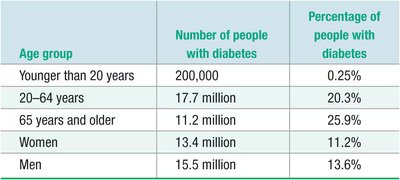
Age: Prevalence increases with age, reaching 25.9% in those 65 and older.
Sex: Slightly higher prevalence in men (13.6%) than women (11.2%).
Diabetes by Race and Ethnicity
Race/ethnicity | Percentage with diabetes (%) |
|---|---|
White, non-Hispanic | 7.6 |
Asian American | 9.0 |
Hispanic American | 12.8 |
Black, non-Hispanic | 13.2 |
Native American | 15.9 |
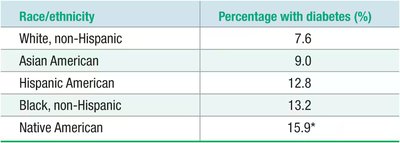
Highest prevalence: Native Americans (15.9%).
Lowest prevalence: White, non-Hispanic (7.6%).
Global Trends in Diabetes
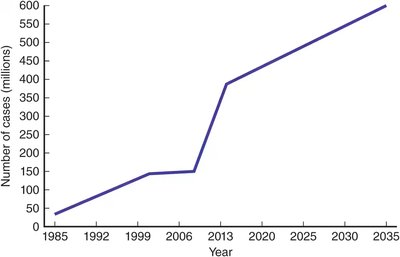
Diabetes is a growing global epidemic. The number of cases has increased dramatically over the past decades and is projected to continue rising.
In 1985: 30 million cases worldwide.
By 2000: 150 million cases.
By 2014: 387 million cases (8.3% of world population).
By 2035 (projected): 600 million cases.
Economic Impact
Direct medical costs (U.S., 2012): $176 billion.
Total costs (including indirect): $245 billion.
Obesity and Diabetes
Relationship Between Obesity and Diabetes
Obesity is the leading risk factor for type 2 diabetes mellitus. The prevalence of obesity has increased alongside diabetes, driven by changes in diet and physical activity.
Obesity definition: High body fat content relative to lean body mass, measured by Body Mass Index (BMI).
BMI formula:
BMI 25–29: Overweight
BMI 30–39: Obese
BMI >39: Severely obese
Obesity rates have doubled in the past 30 years in the U.S., with 35% of adults now obese. Obesity is strongly correlated with the development of type 2 diabetes.
Risk of Type 2 Diabetes by BMI
BMI | Likelihood of developing type 2 diabetes mellitus |
|---|---|
<25 | 1.00 |
25–29.9 | 2.42 |
30–34.9 | 3.35 |
>35 | 6.16 |
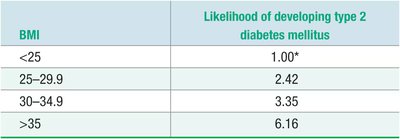
Higher BMI dramatically increases the risk of developing type 2 diabetes.
Classification of Diabetes
Types of Diabetes
Type 1 Diabetes Mellitus (DM): Autoimmune destruction of pancreatic beta cells leads to insufficient insulin production. Usually diagnosed in childhood or adolescence. Accounts for 5–10% of cases.
Type 2 Diabetes Mellitus (DM): Characterized by insulin resistance—cells fail to respond to insulin. Most common form, associated with obesity and lifestyle factors.
Gestational Diabetes: Develops during pregnancy due to hormone-induced insulin resistance. 5–10% of affected women develop type 2 DM after pregnancy.
Prediabetes: Blood glucose levels are elevated (100–125 mg/dL fasting), but not high enough for a diabetes diagnosis. High risk of progression to type 2 DM.
Diabetes Insipidus: Not related to blood glucose; involves problems with antidiuretic hormone (ADH) regulation, leading to excessive urination and thirst.
Diagnosis of Diabetes Mellitus
Diagnostic Criteria
Fasting Plasma Glucose Test: No food for 8 hours before blood sample.
Normal: 60–100 mg/dL
Prediabetes: 100–125 mg/dL
Diabetes: >125 mg/dL
Oral Glucose Tolerance Test: 75g glucose solution after fasting; plasma glucose measured after 2 hours.
Normal: <139 mg/dL
Prediabetes: 140–199 mg/dL
Diabetes: >200 mg/dL
Symptoms and Complications of Diabetes Mellitus
Common Symptoms
Elevated blood glucose
Glucose in urine (glycosuria)
Excessive urination (polyuria)
Excessive thirst (polydipsia)
Fatigue and lethargy
Long-term Complications
Cardiovascular disease (e.g., atherosclerosis, heart attack, stroke)
Kidney disease
Nerve damage (neuropathy)
Eye disease (retinopathy)
Erectile dysfunction
Treatment of Diabetes Mellitus
Blood Glucose Management
Goal: Maintain fasting blood glucose between 70 and 120 mg/dL to reduce complications.
Self-monitoring: Frequent blood glucose testing and dietary management.
Hemoglobin A1c test: Measures average blood glucose over 2–3 months by quantifying glucose bound to hemoglobin in red blood cells.
Pharmacological Treatments
Type 1 DM: Insulin injections are required.
Type 2 DM: May require oral medications (e.g., sulfonylureas, meglitinides, thiazolidinediones, biguanides) or insulin if other measures fail.
As diabetes progresses, additional treatments may be needed for secondary complications such as cardiovascular disease.
Example: BMI and Diabetes Risk
A person with a BMI of 32 has a more than threefold increased risk of developing type 2 diabetes compared to someone with a BMI below 25.
Additional info: The notes above integrate and expand upon the provided tables and figures, offering a comprehensive overview suitable for ANP college students studying diabetes mellitus as part of human physiology and pathophysiology.
