 Back
BackThe Endocrine System: Structure, Function, and Regulation
Study Guide - Smart Notes
 Tailored notes based on your materials, expanded with key definitions, examples, and context.
The Endocrine System
Overview of the Endocrine System
The endocrine system is a network of glands that secrete hormones directly into the bloodstream, regulating various physiological processes throughout the body. Unlike the nervous system, which acts rapidly and locally, the endocrine system initiates slower, long-lasting responses that affect diffuse targets.
Hormones: Chemical messengers transported via blood or lymph.
Endocrine organs: Scattered throughout the body, not grouped in specific areas.
Major functions: Regulation of metabolism, growth, development, tissue function, and homeostasis.
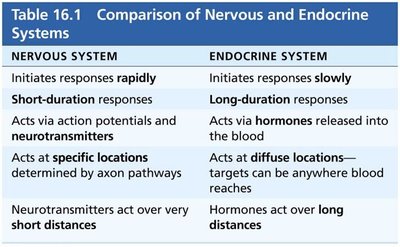
Comparison of Nervous and Endocrine Systems
The nervous and endocrine systems both coordinate body functions, but differ in speed, duration, and mechanism of action.
Nervous System | Endocrine System |
|---|---|
Initiates responses rapidly | Initiates responses slowly |
Short-duration responses | Long-duration responses |
Acts via action potentials and neurotransmitters | Acts via hormones released into the blood |
Acts at specific locations determined by axon pathways | Acts at diffuse locations—targets can be anywhere blood reaches |
Neurotransmitters act over very short distances | Hormones act over long distances |
Hormone Characteristics & Mechanisms of Action
Hormone Properties
Hormones can be classified based on their solubility and their mechanism of action on target cells.
Water-soluble hormones: Cannot cross cell membranes easily; act via surface receptors.
Lipid-soluble hormones: (e.g., steroid hormones) pass through cell membranes and directly affect gene expression.
Target cell specificity: Only cells with appropriate receptors respond to a given hormone.
Hormone actions: Open/close ion channels, activate/deactivate enzymes, induce secretion, stimulate mitosis.
Hormone breakdown: Enzymes degrade hormones; continuous synthesis and release is required.
Stimuli Causing Hormone Release
Hormone secretion is regulated by negative feedback mechanisms and can be triggered by three main types of stimuli:
Humoral stimuli: Changes in blood levels of ions or nutrients (e.g., Ca2+, glucose).
Neural stimuli: Nerve fibers stimulate hormone release (e.g., sympathetic stimulation of adrenal medulla).
Hormonal stimuli: Hormones from one gland stimulate another gland to release hormones (e.g., hypothalamus → pituitary → target gland).
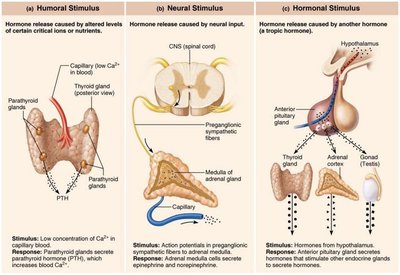
Hormone Interaction with Target Cells
Types of Hormone Interactions
Hormones can interact in several ways to regulate physiological processes:
Permissiveness: One hormone requires another to exert its full effect (e.g., reproductive hormones and thyroid hormone).
Synergism: Two hormones produce amplified effects together (e.g., glucagon and epinephrine increase glucose release).
Antagonism: One hormone opposes the action of another (e.g., insulin lowers blood glucose, glucagon raises it).
Major Endocrine Organs and Their Functions
Pituitary Gland (Hypophysis)
The pituitary gland is located in the sella turcica of the sphenoid bone and is connected to the hypothalamus. It consists of two distinct parts:
Posterior pituitary: Neural tissue; stores and releases hormones from the hypothalamus (oxytocin, ADH).
Anterior pituitary: Glandular tissue; manufactures and releases hormones (GH, TSH, ACTH, FSH, LH, PRO).
Thyroid Gland
The thyroid gland is the largest endocrine gland, located anterior to the trachea and inferior to the larynx. It is butterfly-shaped and consists of two lobes.
Thyroid hormone: Major metabolic hormone; increases basal metabolic rate, regulates tissue growth, development, and blood pressure.
Calcitonin: Lowers blood calcium levels when they are too high.
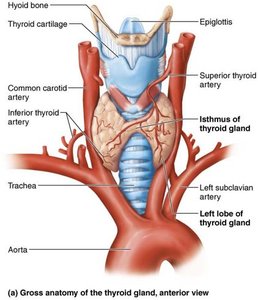
Parathyroid Glands
Parathyroid glands are small glands located posterior to the thyroid. They are the primary regulators of blood calcium levels.
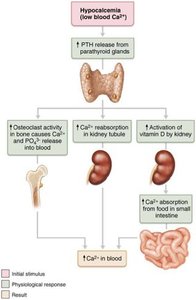
Parathyroid hormone (PTH): Raises blood calcium levels when they are too low.
Importance of Ca2+: Essential for action potential transmission, muscle contraction, and blood clotting.
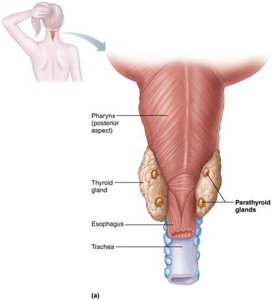
PTH Release Mechanism
PTH acts on three target organs to increase blood calcium:
Skeletal system: Stimulates osteoclasts to release calcium and phosphate from bone.
Kidneys: Enhances reabsorption of calcium from urine.
Small intestine: Activates vitamin D to increase calcium absorption from food.
Adrenal Glands
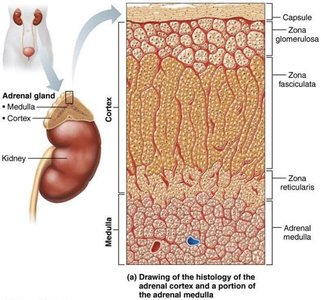
The adrenal glands are paired organs located on top of the kidneys. They consist of two regions:
Adrenal cortex: Secretes aldosterone (regulates Na+ and K+), cortisol (converts fats/proteins to glucose, increases blood pressure), and androgens (sex hormones).
Adrenal medulla: Secretes epinephrine and norepinephrine; mediates fight-or-flight response.
Pineal Gland and Pancreas
The pineal gland and pancreas have distinct endocrine functions:
Pineal gland: Secretes melatonin; regulates sleep-wake cycle.
Pancreas: Contains acinar cells (digestive enzymes) and pancreatic islets (alpha cells secrete glucagon, beta cells secrete insulin).
Glucagon/Insulin Regulation
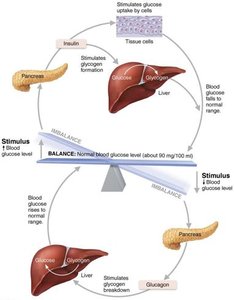
Glucagon and insulin regulate blood glucose levels through negative feedback:
Glucagon: Increases blood glucose by breaking down glycogen in the liver.
Insulin: Decreases blood glucose by promoting uptake into cells and storage as glycogen or fat.
Gonads and Placenta
The gonads (ovaries and testes) and placenta are endocrine organs involved in reproduction:
Ovaries: Produce ova, estrogen, and progesterone; regulate reproductive organ maturation, secondary sex characteristics, and menstrual cycle.
Testes: Produce sperm and testosterone; regulate reproductive organ maturation, secondary sex characteristics, sex drive, and sperm production.
Placenta: Temporary endocrine organ; secretes estrogen, progesterone, and hCG to influence pregnancy.
Summary Table: Major Endocrine Glands and Their Hormones
Gland | Hormone(s) | Main Function |
|---|---|---|
Pituitary (anterior) | GH, TSH, ACTH, FSH, LH, PRO | Growth, metabolism, reproduction |
Pituitary (posterior) | Oxytocin, ADH | Uterine contraction, water balance |
Thyroid | Thyroid hormone, calcitonin | Metabolism, calcium regulation |
Parathyroid | PTH | Calcium regulation |
Adrenal cortex | Aldosterone, cortisol, androgens | Electrolyte balance, stress response, sex hormones |
Adrenal medulla | Epinephrine, norepinephrine | Fight-or-flight response |
Pineal | Melatonin | Sleep-wake cycle |
Pancreas | Insulin, glucagon | Blood glucose regulation |
Ovaries | Estrogen, progesterone | Reproduction, secondary sex characteristics |
Testes | Testosterone | Reproduction, secondary sex characteristics |
Placenta | Estrogen, progesterone, hCG | Pregnancy regulation |
