 Back
BackThe Endocrine System: Structure, Function, and Regulation
Study Guide - Smart Notes
 Tailored notes based on your materials, expanded with key definitions, examples, and context.
The Endocrine System
Overview of the Endocrine System
The endocrine system is a network of glands that secrete hormones directly into the bloodstream to regulate various physiological processes. It works closely with the nervous system to maintain homeostasis, growth, metabolism, and reproduction.
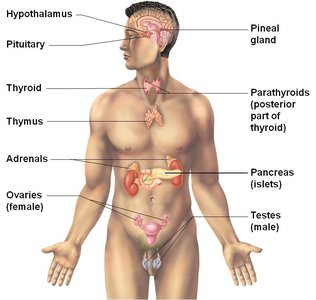
Major endocrine glands: hypothalamus, pituitary, thyroid, parathyroids, adrenals, pancreas (islets), pineal gland, ovaries (female), and testes (male).
Hormones: Chemical messengers that act on target tissues to elicit specific responses.
Nervous vs. Endocrine Systems
The nervous and endocrine systems are the primary means of communication and regulation in the body. They share similarities but also have distinct differences in their modes of action.
Similarities: Both are associated with the brain (e.g., hypothalamus, pineal gland) and can influence each other.
Differences:
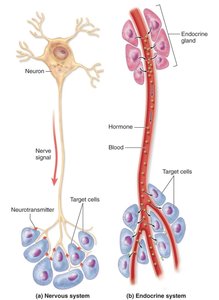
Mode of transport: Nervous system uses axons; endocrine system uses blood.
Speed of response: Nervous system is rapid (milliseconds); endocrine is slower (seconds to days).
Duration of response: Nervous system is short-lived; endocrine is longer-lasting.
Principles of Chemical Communication
Classes of Chemical Messengers
Chemical messengers are classified based on their source and target:
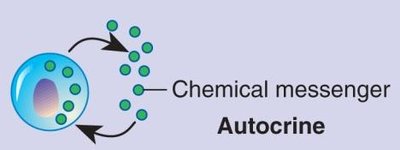
Autocrine: Affect the same cell that secretes them.
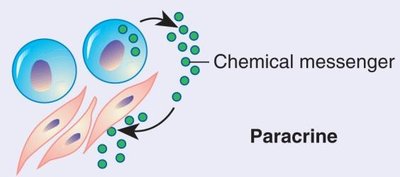
Paracrine: Affect nearby but different cell types.
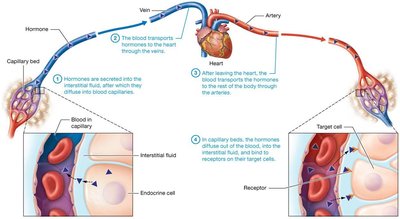
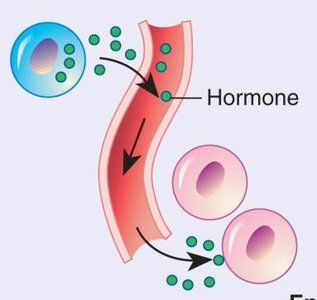
Endocrine: Affect distant cells via the bloodstream.
Neurotransmitters: Released by neurons into synaptic clefts to affect postsynaptic cells.
Functions of the Endocrine System
The endocrine system regulates essential body functions:
Development, growth, and metabolism
Blood composition and volume
Digestion
Reproduction
Control of Hormone Secretion
Regulation Mechanisms
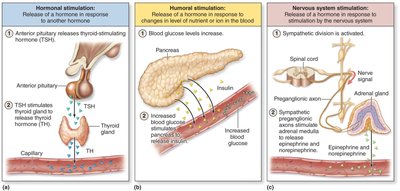
Hormone secretion is typically regulated by negative feedback and can be controlled by:
Hormonal control: One hormone stimulates the release of another (e.g., TSH stimulates thyroid hormones).
Neural control: Nervous system directly stimulates hormone release.
Humoral control: Changes in blood levels of ions or nutrients trigger hormone release (e.g., glucose stimulates insulin).
Patterns of Hormone Secretion
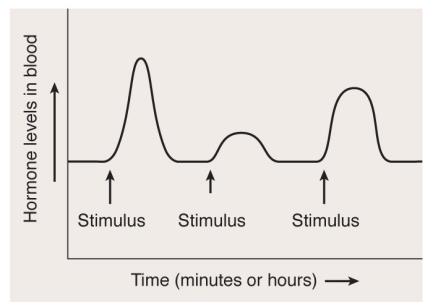
Chronic: Relatively constant levels (e.g., thyroid hormone).
Acute: Dramatic changes in response to stimuli (e.g., epinephrine).
Episodic (Cyclic): Regular intervals (e.g., reproductive hormones).
Hormone Chemistry and Transport
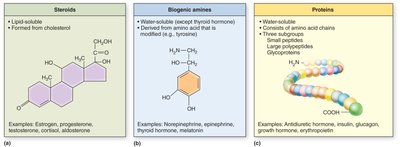
Types of Hormones
Steroids: Lipid-soluble, derived from cholesterol (e.g., estrogen, cortisol).
Biogenic amines: Modified amino acids (e.g., norepinephrine, thyroid hormone).
Proteins: Water-soluble, chains of amino acids (e.g., insulin, growth hormone).
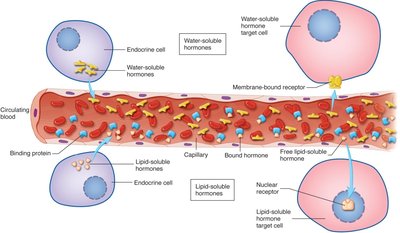
Hormone Transport in Blood
Lipid-soluble hormones: Require transport proteins in blood; only free hormones are active.
Water-soluble hormones: Circulate freely in plasma; act directly on target cells.
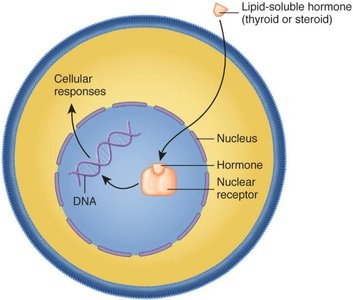
Hormone Action Mechanisms
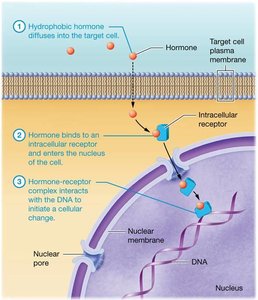
Lipid-Soluble Hormones
Lipid-soluble hormones diffuse through cell membranes and bind to intracellular receptors, forming a hormone-receptor complex that regulates gene expression.
Examples: testosterone, estrogen, progesterone, thyroid hormones
Effects: Induce transcription and translation of new proteins; effects are slower but longer-lasting.
Water-Soluble Hormones
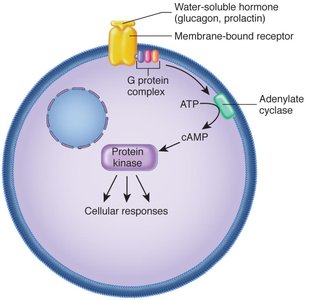
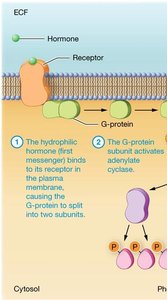
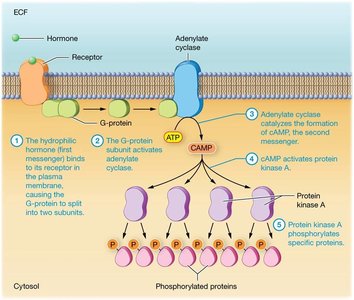
Water-soluble hormones bind to membrane-bound receptors, activating second messenger systems (e.g., cAMP) via G-proteins, leading to rapid cellular responses.
Examples: insulin, glucagon, antidiuretic hormone
Effects: Activate or inhibit enzymes, open ion channels, or initiate other signaling cascades.
Signal Amplification
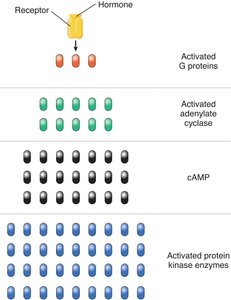
Signal amplification allows a small amount of hormone to produce a large cellular response, providing multiple points for regulation and fine-tuning.
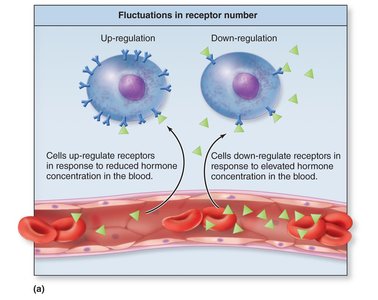
Regulation of Receptor Number
The number of hormone receptors on target cells can change, affecting sensitivity:
Up-regulation: Increased receptor number increases sensitivity (often when hormone levels are low).
Down-regulation: Decreased receptor number decreases sensitivity (often when hormone levels are high).
Major Endocrine Glands and Their Hormones
Hypothalamus and Pituitary Gland
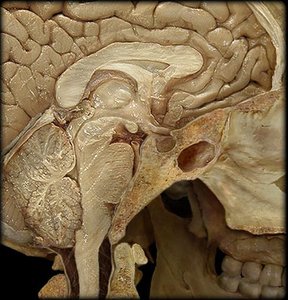
The hypothalamus and pituitary gland are central to endocrine regulation. The hypothalamus controls the pituitary via the infundibulum, and the pituitary regulates other endocrine glands.
Anterior pituitary (adenohypophysis): Secretes hormones like GH, TSH, ACTH, LH, FSH, and prolactin.
Posterior pituitary (neurohypophysis): Releases ADH and oxytocin produced by the hypothalamus.
Thyroid and Parathyroid Glands
The thyroid gland produces thyroxine (T3 and T4) to regulate metabolism and calcitonin to lower blood calcium. The parathyroid glands secrete parathyroid hormone (PTH) to increase blood calcium.
Thyroxine: Increases metabolic rate, protein synthesis, and is essential for growth.
Calcitonin: Decreases blood calcium by inhibiting osteoclasts.
PTH: Increases blood calcium by stimulating osteoclasts, increasing intestinal absorption, and reducing urinary loss.
Adrenal Glands
The adrenal glands consist of the cortex (producing corticosteroids) and medulla (producing catecholamines).
Adrenal cortex:
Mineralocorticoids (aldosterone): Regulate sodium and potassium balance.
Glucocorticoids (cortisol): Regulate metabolism, stress response, and inflammation.
Androgens: Contribute to secondary sex characteristics.
Adrenal medulla: Secretes epinephrine and norepinephrine for fight-or-flight response.
Pancreas
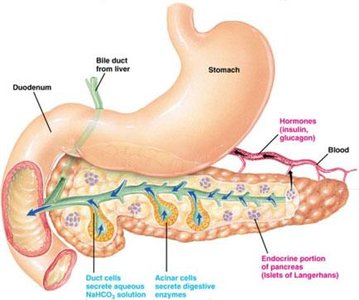
The pancreas has both exocrine (digestive enzymes) and endocrine (hormones) functions. The islets of Langerhans contain alpha cells (glucagon) and beta cells (insulin).
Insulin: Lowers blood glucose by promoting cellular uptake and storage.
Glucagon: Raises blood glucose by stimulating glycogen breakdown and gluconeogenesis.
Pineal Gland and Other Endocrine Organs
Pineal gland: Produces melatonin, regulating circadian rhythms.
Thymus: Secretes thymic hormones for T-cell maturation.
Heart: Secretes atrial natriuretic peptide (ANP) to lower blood pressure.
Kidney: Releases erythropoietin (EPO) to stimulate red blood cell production.
Gonads: Ovaries secrete estrogen and progesterone; testes secrete testosterone.
Clinical Correlations
Disorders of Endocrine Function
Growth hormone disorders: Dwarfism (deficiency), gigantism (excess in children), acromegaly (excess in adults).
Thyroid disorders: Hyperthyroidism (excess TH), hypothyroidism (deficiency), goiter (enlarged thyroid due to iodine deficiency).
Adrenal disorders: Cushing syndrome (excess cortisol), Addison disease (cortisol deficiency).
Pancreatic disorders: Diabetes mellitus (type 1, type 2, gestational), hypoglycemia (low blood glucose).
Summary Table: Major Endocrine Glands and Hormones
Gland | Hormone(s) | Main Function(s) |
|---|---|---|
Pituitary (anterior) | GH, TSH, ACTH, LH, FSH, PRL | Growth, metabolism, stress, reproduction, lactation |
Pituitary (posterior) | ADH, Oxytocin | Water balance, uterine contraction, milk ejection |
Thyroid | T3, T4, Calcitonin | Metabolism, calcium regulation |
Parathyroid | PTH | Calcium and phosphate regulation |
Adrenal cortex | Aldosterone, Cortisol, Androgens | Electrolyte balance, stress response, sex traits |
Adrenal medulla | Epinephrine, Norepinephrine | Fight-or-flight response |
Pancreas | Insulin, Glucagon | Blood glucose regulation |
Pineal | Melatonin | Circadian rhythms |
Gonads | Estrogen, Progesterone, Testosterone | Reproduction, secondary sex characteristics |
