 Back
BackThe Endocrine System: Structure, Function, and Regulation
Study Guide - Smart Notes
 Tailored notes based on your materials, expanded with key definitions, examples, and context.
The Endocrine System
Overview of the Endocrine System
The endocrine system is a network of ductless glands and specialized cells that synthesize and secrete hormones directly into the bloodstream. These hormones regulate and coordinate physiological processes such as growth, metabolism, reproduction, and homeostasis. Unlike the nervous system, which uses electrical signals and neurotransmitters for rapid, short-term responses, the endocrine system uses hormones for slower but longer-lasting effects.
Hormones: Chemical messengers produced by glands, released into the bloodstream to target organs or cells, influencing body functions such as growth, energy use, and stress response.
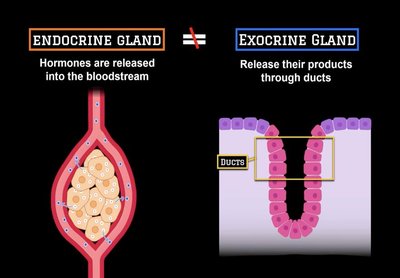
Endocrine glands: Ductless glands that release hormones into the blood (e.g., pituitary, thyroid, parathyroid, adrenal, pineal glands).
Exocrine glands: Glands with ducts that release nonhormonal substances (e.g., sweat, saliva) to a surface.
Neuroendocrine organ: The hypothalamus, which links the nervous and endocrine systems.
Other hormone-producing organs: Pancreas, gonads, placenta, stomach, intestine, heart, kidneys, skin, thymus, bone, adipose tissue.
Major Processes Controlled by the Endocrine System
Reproduction
Growth and development
Maintenance of electrolyte, water, and nutrient balance
Regulation of cellular metabolism and energy balance
Mobilization of body defenses
Endocrine vs. Nervous System
Endocrine system: Slow to initiate, long-lasting, uses hormones, acts at diffuse locations, signal strength coded by hormone concentration.
Nervous system: Rapid, short-duration, uses action potentials and neurotransmitters, acts at specific locations, signal strength coded by action potential frequency.
Location of Major Endocrine Organs
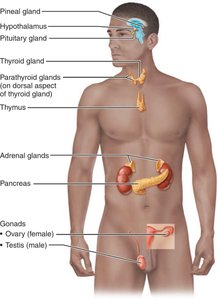
Endocrine glands are distributed throughout the body, with major glands including the pituitary, thyroid, parathyroid, adrenal, and pineal glands. Other organs such as the pancreas, gonads, and placenta also have endocrine functions.
Chemical Messengers: Hormones, Autocrines, and Paracrines
Types of Chemical Messengers
Hormones: Long-distance chemical signals that travel in blood or lymph to target cells.
Autocrines: Chemicals that exert effects on the same cells that secrete them (e.g., immune cells).
Paracrines: Locally acting chemicals that affect neighboring cells (e.g., histamine).
Autocrines and paracrines are local messengers and are not considered part of the endocrine system.
Chemical Structure of Hormones
Main Classes of Hormones
Amino acid–based hormones: Includes amines (e.g., catecholamines like epinephrine, norepinephrine, dopamine), peptides, and proteins. Most are water-soluble and cannot cross the plasma membrane.
Steroid hormones: Synthesized from cholesterol, lipid-soluble, can cross the plasma membrane (e.g., gonadal and adrenocortical hormones).
Eicosanoids: Sometimes considered hormones, but mostly act as local paracrine or autocrine signals.
Hormone Action Mechanisms
Water-soluble hormones: Act on plasma membrane receptors, usually via G proteins and second messengers (cannot enter cells).
Lipid-soluble hormones: Act on intracellular receptors that directly activate genes (can enter cells).
Regulation of Hormone Release
Types of Endocrine Gland Stimuli
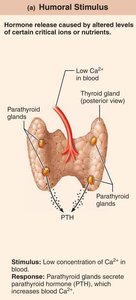
Humoral stimuli: Changing blood levels of ions or nutrients directly stimulate hormone release (e.g., low blood Ca2+ stimulates parathyroid hormone release).
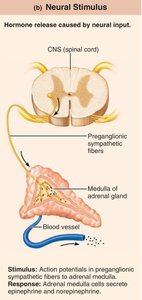
Neural stimuli: Nerve fibers stimulate hormone release (e.g., sympathetic nervous system stimulates adrenal medulla to secrete catecholamines).
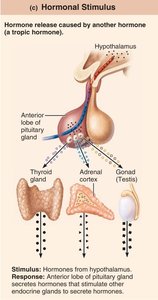
Hormonal stimuli: Hormones stimulate other endocrine organs to release their hormones (e.g., hypothalamic hormones regulate anterior pituitary hormones).
Nervous System Modulation
The nervous system can override or modify endocrine controls, especially during stress (e.g., fight-or-flight response).
Hormone Activity and Target Cell Specificity
Target Cell Activation
Target cells must have specific receptors for a hormone to respond.
Degree of activation depends on blood hormone levels, number of receptors, and receptor affinity.
Up-regulation: Target cells form more receptors in response to low hormone levels.
Down-regulation: Target cells lose receptors in response to high hormone levels.
Hormone Half-Life, Onset, and Duration
Hormones circulate either free or bound to plasma proteins (steroids and thyroid hormone are bound; others are free).
Half-life: Time required for hormone level in blood to decrease by half.
Onset and duration of hormone action vary by hormone type (water-soluble vs. lipid-soluble).
Comparison of Lipid- and Water-Soluble Hormones
Lipid-soluble hormones | Water-soluble hormones | |
|---|---|---|
Consist of | All steroid hormones and thyroid hormone | All amino acid–based hormones except thyroid hormone |
Sources | Adrenal cortex, gonads, thyroid gland | All other endocrine glands |
Stored in secretory vesicles | No | Yes |
Transport in blood | Bound to plasma proteins | Usually free in plasma |
Half-life in blood | Long (metabolized by liver) | Short (removed by kidneys) |
Location of receptors | Usually inside cell | On plasma membrane |
Mechanism of action | Activate genes, causing synthesis of new proteins | Usually act through second-messenger systems |
Hormone Interactions at Target Cells
Permissiveness: One hormone cannot exert its effects without another hormone present (e.g., reproductive hormones need thyroid hormone).
Synergism: More than one hormone produces the same effects, amplifying the response (e.g., glucagon and epinephrine).
Antagonism: One or more hormones oppose the action of another (e.g., insulin and glucagon).
The Hypothalamus and Pituitary Gland
Hypothalamus
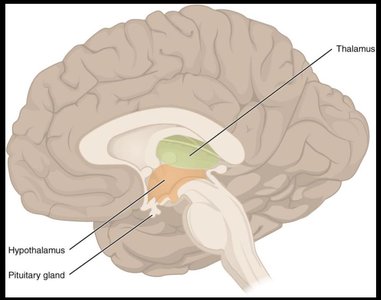
The hypothalamus is located below the thalamus and sits directly above the pituitary gland, connected by the infundibulum. It acts as a link between the nervous and endocrine systems, producing tropic hormones that regulate the pituitary gland.
Pituitary Gland (Hypophysis)
Connected to the hypothalamus via the infundibulum.
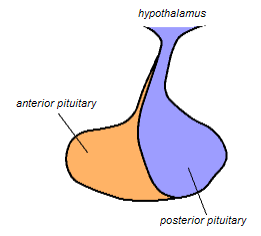
Two major lobes: posterior pituitary (neural tissue, stores and releases hormones made by hypothalamus) and anterior pituitary (glandular tissue, produces and releases its own hormones).
Posterior Pituitary and Hypothalamic Hormones
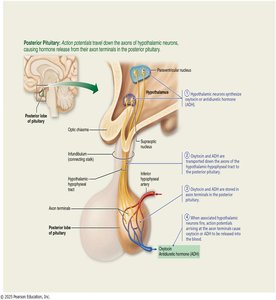
Oxytocin: Stimulates uterine contractions during labor and milk ejection during breastfeeding; regulated by positive feedback.
Antidiuretic hormone (ADH, vasopressin): Promotes water reabsorption in kidneys, reducing urine output; secretion triggered by high blood osmolarity, pain, low blood pressure, and inhibited by alcohol.
Anterior Pituitary Hormones
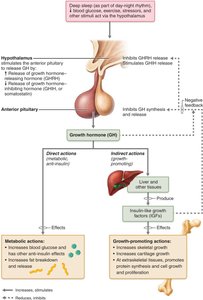
Growth hormone (GH): Stimulates growth and metabolism; direct actions increase blood glucose and fatty acids, indirect actions via IGFs stimulate cell growth and division.
Thyroid-stimulating hormone (TSH): Stimulates thyroid gland to release thyroid hormones.
Adrenocorticotropic hormone (ACTH): Stimulates adrenal cortex to release corticosteroids.
Follicle-stimulating hormone (FSH) and Luteinizing hormone (LH): Regulate gonadal function and hormone production.
Prolactin (PRL): Stimulates milk production in females.
The Thyroid and Parathyroid Glands
Thyroid Gland
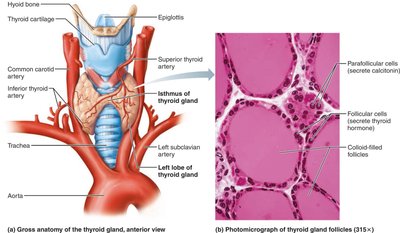
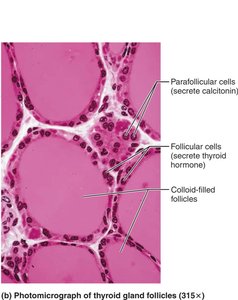
The thyroid gland is a butterfly-shaped organ located on the anterior trachea, just below the larynx. It consists of follicles that produce thyroglobulin, which is used to synthesize thyroid hormone (TH: T3 and T4), and parafollicular cells that produce calcitonin.
Thyroid Hormone (TH)
Major metabolic hormone, increases basal metabolic rate, heat production, and regulates tissue growth and development.
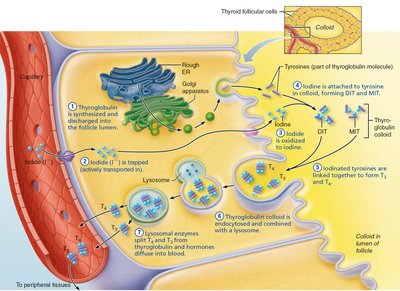
TH is synthesized from thyroglobulin and iodine in a multi-step process and stored in the colloid of follicles.
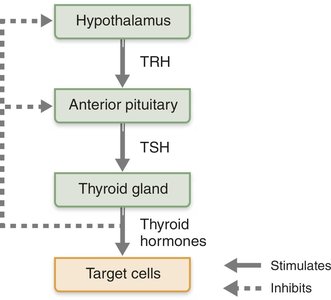
TH release is regulated by negative feedback involving TRH (hypothalamus) and TSH (anterior pituitary).
Thyroid Disorders
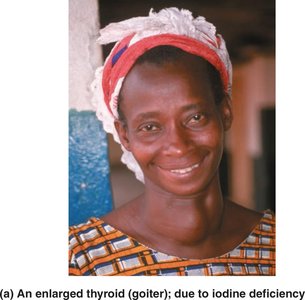
Hypothyroidism (e.g., myxedema, goiter): Low metabolic rate, weight gain, cold intolerance, mental sluggishness.
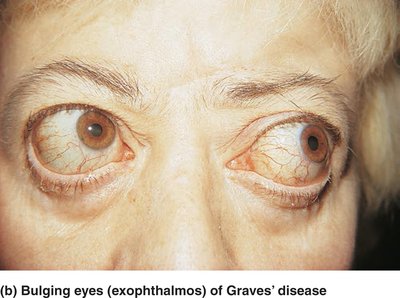
Hyperthyroidism (e.g., Graves' disease): High metabolic rate, weight loss, heat intolerance, nervousness, exophthalmos (bulging eyes).
Calcitonin
Produced by parafollicular (C) cells in response to high blood Ca2+ levels.
Inhibits osteoclast activity, stimulates Ca2+ uptake into bone matrix (bone-sparing effect at high doses).
Parathyroid Glands
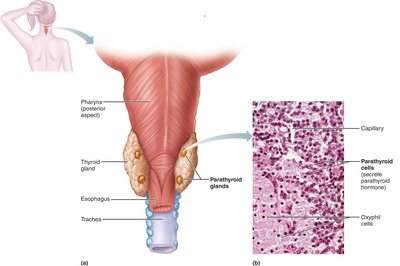
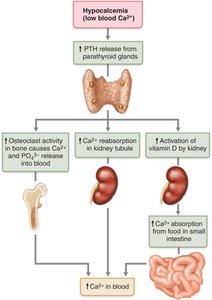
Four small glands embedded in the posterior thyroid; secrete parathyroid hormone (PTH), the most important regulator of blood Ca2+ levels.
PTH increases blood Ca2+ by stimulating osteoclasts, enhancing kidney reabsorption of Ca2+, and activating vitamin D to increase intestinal absorption of Ca2+.
The Adrenal Glands
Structure and Function
The adrenal glands are pyramid-shaped organs atop the kidneys, consisting of the adrenal cortex (outer, glandular) and adrenal medulla (inner, nervous tissue).
Adrenal cortex: Produces corticosteroids (mineralocorticoids, glucocorticoids, gonadocorticoids).
Adrenal medulla: Produces catecholamines (epinephrine and norepinephrine) for the fight-or-flight response.
Adrenal Cortex Hormones
Mineralocorticoids (e.g., aldosterone): Regulate Na+ and K+ balance, blood volume, and pressure.
Glucocorticoids (e.g., cortisol): Regulate metabolism, stress response, and immune function.
Gonadocorticoids (e.g., androgens): Contribute to secondary sex characteristics and libido.
Adrenal Medulla Hormones
Catecholamines (epinephrine, norepinephrine): Increase heart rate, blood pressure, blood glucose, and divert blood to essential organs during stress.
The Pineal Gland
Melatonin Secretion
Located in the diencephalon, the pineal gland secretes melatonin, which regulates sleep-wake cycles and may have antioxidant and antigonadotropic effects.
The Pancreas and Gonads
Pancreas
Mixed gland with exocrine (digestive enzymes) and endocrine (hormones) functions.
Alpha cells: Produce glucagon (raises blood glucose).
Beta cells: Produce insulin (lowers blood glucose).
Gonads
Ovaries: Produce estrogens and progesterone, regulating female reproductive development and cycles.
Testes: Produce testosterone, regulating male reproductive development and function.
Clinical Correlations
Diabetes insipidus: ADH deficiency, causing excessive thirst and urination.
SIADH: Excess ADH, causing fluid retention and hyponatremia.
Gigantism/acromegaly: Excess GH in children/adults, causing abnormal growth.
Pituitary dwarfism: GH deficiency in children, causing short stature.
Myxedema/goiter: Hypothyroidism, often due to iodine deficiency.
Graves' disease: Hyperthyroidism, autoimmune stimulation of the thyroid.
Hyperparathyroidism: Excess PTH, bone demineralization, kidney stones.
Hypoparathyroidism: Low PTH, tetany, convulsions.
