 Back
BackThe Endocrine System: Structure, Function, and Major Hormones
Study Guide - Smart Notes
 Tailored notes based on your materials, expanded with key definitions, examples, and context.
Introduction to the Endocrine System
Types of Chemical Messengers
The endocrine system uses chemical messengers called hormones to regulate body functions. These messengers are released by endocrine glands and travel through the bloodstream to target cells. There are two main parts of any chemical signal:
Chemical messenger: The hormone itself, secreted by endocrine cells.
Receptor: A protein on or in the target cell that binds the hormone and initiates a response.
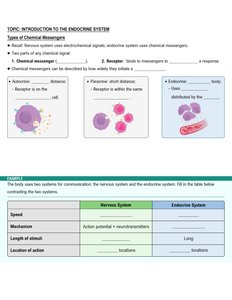
Hormones can act in different ways:
Autocrine: Acts on the same cell that secreted it.
Paracrine: Acts on nearby cells.
Endocrine: Hormones are distributed by the blood to distant target cells.
Comparison: Nervous System vs. Endocrine System
The nervous and endocrine systems both coordinate body functions but differ in their mechanisms and effects.
Nervous System | Endocrine System | |
|---|---|---|
Speed | Fast | Slow |
Mechanism | Action potentials / neurotransmitters | Hormones |
Length of signal | Short | Long |
Location of action | Localized | Widespread |
Components of the Endocrine System
Major Endocrine Glands and Functions
The endocrine system is composed of glands that secrete hormones into the bloodstream. These hormones regulate various physiological processes.
Glands: Specialized for secretion of hormones.
Endocrine glands: Pituitary, thyroid, parathyroid, adrenal, pineal, pancreas, gonads (ovaries and testes).
Target cells: Cells with specific receptors for a hormone.
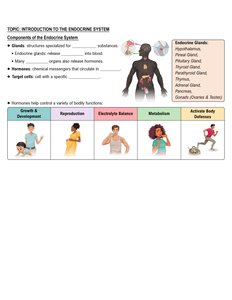
Hormones help control:
Growth & Development
Reproduction
Electrolyte Balance
Metabolism
Body Defenses
Examples of Hormones and Their Functions
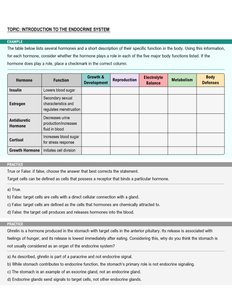
Hormone | Function | Growth & Development | Reproduction | Electrolyte Balance | Metabolism | Body Defenses |
|---|---|---|---|---|---|---|
Insulin | Lowers blood sugar | X | ||||
Estrogen | Regulates female reproductive system | X | X | |||
Antidiuretic Hormone | Reduces urine output | X | ||||
Adrenaline | Increases blood sugar, heart rate | X | X | |||
Cortisol | Stress hormone | X | X | |||
Growth Hormone | Stimulates growth | X |
Hormones: Structure and Classification
Types of Hormones
Hormones are classified based on their chemical structure and solubility:
Amino acid-based hormones: Water-soluble, cannot cross cell membranes easily, bind to receptors on the cell surface (e.g., insulin, epinephrine).
Steroid hormones: Lipid-soluble, derived from cholesterol, can cross cell membranes and bind to intracellular receptors (e.g., cortisol, estrogen).
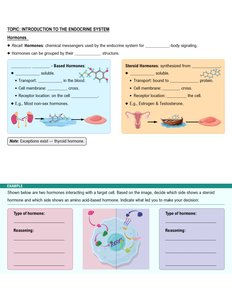
Transport: Steroid hormones require transport proteins in the blood due to their low solubility in water.
Hormone Receptors and Signal Transduction
Membrane-Bound Receptors and Secondary Messengers
Many hormones act through membrane-bound receptors, often using secondary messengers to amplify the signal inside the cell. A common example is the G protein-coupled receptor (GPCR) pathway using cyclic AMP (cAMP) as a second messenger.
Signaling cascade: A series of molecular events triggered by hormone binding, leading to a cellular response.
Amplification: One hormone molecule can activate many secondary messengers, amplifying the response.
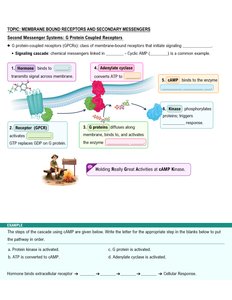
Key steps in the cAMP pathway:
Hormone binds to GPCR.
G protein activates adenylate cyclase.
Adenylate cyclase converts ATP to cAMP.
cAMP activates protein kinases, leading to cellular responses.
Other Secondary Messenger Systems
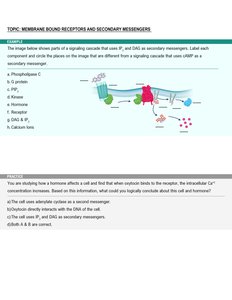
Other secondary messengers include IP3 (inositol trisphosphate), DAG (diacylglycerol), and Ca2+ ions. These pathways can trigger different cellular responses depending on the hormone and target cell.
Intracellular Receptors and Direct Gene Action
Steroid Hormone Mechanism
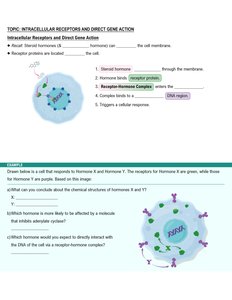
Steroid hormones and thyroid hormones can cross the cell membrane and bind to intracellular receptors. The hormone-receptor complex then binds to DNA, directly influencing gene expression and protein synthesis.
Hormone enters cell and binds to receptor protein in cytoplasm or nucleus.
Hormone-receptor complex binds to DNA at specific regions.
Triggers transcription of target genes, leading to protein synthesis.
The Hypothalamus and Pituitary Gland
Integration of Nervous and Endocrine Systems
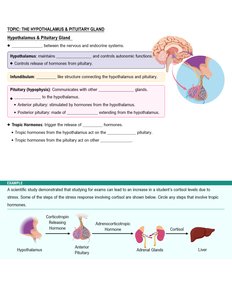
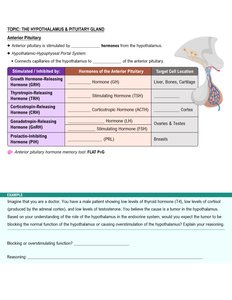
The hypothalamus links the nervous and endocrine systems, controlling the release of hormones from the pituitary gland. The pituitary gland is divided into anterior and posterior lobes, each with distinct functions and hormone products.
Anterior pituitary: Releases hormones in response to hypothalamic releasing or inhibiting hormones.
Posterior pituitary: Stores and releases hormones produced by the hypothalamus (e.g., ADH, oxytocin).
Major Hormones of the Pituitary Gland
Hormone | Target | Main Function |
|---|---|---|
Growth Hormone (GH) | Liver, bones, cartilage | Stimulates growth |
Thyroid-Stimulating Hormone (TSH) | Thyroid gland | Stimulates thyroid hormone release |
Adrenocorticotropic Hormone (ACTH) | Adrenal cortex | Stimulates cortisol release |
Follicle-Stimulating Hormone (FSH) | Ovaries, testes | Stimulates gamete production |
Luteinizing Hormone (LH) | Ovaries, testes | Stimulates sex hormone production |
Prolactin (PRL) | Breasts | Stimulates milk production |
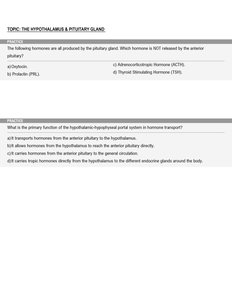
Antidiuretic Hormone (ADH) | Kidneys | Reduces urine output |
Oxytocin | Uterus, breasts | Stimulates uterine contractions and milk ejection |
Review of Major Hormones and Glands
Summary Table of Major Endocrine Glands and Hormones
Gland | Hormones | Main Functions |
|---|---|---|
Anterior Pituitary | GH, TSH, ACTH, FSH, LH, PRL | Growth, metabolism, stress, reproduction |
Posterior Pituitary | ADH, Oxytocin | Water balance, childbirth, lactation |
Thyroid & Parathyroid | T3, T4, Calcitonin, PTH | Metabolism, calcium balance |
Pancreas | Insulin, Glucagon | Blood glucose regulation |
Adrenal Glands | Epinephrine, Norepinephrine, Cortisol, Aldosterone | Stress response, electrolyte balance |
Pineal Gland | Melatonin | Regulates circadian rhythms |
Gonads | Estrogen, Progesterone, Testosterone | Sex hormone production, reproduction |
Key Concepts and Applications
Hormones regulate nearly every major physiological process in the body.
Disorders of the endocrine system can lead to significant health problems, such as diabetes, thyroid disease, and growth disorders.
Understanding hormone pathways is essential for diagnosing and treating endocrine diseases.
Additional info: This guide covers the foundational concepts of the endocrine system, including hormone classification, mechanisms of action, and the roles of major glands and hormones. For more advanced study, refer to clinical correlations and regulatory feedback mechanisms.
