 Back
BackThe Endocrine System: Structure, Function, and Disorders
Study Guide - Smart Notes
 Tailored notes based on your materials, expanded with key definitions, examples, and context.
The Endocrine System
Overview and Functions
The endocrine system is a major regulatory system of the body, working closely with the nervous system to maintain homeostasis. It is composed of ductless glands that secrete hormones directly into the interstitial fluid and bloodstream, affecting target tissues throughout the body. - Key Point 1: Endocrine glands release hormones that regulate body processes such as growth, metabolism, and reproduction. - Key Point 2: Hormonal effects are typically slower to initiate but last longer than nervous system responses. - Example: Hormones may take seconds to days to act, but their effects can persist for weeks or months. 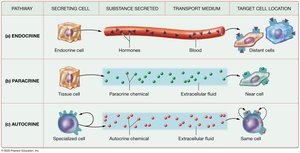
Nervous vs. Endocrine System
The nervous and endocrine systems both regulate physiological processes, but they differ in their mechanisms and speed of action. - Nervous System: Uses nerve impulses and neurotransmitters for rapid, brief, and targeted responses. - Endocrine System: Uses hormones as mediator molecules, which are released in one part of the body and regulate activity in distant cells; responses are slower, longer-lasting, and have broader influence.
Hormone Types and Signaling
Paracrine and Autocrine Signaling
Hormones can act in different ways depending on their target: - Paracrine: Act on neighboring cells (e.g., histamine, neurotransmitters like acetylcholine and epinephrine). - Autocrine: Act on the same cell that secreted them (e.g., WBCs, interleukin-1, prostaglandins).
Major Endocrine Glands
Locations and Functions
The major endocrine glands include the pituitary, hypothalamus, thyroid, parathyroid, pineal, adrenal glands, pancreas, and gonads (ovaries and testes). Each gland produces specific hormones that regulate various body functions. 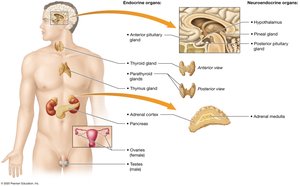
Hypothalamus and Pituitary Gland
Structure and Connection
The pituitary gland (hypophysis) lies inferior to the hypothalamus and is connected by the infundibulum. It is partitioned into anterior and posterior lobes and is located in the hypophyseal fossa of the sphenoid bone. 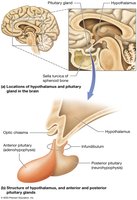
Hormones and Target Organs
The anterior pituitary secretes tropic hormones that regulate other glands, as well as hormones that act on body cells. - Tropic Hormones: TSH (thyroid stimulating hormone), FSH (follicle stimulating hormone), LH (luteinizing hormone), ACTH (adrenocorticotropic hormone) - Other Hormones: GH (growth hormone), PRL (prolactin) 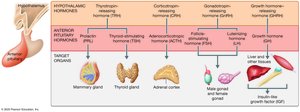
Regulation of Hormone Secretion
Hormone secretion is regulated by negative feedback loops, ensuring homeostasis. 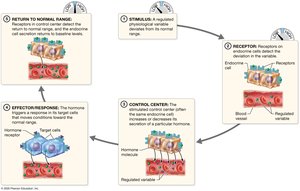
Regulation and Effects of Growth Hormone
Growth hormone (GH) is regulated by hypothalamic hormones and acts on various tissues to stimulate growth and metabolism. 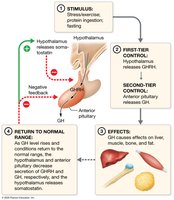
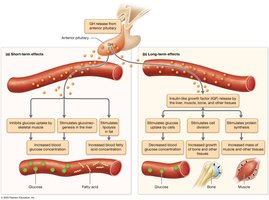
Posterior Pituitary (Neurohypophysis)
The posterior pituitary is composed of nervous tissue and stores hormones produced by the hypothalamus, releasing antidiuretic hormone (ADH) and oxytocin (OT). 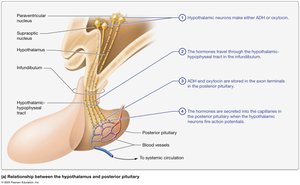
Antidiuretic Hormone (ADH)
ADH targets the kidneys to resorb water, reduce urine volume, and increase blood pressure. 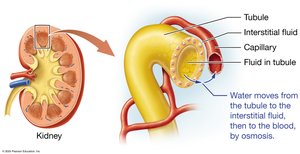
Classes of Hormones
Lipid-Soluble vs. Water-Soluble Hormones
- Lipid-Soluble Hormones: Use transport proteins; include steroids (testosterone, estrogen), thyroid hormones, prostaglandins, nitric oxide. - Water-Soluble Hormones: Circulate in free form; include amine hormones (norepinephrine, epinephrine), peptide/protein hormones (insulin, hGH, ADH), eicosanoids (prostaglandins, leukotrienes). 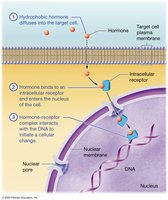
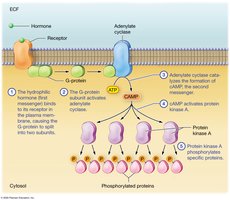
Mechanism of Hormone Action
- Lipid-soluble hormones: Bind to intracellular receptors and directly affect gene transcription. - Water-soluble hormones: Bind to membrane receptors and activate second messenger systems, amplifying the signal. - Responsiveness: Depends on hormone concentration, receptor abundance, and influence of other hormones (permissive, synergistic, antagonistic effects).
Thyroid and Parathyroid Glands
Anatomy and Histology of Thyroid Gland
The thyroid gland is the largest endocrine gland, butterfly-shaped, highly vascularized, and controls metabolism. It produces thyroid hormone and calcitonin. 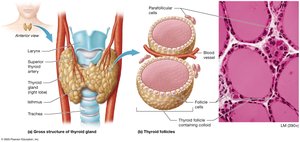
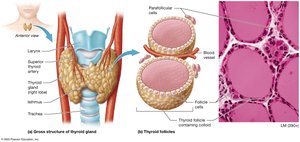
Thyroid Hormones
- T3 (Triiodothyronine): Contains three iodine atoms. - T4 (Thyroxine): Contains four iodine atoms. - Calcitonin: Lowers blood Ca2+ by inhibiting bone resorption.
Effects of Thyroid Hormone
- Regulates metabolic rate and thermoregulation. - Sets basal metabolic rate (BMR). - Increases ATP synthesis, requires Na+/K+ pump. - Stimulates gluconeogenesis, protein breakdown, and fat breakdown.
Thyroid Disorders
- Hyperthyroidism: Overproduction of thyroid hormones (e.g., Grave’s disease). - Hypothyroidism: Underproduction of thyroid hormones (e.g., Hashimoto thyroiditis, Cretinism). 
Parathyroid Glands
Chief cells produce parathyroid hormone (PTH), which regulates calcium, magnesium, and phosphate ions in the blood. PTH increases osteoclast activity and bone resorption. 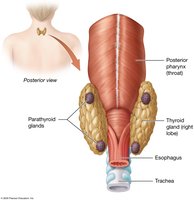
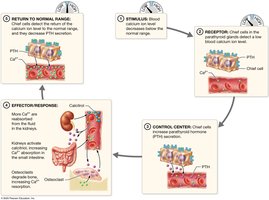
Adrenal Glands
Anatomy and Function
The adrenal glands are paired, pyramid-shaped organs located on the superior surface of each kidney. They consist of an outer cortex and inner medulla, each secreting different hormones. 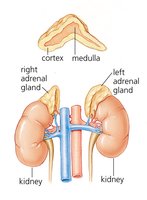
Adrenal Cortex and Medulla
- Adrenal Cortex: Synthesizes corticosteroids; divided into three regions: zona glomerulosa (aldosterone), zona fasciculata (glucocorticoids), zona reticularis (androgens). - Adrenal Medulla: Secretes epinephrine and norepinephrine for fight-or-flight response. 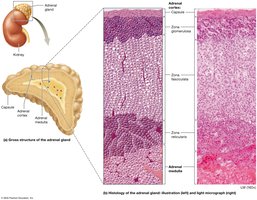
Adrenal Disorders
- Cushing’s Syndrome: Hypersecretion of glucocorticoids, often due to pituitary tumor; causes fat deposits, hyperglycemia, weight gain, and increased blood pressure. 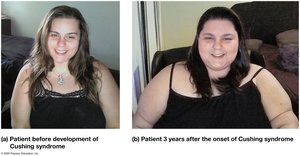 - Addison Disease: Hyposecretion of glucocorticoids and aldosterone; disrupts fluid, electrolyte, and acid-base homeostasis.
Pancreas
Structure and Function
The pancreas is a mixed gland with both exocrine (acinar cells produce digestive enzymes) and endocrine (islets of Langerhans secrete hormones) functions. 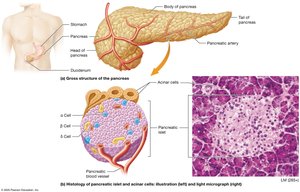
Pancreatic Islets and Hormones
- Alpha cells: Secrete glucagon (raises blood sugar). - Beta cells: Secrete insulin (lowers blood sugar). - Delta cells: Secrete somatostatin (inhibits insulin and glucagon). - F cells: Secrete pancreatic polypeptide.
Regulation of Glucagon and Insulin
Glucagon and insulin are regulated by negative feedback mechanisms to maintain blood glucose homeostasis. 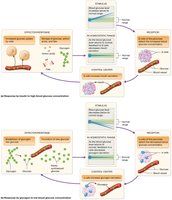
Pancreatic Disorders
- Diabetes Mellitus: Inability to produce or use insulin; Type I (absolute deficiency), Type II (insulin resistance). - Hyperglycemia: Elevated blood glucose due to insufficient insulin or decreased sensitivity. - Hypoglycemia: Low blood glucose, often caused by excess insulin.
Other Endocrine Glands
Pineal Gland
Secretes melatonin, regulates circadian rhythm, and may influence reproductive hormone synthesis.
Ovaries
- Estrogen: Stimulates development of female reproductive organs, follicle maturation, menstrual cycle regulation, and mammary gland growth. - Progesterone: Regulates menstrual cycle, uterine lining growth, and mammary gland development. - Inhibin: Inhibits FSH secretion. 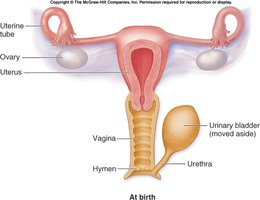
Testes
- Androgens (testosterone): Stimulate male reproductive organ development and sperm production. - Inhibin: Inhibits FSH secretion. 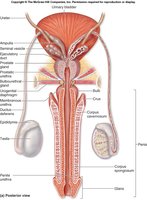
Thymus
Produces thymosin and other factors involved in T cell maturation; large in infants and children, diminishes with age. 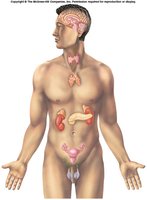
Paraneoplastic Syndrome
Some cancer cells produce hormones, causing symptoms known as paraneoplastic syndrome. These symptoms often precede other cancer symptoms and may include fluid, calcium, and sodium imbalances.
Summary Table: Major Endocrine Glands and Their Hormones
Gland | Main Hormones | Primary Functions |
|---|---|---|
Pituitary | TSH, FSH, LH, ACTH, GH, PRL, ADH, OT | Regulates other glands, growth, water balance, reproduction |
Thyroid | T3, T4, Calcitonin | Metabolism, calcium regulation |
Parathyroid | PTH | Calcium, magnesium, phosphate regulation |
Adrenal | Aldosterone, cortisol, androgens, epinephrine, norepinephrine | Electrolyte balance, stress response, metabolism |
Pancreas | Insulin, glucagon, somatostatin | Blood glucose regulation |
Pineal | Melatonin | Circadian rhythm |
Ovaries | Estrogen, progesterone, inhibin | Reproduction, menstrual cycle |
Testes | Testosterone, inhibin | Reproduction, sperm production |
Thymus | Thymosin, THF, TF, thymopoietin | T cell maturation |
Key Equations
Feedback Regulation Example
Glucose Regulation
Additional info:
Some explanations and context were expanded for clarity and completeness, including definitions, examples, and summary tables.
