 Back
The Endocrine System: Structure, Function, and Hormonal Regulation
Study Guide - Smart Notes
 Tailored notes based on your materials, expanded with key definitions, examples, and context.
The Endocrine System
Overview and Functions
The endocrine system is a collection of ductless glands that secrete hormones directly into the bloodstream. These hormones act as chemical messengers, regulating various physiological processes throughout the body. The endocrine system works closely with the nervous system to maintain homeostasis and coordinate body functions.
Endocrinology: The scientific study of hormones and endocrine glands.
Endocrine glands are widely distributed and include both pure endocrine organs and organs with endocrine cells.
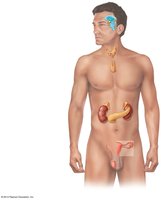
Major Endocrine Organs
Pure endocrine organs: Pituitary gland, pineal gland, thyroid gland, parathyroid glands, adrenal glands (cortex and medulla).
Organs with large proportions of endocrine cells: Pancreas, thymus, gonads (ovaries and testes), hypothalamus (a neuroendocrine organ).
Other organs with some endocrine cells: Heart, digestive tract, kidneys, skin.
Hormones: Classes and Actions
Types of Hormones
Amino acid–based hormones: Derived from amino acids, peptides, or proteins.
Steroid hormones: Derived from cholesterol.
Hormones circulate in the blood but only affect target cells that have specific receptors. The same hormone can have different effects on different target cells.
Control of Hormone Secretion
Types of Stimuli
Hormone secretion is regulated by three main types of stimuli:
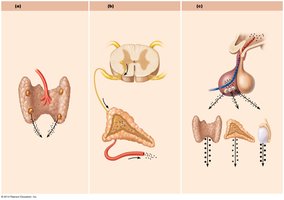
Humoral stimulus: Changes in blood levels of ions or nutrients trigger hormone release (e.g., low blood calcium stimulates parathyroid hormone release).
Neural stimulus: Nerve fibers stimulate hormone release (e.g., sympathetic nerves stimulate adrenal medulla to release epinephrine).
Hormonal stimulus: Hormones from one gland stimulate hormone release from another gland (e.g., hypothalamic hormones stimulate pituitary hormones).
Feedback Loops
Hormone secretion is often regulated by negative feedback loops:
If blood hormone concentration drops below a minimum, more hormone is secreted.
If blood hormone concentration exceeds a maximum, hormone production is halted.
The Pituitary Gland (Hypophysis)
Structure and Divisions
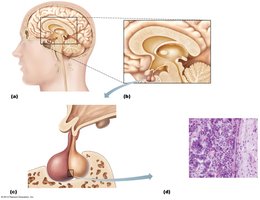
The pituitary gland is a small, pea-shaped gland attached to the hypothalamus by the infundibulum. It is divided into two main lobes:
Anterior lobe (adenohypophysis): Pars distalis, pars intermedia, pars tuberalis.
Posterior lobe (neurohypophysis): Pars nervosa, infundibulum.
The Anterior Lobe of the Pituitary Gland
Hormones and Cell Types
The anterior lobe contains five types of endocrine cells and produces seven major hormones. These hormones are classified as either tropic hormones (which regulate other endocrine glands) or hormones that act directly on nonendocrine tissues.
Tropic hormones: Thyroid-stimulating hormone (TSH), adrenocorticotropic hormone (ACTH), follicle-stimulating hormone (FSH), luteinizing hormone (LH).
Direct-acting hormones: Growth hormone (GH), prolactin (PRL), melanocyte-stimulating hormone (MSH).
The five cell types are classified as acidophils, basophils, and chromophobes.
Summary Table: Pituitary Hormones (Anterior Lobe)
Hormone (Cell Type) | Target Organ and Effects | Effects of Hyposecretion & Hypersecretion |
|---|---|---|
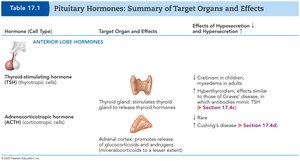
Thyroid-stimulating hormone (TSH) (thyrotropic cells) | Stimulates thyroid gland to release thyroid hormones | Hypo: Cretinism (children), myxedema (adults) Hyper: Graves' disease |
Adrenocorticotropic hormone (ACTH) (corticotropic cells) | Stimulates adrenal cortex to release glucocorticoids | Hypo: Rare Hyper: Cushing's disease |
Hormone (Cell Type) | Target Organ and Effects | Effects of Hyposecretion & Hypersecretion |
|---|---|---|
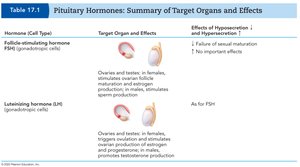
Follicle-stimulating hormone (FSH) (gonadotropic cells) | Ovaries/testes: stimulates gamete production | Hypo: Failure of sexual maturation Hyper: No important effects |
Luteinizing hormone (LH) (gonadotropic cells) | Ovaries/testes: triggers ovulation, stimulates sex hormone production | As for FSH |
Hormone (Cell Type) | Target Organ and Effects | Effects of Hyposecretion & Hypersecretion |
|---|---|---|
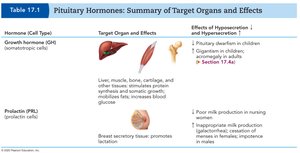
Growth hormone (GH) (somatotropic cells) | Stimulates growth of body tissues, protein synthesis, increases blood glucose | Hypo: Pituitary dwarfism (children) Hyper: Gigantism (children), acromegaly (adults) |
Prolactin (PRL) (prolactin cells) | Breast tissue: promotes lactation | Hypo: Poor milk production Hyper: Inappropriate milk production, impotence in males |
Hypothalamic Control of the Anterior Pituitary
Mechanism of Control
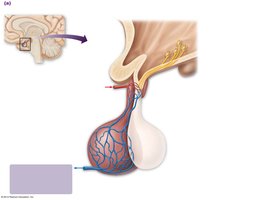
The hypothalamus regulates the anterior pituitary by secreting releasing and inhibiting hormones into the hypophyseal portal system. These hormones travel through a network of blood vessels to the anterior pituitary, where they stimulate or inhibit hormone release.
Releasing hormones: Stimulate anterior pituitary hormone secretion.
Inhibiting hormones: Suppress anterior pituitary hormone secretion.
The Posterior Lobe of the Pituitary Gland
Structure and Function
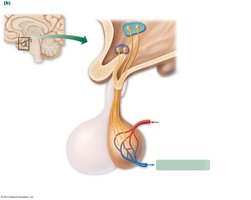
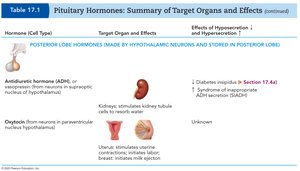
The posterior lobe is an extension of the brain and consists mainly of axons from hypothalamic neurons. It does not synthesize hormones but stores and releases two peptide hormones produced by the hypothalamus: antidiuretic hormone (ADH) and oxytocin.
ADH (vasopressin): Promotes water reabsorption in the kidneys, reducing urine output.
Oxytocin: Stimulates uterine contractions during childbirth and milk ejection during breastfeeding.
Summary Table: Pituitary Hormones (Posterior Lobe)
Hormone (Source) | Target Organ and Effects | Effects of Hyposecretion & Hypersecretion |
|---|---|---|
Antidiuretic hormone (ADH) | Kidneys: stimulates water reabsorption | Hypo: Diabetes insipidus Hyper: Syndrome of inappropriate ADH secretion (SIADH) |
Oxytocin | Uterus: stimulates contractions Breast: initiates milk ejection | Unknown |
Additional info:
The hypothalamus and pituitary gland form a major regulatory axis for many endocrine functions, integrating neural and hormonal signals.
Disorders of the pituitary gland can have widespread effects due to its regulatory role over other endocrine glands.
