 Back
BackThe Human Respiratory System: Structure and Function
Study Guide - Smart Notes
 Tailored notes based on your materials, expanded with key definitions, examples, and context.
Respiration and Breathing
Definitions and Types
The respiratory system is responsible for the exchange of gases between the atmosphere and the cells of the body. This process is essential for cellular metabolism and overall homeostasis.
Respiration: The physiological process of gas exchange. It includes two main types:
External respiration: Exchange of gases between the air in the lungs and the blood.
Internal respiration: Exchange of gases between the blood and the body’s cells.
Breathing: The mechanical process of moving air into and out of the lungs. There are two types:
Costal (thoracic) breathing: Movement of air primarily by the rib cage.
Diaphragmatic (abdominal) breathing: Movement of air primarily by the diaphragm and abdominal wall.
Main Subdivisions and Functions of the Respiratory System
Overview of Components
The respiratory system consists of air passageways and two lungs. Air travels from the external environment to the alveoli, where gas exchange occurs.
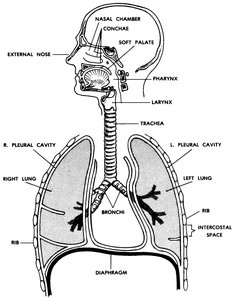
Subdivisions and Their Functions
Subdivision | Function |
|---|---|
Supralaryngeal Structures | Cleanse, warm, moisten, and test inflowing air |
Larynx (Voice Box) | Controls volume of inflowing air; produces selected pitch (vibration frequency) in the moving column of air |
Infralaryngeal Structures | Distribute air to the alveoli of the lung where external respiration takes place |
Supralaryngeal Structures
External Nose and Nasal Chambers
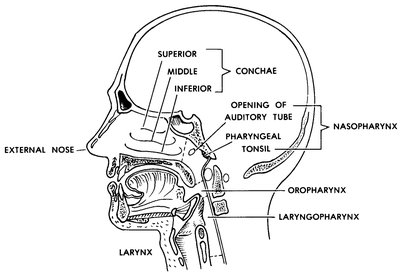
The external nose is supported by cartilage and contains paired nostrils leading to vestibules. Guard hairs filter incoming air. The nasal chambers (internal nose) are separated by the nasal septum and lined with mucoperiosteum, a ciliated, vascular membrane that warms and moistens air. The lateral walls contain conchae (superior, middle, inferior), which increase surface area for air processing. The olfactory epithelium in the upper nasal chambers is responsible for the sense of smell. Paranasal sinuses are air-filled cavities in the skull that connect to the nasal chambers and are lined with the same mucosa.
Pharynx
The pharynx is a shared passageway for the respiratory and digestive systems, divided into three regions:
Nasopharynx: Above the soft palate; receives air from the nasal chambers and contains the pharyngeal tonsil and openings to the auditory tubes.
Oropharynx: Below the soft palate and above the epiglottis; passage for food and air.
Laryngopharynx: Below the epiglottis; common to both respiratory and digestive tracts.
Larynx (Voice Box)
Structure and Function
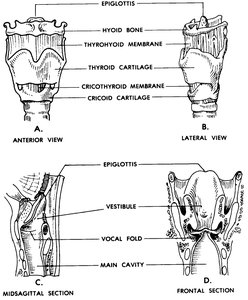
The larynx connects the pharynx to the trachea and is responsible for sound production and regulating airflow. It is composed of several cartilages (thyroid, cricoid, epiglottis, etc.) and contains the vocal cords. The larynx has two main muscle groups: one controls the size of the glottis (regulating airflow), and the other adjusts the tension of the vocal cords (controlling pitch).
Infralaryngeal Structures
Trachea, Bronchi, and Alveoli
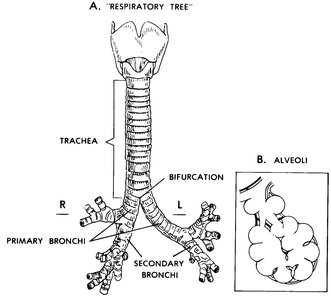
The trachea (windpipe) and bronchi form the "respiratory tree," conducting air from the larynx to the alveoli. The trachea divides into right and left primary bronchi, which further branch into secondary and tertiary bronchi. These airways are supported by cartilage rings and lined with ciliated epithelium to remove debris. The alveoli are tiny, balloon-like sacs where external respiration (gas exchange with blood) occurs. Their small size and large number maximize surface area for efficient gas exchange.
Lungs and Pleural Cavities
The lungs are paired organs composed of bronchi, bronchioles, and alveoli, bound by fibrous connective tissue. The right lung has three lobes and ten bronchopulmonary segments; the left lung has two lobes and eight segments (to accommodate the heart). Each lung is surrounded by a pleural cavity, a potential space between the visceral pleura (covering the lung) and the parietal pleura (lining the thoracic cavity). The pleural cavities reduce friction during breathing movements.
Mechanics of Breathing
Boyle’s Law and Pressure-Volume Relationships
Breathing is governed by Boyle’s law, which states that the pressure of a gas is inversely proportional to its volume in a closed system:
As thoracic volume increases, intrapulmonary pressure decreases, causing air to flow into the lungs. As thoracic volume decreases, pressure increases, and air is expelled.
Costal (Thoracic) Breathing
Inhalation: Muscles raise the rib cage, increasing thoracic volume and decreasing pressure, so air flows in.
Exhalation: Rib cage lowers, thoracic volume decreases, pressure increases, and air is forced out.
Diaphragmatic (Abdominal) Breathing
Inhalation: Diaphragm contracts and flattens, increasing thoracic cavity depth and volume, decreasing pressure, and drawing air in.
Exhalation: Diaphragm relaxes, abdominal wall pushes it upward, decreasing thoracic volume and expelling air.
Summary Table: Key Structures and Functions
Structure | Main Function |
|---|---|
External Nose | Filters, warms, and moistens incoming air |
Nasal Chambers | Further cleanses and conditions air; houses olfactory receptors |
Pharynx | Passageway for air and food; connects nasal and oral cavities to larynx and esophagus |
Larynx | Voice production; regulates airflow into trachea |
Trachea & Bronchi | Conduct air to lungs; remove debris via cilia |
Alveoli | Site of gas exchange with blood |
Lungs | House bronchi, bronchioles, and alveoli; enable gas exchange |
Pleural Cavities | Allow frictionless movement of lungs during breathing |
Additional info: The respiratory system is closely integrated with the cardiovascular system to ensure efficient oxygen delivery and carbon dioxide removal. Disorders of the respiratory system can significantly impact overall health and homeostasis.
