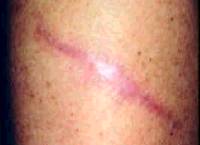
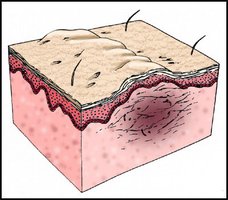
Back
The Integumentary System III: Hair, Nails, and Skin Pathology
Study Guide - Smart Notes
 Tailored notes based on your materials, expanded with key definitions, examples, and context.
The Integumentary System III
Nails
The nail is a specialized structure of the epidermis found on the distal dorsal surfaces of the fingers and toes. Nails serve to protect the distal phalanx, enhance sensation, and aid in picking up small objects.
Nail bed: The layer of skin beneath the nail plate, rich in blood vessels, giving the nail its pinkish color.
Nail matrix: The region of proliferating cells at the base of the nail; responsible for nail growth.
Nail folds: Folds of skin that frame and support the nail on three sides.
Lunula: The crescent-shaped whitish area at the base of the nail, visible part of the matrix.
Cuticle (Eponychium): The thickened layer of skin at the base of the nail, protecting the matrix.
Quick: The sensitive tissue under the nail plate.
Free edge: The part of the nail that extends beyond the finger or toe.
Homeostatic Imbalance: In-grown toenail occurs when the nail grows into the surrounding skin, causing pain and possible infection.
Hair (Pili)
Hair is a filamentous structure composed of dead, keratinized cells. It serves various functions including protection, sensation, and thermoregulation.
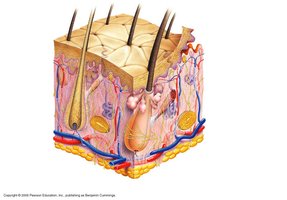
Shaft: The visible part of the hair above the skin surface.
Root: The portion of the hair embedded in the skin.
Bulb: The expanded base of the hair follicle where hair production occurs.
Root hair plexus: A network of sensory nerve endings around the bulb, sensitive to hair movement.
Arrector pili muscle: A small band of smooth muscle attached to the follicle; contraction causes hair to stand upright (goosebumps), aiding in thermoregulation and making animals appear larger when threatened.
Functions of Hair
Scalp: Protects against physical trauma, heat loss, and sunlight.
Eyebrows/Eyelashes: Shield the eyes from sweat, debris, and sunlight.
Nose hair: Filters large particles from inhaled air.
Body hair: Senses light touch and provides minimal insulation.
Hair Growth and Types
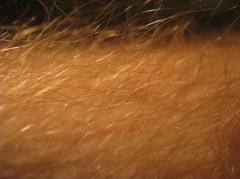
Hair grows at an average rate of approximately 2.5 mm per week. Hair follicles cycle through periods of growth (anagen), regression (catagen), and rest (telogen). Old hairs are shed as new ones grow.
Vellus hair: Fine, pale hair found on children and adult females.
Terminal hair: Coarse, long hair of eyebrows, scalp, axillary, and pubic regions.
Homeostatic Imbalances of Hair
Hirsutism: Excessive production of terminal hair in areas where it is normally minimal or absent, often due to hormonal imbalance.
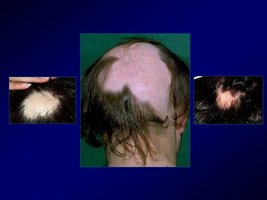
Alopecia: Partial or complete loss of hair from areas where it normally grows; can be caused by genetics, autoimmune disorders, or treatments like electrolysis or laser therapy.
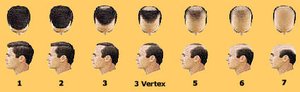
Male-pattern baldness: A genetically determined, sex-influenced condition resulting in hair loss in a characteristic pattern.

Hair Color
Hair color is determined by the amount and type of melanin produced by melanocytes in the hair bulb. Variations in color result from different proportions of eumelanin (brown/black pigment) and pheomelanin (red/yellow pigment). Gray or white hair results from decreased melanin production and air bubbles in the hair shaft.






Homeostatic Imbalances of the Skin
Disorders of the skin can range from mild to life-threatening. Common imbalances include infections, inflammatory conditions, and cancers.
Skin Cancer Types
Skin cancer is the most common type of cancer. The three major types are:
Basal Cell Carcinoma: The most common and least malignant type; arises from basal cells in the epidermis.
Squamous Cell Carcinoma: Arises from keratinocytes of the stratum spinosum; can metastasize if not removed.
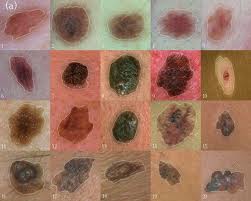
Melanoma: The most dangerous form; arises from melanocytes and is highly metastatic.
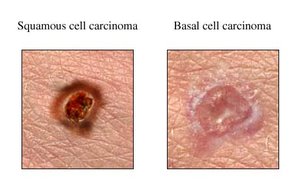
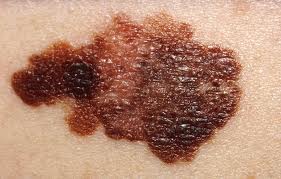
Skin Cancer Recognition: The ABCDE Rule
A = Asymmetry: Two sides of the pigmented area do not match.
B = Border: Edges are irregular, ragged, or blurred.
C = Color: Pigmentation is not uniform; may include shades of brown, black, tan, red, white, or blue.
D = Diameter: Greater than 6 mm (about the size of a pencil eraser).
E = Elevation or Evolution: The lesion is raised or changing in appearance.
Burns
Burns are injuries to tissues caused by heat, electricity, radiation, or chemicals. They denature cell proteins and cause cell death. Severity depends on the extent and depth of the burn.
Extent: Assessed using the "Rule of Nines" to estimate the percentage of body surface area affected.
Degree: Classified by the depth of tissue damage.
Complications: Include dehydration, electrolyte and protein imbalance, infection, and renal shutdown.
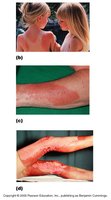
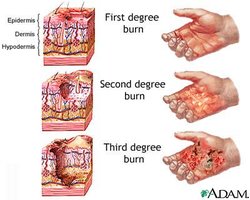
Classification of Burns
First-degree burn: Involves only the epidermis; symptoms include redness and pain (e.g., mild sunburn).
Second-degree burn: Involves the epidermis and upper dermis; symptoms include redness, pain, and blistering.
Third-degree burn: Full-thickness burn involving all layers of the skin; appears gray-white, cherry red, or blackened, and is usually not painful due to nerve destruction.
Tissue Repair
Damaged tissues repair themselves by two main mechanisms:
Regeneration: Replacement of destroyed tissue with the same kind of tissue, restoring normal function.
Fibrosis: Replacement of destroyed tissue with scar tissue (dense connective tissue), which may impair function.
Scars
Scars are areas of fibrous tissue that replace normal skin after injury. They are the result of the body's natural healing process but may lack the function and appearance of the original tissue.