 Back
BackThe Integumentary System: Structure, Function, and Clinical Aspects
Study Guide - Smart Notes
 Tailored notes based on your materials, expanded with key definitions, examples, and context.
The Integumentary System
Introduction to the Integumentary System
The integumentary system consists of the skin and its appendages, serving as the body's primary protective barrier. It is the largest organ system, accounting for approximately 15% of body weight, and is constantly exposed to environmental hazards and pathogens. The skin is waterproof and vital for survival, providing both physical and immunological protection.
Skin: Also known as the integument, it is always visible and susceptible to disease.
Appendages: Includes hair, nails, and cutaneous glands.
Structure of the Skin
Epidermis
The epidermis is the superficial, thinnest layer of the skin, composed of keratinized stratified squamous epithelium. It contains four main cell types and is organized into five distinct layers.
Keratinocytes: Produce keratin, a protein that provides water resistance and strength.
Melanocytes: Synthesize melanin, which determines skin color and protects against UV radiation.
Langerhans cells: Immune cells that defend against pathogens.
Merkel cells: Mechanoreceptors for touch sensation.
The five layers of the epidermis (from deep to superficial):
Stratum basale: Attached to the basement membrane, forms epidermal ridges (fingerprints), contains basal cells.
Stratum spinosum: 8-10 layers of keratinocytes, contains Langerhans cells, increases thickness.
Stratum granulosum: 3-5 layers of flat keratinocytes with granules.
Stratum lucidum: Clear layer, only in thick skin (palms, soles), cells lack nuclei and organelles.
Stratum corneum: Up to 30 layers of dead, keratinized cells, surface covered in lipids for protection.
Dermis
The dermis lies beneath the epidermis and is composed mainly of dense connective tissue with collagen and elastic fibers. It is divided into two regions:
Papillary layer: Superficial, contains dermal papillae, pain and touch receptors, forms fingerprints.
Reticular layer: Deep, contains dense irregular connective tissue, blood vessels, and sensory receptors.
The thickness of the dermis varies by location, being thickest in the hands and soles, and thinnest on the eyelids.
Skin Color Determinants
Skin color is primarily determined by the amount and type of melanin produced by melanocytes, as well as other factors such as hemoglobin and carotene.
Melanin: Provides pigmentation and UV protection.
Hemoglobin: Contributes to reddish tones.
Carotene: Yellow-orange pigment from diet.
Appendages of the Skin
Cutaneous Glands
Cutaneous glands are exocrine glands that include sebaceous and sweat glands.
Sebaceous glands: Produce sebum, lubricates skin and hair, prevents bacterial infection.
Sweat glands: Two types—eccrine (found all over the body, produce acidic sweat with Na+, vitamin C, lactic acid) and apocrine (confined to axillary/genital areas, secrete fatty acids and proteins).
Hair and Hair Follicles
Hair is produced by follicles and serves protective and sensory functions. Hair growth and characteristics change throughout life, with lanugo present in fetal development and changes in oil production and hair loss occurring with age.
Lanugo: Fine fetal hair, shed before birth.
Vermix caseosa: Protective covering at birth.
Alopecia: Hair loss with aging.
Nails
Nails are protective coverings on the dorsal surfaces of fingers and toes, composed of hard keratin.
Functions of the Skin
The skin performs several essential functions:
Sensation: Detects touch, pain, temperature.
Thermoregulation: Regulates body temperature via sweat and blood flow.
Protection: Shields against mechanical injury, pathogens, and UV radiation.
Excretion: Removes waste products through sweat.
Synthesis of vitamin D: Initiates vitamin D production upon exposure to sunlight.
Burns
Classification of Burns
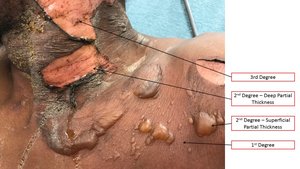
Burns are injuries caused by heat, electricity, UV radiation, or chemicals, resulting in protein denaturation and cell death. They are classified by depth and severity:
First Degree (Superficial): Affects only the epidermis, causes redness and pain.
Second Degree (Superficial Partial Thickness): Involves epidermis and part of dermis, causes blistering.
Second Degree (Deep Partial Thickness): Extends deeper into the dermis, more severe blistering and pain.
Third Degree (Full Thickness): Destroys epidermis and dermis, may affect underlying tissues, skin appears charred or white, sensation may be lost.
Fourth Degree (Full Thickness with Deep Tissue Involvement): Extends into muscle and bone.
Rule of Nines
The Rule of Nines is a method used to estimate the percentage of body surface area affected by burns. It divides the body into regions, each representing approximately 9% (or multiples thereof) of the total body surface area.
Head and neck: 9%
Each arm: 9%
Each leg: 18%
Anterior trunk: 18%
Posterior trunk: 18%
Perineum: 1%
Critical Burns
Burns are considered critical if they meet any of the following criteria:
Over 30% of the body has second-degree burns.
Over 10% of the body has third- or fourth-degree burns.
Third- or fourth-degree burns affect the face, hands, feet, or genitals.
Burns affect the airway.
Circumferential burns (around the body or limb) are present.
Developmental Aspects of Skin
Skin characteristics change throughout life, from fetal development to old age.
Lanugo covers the fetus during the 5th and 6th months.
Vermix caseosa protects the skin at birth.
Adolescence: Increased oil production and acne.
Aging: Decreased subcutaneous tissue, increased sensitivity to cold, drier skin, hair loss.
References
Betts, J.G. et al. (2022) Anatomy and Physiology. 2nd edn. Houston: OpenStax.
Marieb, E.N. and Hoehn, K. (2019) Human Anatomy & Physiology. 11th edn. Harlow: Pearson.
Tortora, G.J. and Derrickson, B. (2021) Principles of Anatomy and Physiology. 16th edn. Hoboken: Wiley.
Ross, M.H. and Pawlina, W. (2020) Histology: A Text and Atlas. 8th edn. Philadelphia: Wolters Kluwer.
Guyton, A.C. and Hall, J.E. (2021) Textbook of Medical Physiology. 14th edn. Philadelphia: Elsevier.
NHS (2024) Skin structure and function. Available at: https://www.nhs.uk
National Institute for Health and Care Excellence (NICE) (2023) Burns and skin integrity. Available at: https://www.nice.org.uk
British Association of Dermatologists (2024) Skin structure and function. Available at: https://www.bad.org.uk
