 Back
The Lymphatic and Immune Systems: Structure, Function, and Clinical Relevance
Study Guide - Smart Notes
 Tailored notes based on your materials, expanded with key definitions, examples, and context.
The Lymphatic and Immune Systems
Overview of the Lymphatic System
The lymphatic system is a network of vessels, tissues, and organs that helps maintain fluid balance in the body and plays a critical role in immune defense. Its main function is to return excess tissue fluid to the blood vascular system and to filter pathogens from lymph before it is returned to the bloodstream.
Lymphatic vessels collect tissue fluid (lymph) from loose connective tissue and return it to the blood.
Lymph flows only toward the heart, ensuring one-way movement of fluid.
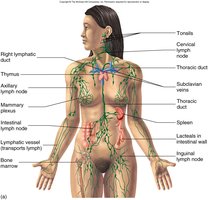
Major lymphatic structures include lymph nodes, lymphatic trunks, and ducts.
Functions of Lymphatic Vessels
Lymphatic vessels are essential for:
Collecting excess tissue fluid and blood proteins that have leaked out of blood capillaries.
Returning these substances to the bloodstream, thus maintaining blood volume and pressure.
Structural Organization of the Lymphatic System
The lymphatic system is organized into a hierarchy of vessels and nodes:
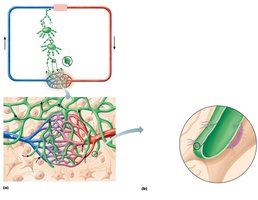
Lymphatic capillaries: Smallest, highly permeable vessels that collect lymph from tissues.
Collecting lymphatic vessels: Receive lymph from capillaries and transport it through lymph nodes.
Lymph trunks: Formed by the convergence of collecting vessels; drain large regions of the body.
Lymph ducts: Largest vessels; empty lymph into the veins of the neck.
Lymphatic Capillaries and Lacteals
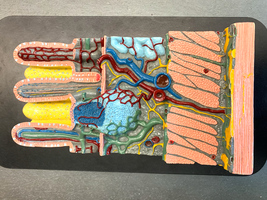
Lymphatic capillaries are found near blood capillaries and are highly permeable due to overlapping endothelial cells that form minivalves. Specialized lymphatic capillaries called lacteals are present in the villi of the small intestine and are responsible for absorbing digested fats, forming a milky fluid called chyle.
Allow entrance of tissue fluid, proteins, bacteria, viruses, and cancer cells.
Lacteals play a key role in fat absorption from the digestive tract.
Flow of Lymph
Lymph is propelled through the lymphatic system by:
Bulging of skeletal muscles
Pulsing of nearby arteries
Contraction of smooth muscle in the vessel walls (tunica media)
Unlike blood, lymph flow is not aided by the heartbeat.
Lymph Nodes: Structure and Function
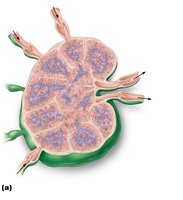
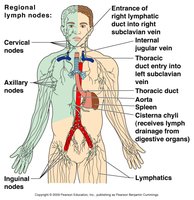
Lymph nodes are small, bean-shaped organs that filter lymph and house lymphocytes. They are distributed throughout the body, with clusters in the cervical, axillary, and inguinal regions.
Cleanse lymph of pathogens and debris.
Site of immune cell activation and proliferation.
Contain a fibrous capsule, trabeculae, cortex, and medulla.
Lymphatic Trunks and Ducts
Collecting lymphatic vessels converge to form five major lymph trunks:
Lumbar trunks: Drain lower limbs
Intestinal trunk: Receives chyle from digestive organs
Bronchomediastinal trunks: Drain thoracic viscera
Subclavian trunks: Drain upper limbs and thoracic wall
Jugular trunks: Drain head and neck
The two main lymphatic ducts are:
Thoracic duct: Drains lymph from three-quarters of the body into the left subclavian vein.
Right lymphatic duct: Drains the right upper quadrant of the body into the right subclavian vein.
The Immune System
Overview and Components
The immune system protects the body from foreign organisms and confers immunity to disease. It is composed of lymphocytes, lymphoid tissue, and lymphoid organs.
Lymphocytes: Key cells that recognize and destroy pathogens.
Lymphoid organs: Include lymph nodes, spleen, thymus, tonsils, aggregated lymphoid nodules, and appendix.
Lymphocyte Types and Functions
Lymphocytes are divided into three main classes:
B lymphocytes (B cells): Mature in bone marrow; produce antibodies that mark pathogens for destruction.
T lymphocytes (T cells): Mature in the thymus; directly attack infected or cancerous cells.
Natural killer (NK) cells: Attack abnormal cells without the need for antigen recognition.
Lymphocyte Activation and Immune Memory
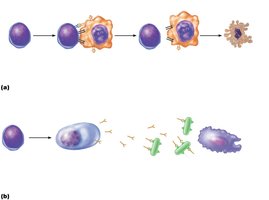
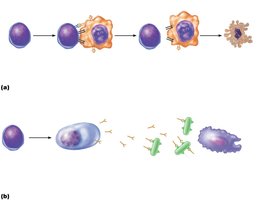
Lymphocytes originate in the bone marrow. T cell precursors migrate to the thymus to mature, while B cells mature in the bone marrow. Upon encountering their specific antigen, lymphocytes become activated, proliferate, and differentiate into effector and memory cells. Memory cells provide long-term immunity by responding rapidly to subsequent exposures to the same antigen.
Lymphoid Tissue and Organs
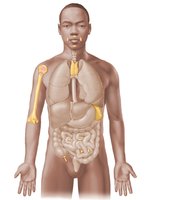
Lymphoid tissue is found in mucous membranes (MALT) and in lymphoid organs. The primary lymphoid organs are the bone marrow and thymus, where lymphocytes mature. Secondary lymphoid organs include lymph nodes, spleen, tonsils, aggregated lymphoid nodules (Peyer's patches), and appendix, which are sites of immune activation and lymphocyte storage.
The Spleen
The spleen is the largest lymphoid organ and has two main functions: removal of bloodborne antigens and destruction of old or defective blood cells. It also serves as a site for B cell maturation and storage of platelets.
White pulp: Contains lymphoid tissue and is involved in immune responses.
Red pulp: Contains sinusoids and cords responsible for filtering blood and removing old erythrocytes.
Tonsils and MALT
Tonsils are the simplest lymphoid organs and are arranged in a ring to gather and remove pathogens entering through the mouth and nose. Mucosa-associated lymphoid tissue (MALT) is abundant in the walls of the intestines and other mucosal surfaces, providing immune defense at entry points for pathogens.
Disorders of the Lymphatic and Immune Systems
Common disorders include:
Chylothorax: Leakage of fatty lymph into the thorax.
Lymphangitis: Inflammation of a lymph vessel.
Mononucleosis: Viral disease caused by Epstein-Barr virus, primarily affecting B lymphocytes.
Hodgkin’s lymphoma: Cancer of lymph nodes.
Non-Hodgkin’s lymphoma: Uncontrolled multiplication and metastasis of undifferentiated lymphocytes.
