 Back
BackThe Lymphatic System and Immunity: Structure, Function, and Cellular Components
Study Guide - Smart Notes
 Tailored notes based on your materials, expanded with key definitions, examples, and context.
The Lymphatic System and Immunity
Introduction to the Lymphatic System
The lymphatic system is a vital component of the body's defense mechanisms, consisting of cells, tissues, and organs that protect against environmental pathogens, toxins, and abnormal body cells such as cancers. It works closely with the immune system to maintain homeostasis and defend the body from disease.
Pathogens: Microscopic organisms that cause disease, including viruses, bacteria, fungi, and parasites. Each pathogen attacks the body in a specific way.
Immunity: The ability to resist infections or disease, involving all body cells and tissues, not just those of the lymphatic system.
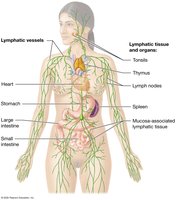
Components of the Lymphatic System
Lymph: A fluid similar to plasma but with fewer proteins, originating as interstitial fluid (IF).
Lymphatic vessels: Transport lymph from peripheral tissues to the venous system.
Lymphoid tissues: High concentrations of lymphocytes and macrophages, not enclosed by a capsule.
Lymphoid organs: High concentrations of lymphocytes and macrophages, enclosed in a capsule (e.g., lymph nodes, spleen, thymus).
Structure and Function of the Lymphatic System
Functions of the Lymphatic System
Lymphocyte production: Occurs in lymphoid tissues (e.g., tonsils), lymphoid organs (e.g., spleen, thymus), and red bone marrow. T-cells mature in lymphatic tissues and organs and migrate to sites of injury or infection.
Drainage of excess interstitial fluid: Returns fluid to the blood, maintaining blood volume and ensuring similar composition of interstitial fluid throughout the body.
Immunity: Lymph passes through lymph nodes, where immune cells can activate an immune response if needed.
Lymphatic Vessels and Lymph Circulation
Lymphatic vessels begin as lymphatic capillaries, which differ from blood capillaries in several ways:
Start as pockets rather than tubes
Have larger diameters
Have thinner walls
Have an irregular outline
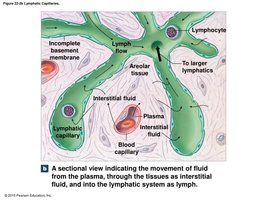
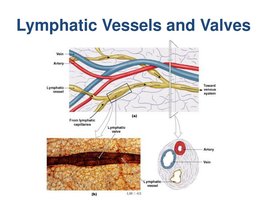
Lymphatic capillaries have loosely bound endothelial cells that overlap to form one-way valves, allowing fluids, solutes, viruses, and bacteria to enter but preventing their return to interstitial spaces.
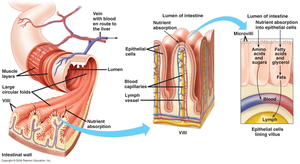
Lacteals: Specialized lymphatic capillaries in the small intestine that transport lipids from the digestive tract.
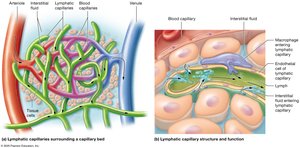
Lymphatic Vessel Structure
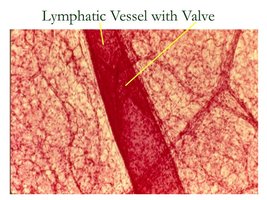
Lymphatic vessels contain one-way valves and travel alongside veins toward the trunk. They are divided into:
Superficial lymphatics: Found in the skin, mucous membranes, and serous membranes lining body cavities.
Deep lymphatics: Larger vessels accompanying deep arteries and veins, found in the neck, limbs, and trunk.
Lymphatic Trunks and Ducts
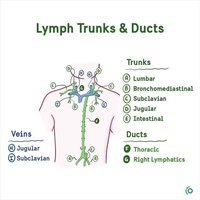
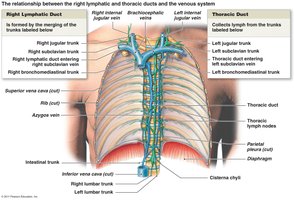
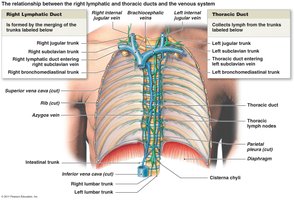
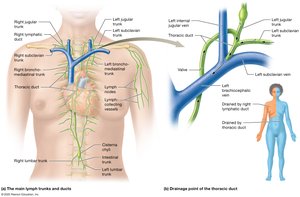
Superficial and deep lymphatics join to form larger vessels called lymphatic trunks, which empty into two major collecting vessels:
Thoracic duct: Drains lymph from most of the body into the left subclavian vein.
Right lymphatic duct: Drains lymph from the right upper quadrant of the body into the right subclavian vein.
Lymphoid Tissues and Organs
Lymphoid Tissue and Nodules
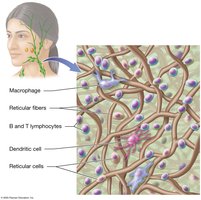
Lymphoid tissue is loose reticular connective tissue dominated by lymphocytes and contains thin reticular fibers that trap pathogens. Lymphoid nodules are areolar tissue with densely packed dividing lymphocytes and do not have a fibrous capsule.
Distribution of Lymphoid Nodules
Lymph nodes
Spleen
Respiratory tract (tonsils)
Along digestive, urinary, and reproductive tracts
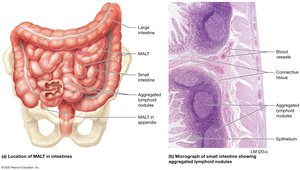
Mucosa-Associated Lymphatic Tissue (MALT): Collection of unencapsulated lymphoid tissue associated with the digestive system, including Peyer's patches (aggregated lymphoid nodules), the appendix, and tonsils.
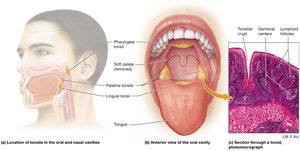
Lymphoid Organs
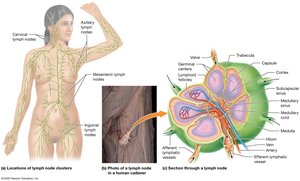
Lymphoid organs are separated from surrounding tissues by a fibrous connective tissue capsule and include lymph nodes, thymus, and spleen.
Lymph nodes: Small clusters of lymphatic tissue located along lymphatic vessels, concentrated in the neck, armpit, and groin. They filter lymph before returning it to venous circulation and stop pathogens before they reach vital organs.
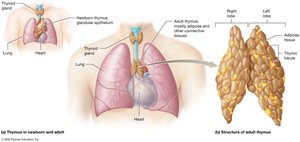
Thymus: Located in the mediastinum, divided into two lobes, large and active in infants and children, atrophies after puberty. Secretes thymosin to stimulate stem cell divisions and T cell differentiation.
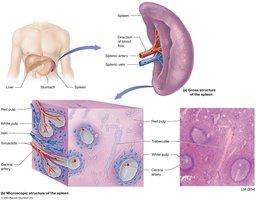
Spleen: Largest lymphoid organ, located in the left upper quadrant. Functions include removal of abnormal red blood cells, initiation of immune responses by B and T cells, storage of red blood cells and platelets, and maintenance of blood volume.
Cells and Proteins of the Innate and Adaptive Immune Systems
Body Defenses: Innate and Adaptive Immunity
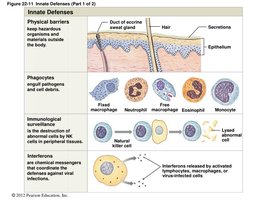
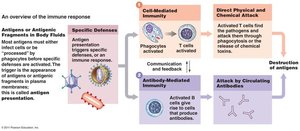
Innate (nonspecific) defenses: Provide resistance against any type of invading agent. Includes physical barriers, phagocytes, immune surveillance, interferons, and inflammation.
Adaptive (specific) defenses: Protect against specific pathogens, depend on lymphocyte activity, and develop after exposure to environmental hazards.
Cells of Innate Immunity
Phagocytes: Engulf and degrade cellular debris, foreign compounds, and pathogens. Includes microphages (neutrophils and eosinophils) and macrophages (derived from monocytes).
Basophils: Aid in the mobility and action of other white blood cells by releasing leukotrienes, histamine, and heparin.
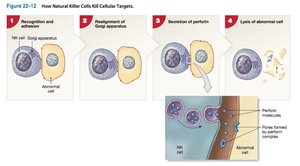
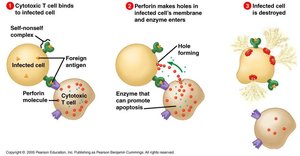
Natural Killer (NK) cells: Attack foreign cells, virus-infected cells, and cancer cells by releasing perforin, which perforates the plasma membrane of the target cell, leading to cytolysis.

Cells of Adaptive Immunity
Lymphocytes: Make up 20-30% of circulating leukocytes. Most are not circulating but reside in lymphoid tissues and organs.
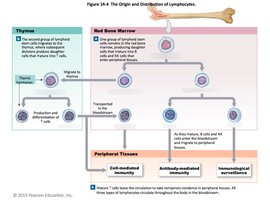
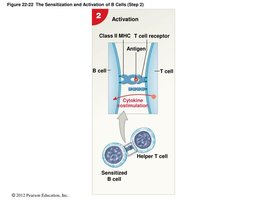
T cells (Thymus-dependent): Provide cell-mediated immunity by attacking foreign cells or cells infected by viruses. Types include cytotoxic T cells (destroy infected cells), helper T cells (stimulate proliferation and differentiation of T and B cells).
B cells (Bone marrow-derived): Provide antibody-mediated immunity by producing specific antibodies. Activated B cells divide into plasma cells (produce antibodies).
NK cells: Provide immune surveillance.
Lymphocyte Production (Lymphopoiesis)
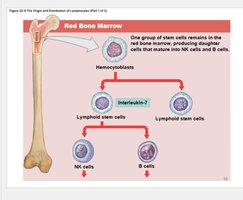
Occurs in red bone marrow, thymus gland, and peripheral lymphoid tissues.
Hemocytoblasts in bone marrow divide into two types of lymphoid stem cells:
Type I: Remains in bone marrow, produces B cells and NK cells.
Type II: Migrates to thymus, produces T cells.
Summary Table: Main Lymphatic Structures and Functions
Structure | Main Function |
|---|---|
Lymphatic Capillaries | Absorb interstitial fluid and transport lymph |
Lymphatic Vessels | Carry lymph toward lymph nodes and ducts |
Lymph Nodes | Filter lymph, activate immune response |
Thymus | Site of T cell maturation |
Spleen | Filters blood, initiates immune response, stores blood cells |
MALT | Protects mucosal surfaces |
Additional info: The lymphatic system is essential for both fluid balance and immune defense. Its failure can result in lymphedema, increased infection risk, and impaired nutrient absorption, especially of dietary fats.
