Back
BackThe Lymphatic System and Lymphoid Organs: Structure, Function, and Clinical Significance
Study Guide - Smart Notes
 Tailored notes based on your materials, expanded with key definitions, examples, and context.
The Lymphatic System: Overview and Functions
Introduction to the Lymphatic System
The lymphatic system is a vital component of the circulatory and immune systems. It returns fluids leaked from blood vessels back to the blood, maintains fluid balance, absorbs dietary fats, and provides immune defense. The system consists of a network of lymphatic vessels, lymph (the fluid), and lymph nodes, as well as lymphoid organs and tissues that house immune cells.
Fluid balance: Returns interstitial fluid and leaked plasma proteins to the bloodstream.
Absorption: Specialized lymphatic capillaries (lacteals) absorb fats from the digestive tract.
Immune response: Lymphoid organs and tissues provide sites for immune cell proliferation and surveillance.
Distribution and Structure of Lymphatic Vessels
Lymphatic Capillaries
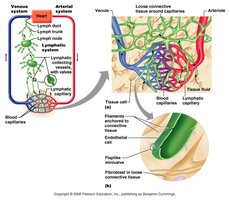
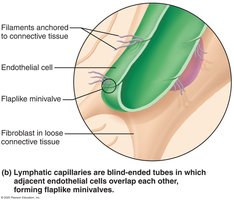
Lymphatic capillaries are blind-ended, highly permeable vessels found throughout most tissues except bone, teeth, bone marrow, and most of the central nervous system. Their unique structure allows them to absorb large molecules and particles, including proteins, cell debris, pathogens, and cancer cells, which blood capillaries cannot.
One-way minivalves: Overlapping endothelial cells form valves that open with increased interstitial fluid, allowing entry of fluid and particles.
Anchoring filaments: Collagen filaments anchor capillaries to surrounding tissue, preventing collapse.
Lacteals: Specialized capillaries in the intestinal mucosa that absorb dietary fats and deliver chyle to the blood.
Larger Lymphatic Vessels
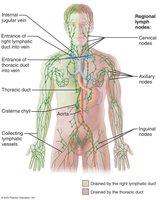
Lymphatic capillaries drain into larger collecting vessels, which then form lymphatic trunks and ducts. These vessels have thinner walls and more internal valves than veins. Collecting vessels in the skin travel with superficial veins, while deep vessels travel with arteries.
Right lymphatic duct: Drains lymph from the right upper arm and right side of the head and thorax.
Thoracic duct: Drains lymph from the rest of the body, beginning as the cisterna chyli in about half of individuals.
Both ducts empty into the venous circulation at the junction of the internal jugular and subclavian veins.
Lymph Transport
Mechanisms of Lymph Flow
The lymphatic system is a low-pressure system, similar to veins. Lymph is propelled by:
Milking action of skeletal muscles
Pressure changes during breathing
Valves to prevent backflow
Pulsations of nearby arteries
Contractions of smooth muscle in vessel walls
Physical activity increases lymph flow, while immobilization slows it, allowing inflammatory materials to remain in the area for healing.
Clinical Significance: Homeostatic Imbalances
Lymphangitis
Lymphangitis is the inflammation of larger lymphatic vessels, often visible as painful red lines under the skin. It is caused by infection or inflammation, leading to congestion of the vasa vasorum (small blood vessels supplying the lymphatic vessel walls).

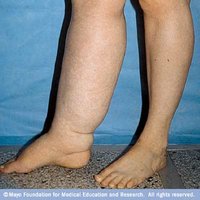
Lymphedema
Lymphedema is severe localized swelling caused by blockage or removal of lymphatic vessels, preventing normal lymph return to the blood. It may occur after cancer surgery or due to tumors blocking lymphatics. If some pathways remain, they may enlarge and partially compensate.
Lymphoma
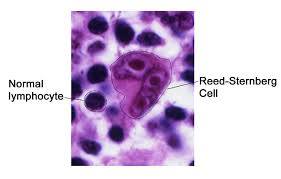
Lymphoma is cancer of the lymphatic system. Hodgkin lymphoma is characterized by Reed-Sternberg cells and usually affects B lymphocytes. Non-Hodgkin lymphoma includes a variety of cancers arising from B or T cells, with varying locations and aggressiveness.
Lymphadenitis and Lymphadenopathy
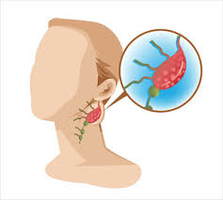
Lymphadenitis refers to inflamed lymph nodes, often due to infection. Lymphadenopathy is the general term for swollen lymph nodes, indicating an immune response to infection or other causes.
Lymphoid Cells, Tissues, and Organs
Lymphoid Cells
Lymphoid cells include immune system cells (lymphocytes, macrophages, dendritic cells) and supporting cells (reticular cells). Lymphocytes are divided into T cells (manage immune response, attack infected cells) and B cells (produce antibodies via plasma cells). Macrophages and dendritic cells help activate lymphocytes and phagocytize foreign substances. Reticular cells produce the stroma, a supportive network for immune cells.
Lymphoid Tissue
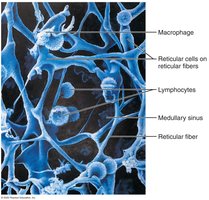
Lymphoid tissue provides sites for lymphocyte proliferation and immune surveillance. It is mainly composed of reticular connective tissue, with macrophages residing on fibers and lymphocytes occupying spaces between fibers.
Lymphoid Organs
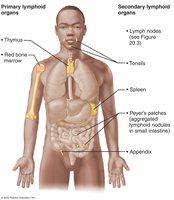
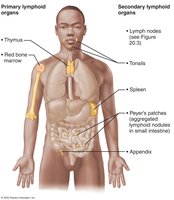
Lymphoid organs are classified as primary (where lymphocytes mature: red bone marrow and thymus) and secondary (where mature lymphocytes encounter antigens: lymph nodes, tonsils, spleen, MALT, and diffuse lymphoid tissues).
Lymph Nodes
Structure and Function
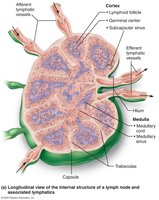
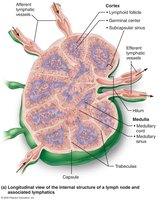
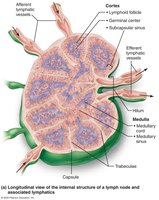
Lymph nodes are small, bean-shaped secondary lymphoid organs found along lymphatic vessels. They filter lymph and provide sites for immune activation. Each node has an external capsule, internal trabeculae, and two main regions: cortex and medulla.
Cleansing lymph: Macrophages remove microorganisms and debris.
Immune activation: Lymphocytes become activated and mount immune responses.
Cortex and Medulla
The cortex contains follicles with germinal centers (B cell proliferation) and T cells in transit. Dendritic cells are abundant and help activate lymphocytes. The medulla contains B cells, T cells, plasma cells, and lymph sinuses lined by macrophages.
Circulation in Lymph Nodes
Lymph enters via afferent vessels, passes through sinuses in the cortex and medulla, and exits via efferent vessels at the hilum. Fewer efferent vessels cause lymph to stagnate, allowing immune cells time to act.
Spleen
Structure and Functions
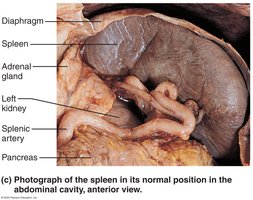
The spleen is the largest lymphoid organ, located in the left upper abdomen. It filters blood, removes old erythrocytes and platelets, stores breakdown products, and is a site for lymphocyte proliferation and immune surveillance.
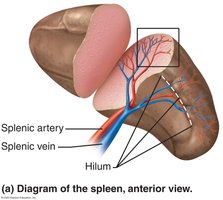
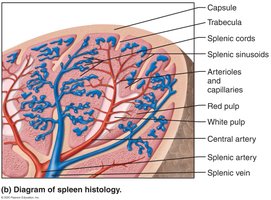
Histology: White and Red Pulp
The spleen contains white pulp (lymphocyte-rich regions for immune function) and red pulp (sites of erythrocyte and pathogen destruction, rich in macrophages and venous sinuses).
MALT, Tonsils, Peyer's Patches, and Appendix
Mucosa-Associated Lymphoid Tissue (MALT)
MALT consists of lymphoid tissues in mucous membranes throughout the body, protecting against pathogens entering via the respiratory, digestive, and genitourinary tracts. Major collections include tonsils, Peyer's patches, and the appendix.
Tonsils
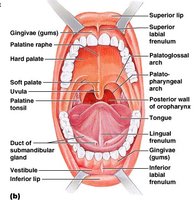
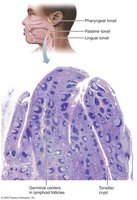
Tonsils form a ring of lymphatic tissue around the pharynx and are named by location (palatine, lingual, pharyngeal, tubal). They gather and remove pathogens from food and air, contain follicles with germinal centers, and have crypts that trap bacteria for immune activation.
Peyer's Patches and Appendix
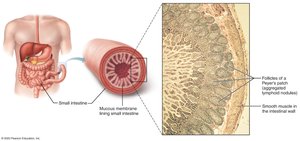
Peyer's patches are clusters of lymphoid follicles in the distal small intestine, and the appendix is a lymphoid organ off the large intestine. Both destroy bacteria and generate memory lymphocytes.
Thymus
Structure and Function
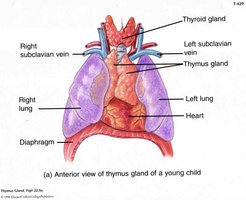
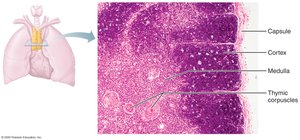
The thymus is a bilobed organ in the neck and mediastinum, where T cells mature. It is most active in childhood and atrophies with age. The thymus has lobules with an outer cortex (rapidly dividing lymphocytes and macrophages) and an inner medulla (fewer lymphocytes, thymic corpuscles for regulatory T cell development).
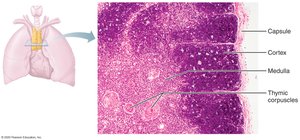
Unique Features of the Thymus
No follicles (lacks B cells)
Does not directly fight antigens
Blood-thymus barrier prevents premature activation of T cells
Stroma is made of epithelial cells, not reticular fibers