 Back
BackThe Reproductive System: Structure, Function, and Processes
Study Guide - Smart Notes
 Tailored notes based on your materials, expanded with key definitions, examples, and context.
The Reproductive System
Introduction to the Male and Female Reproductive Systems
The reproductive system is essential for the production of offspring and the continuation of species. Both male and female systems have primary sex organs called gonads—the testes in males and the ovaries in females—which produce gametes and secrete sex hormones. Accessory reproductive organs support the function of the gonads and facilitate fertilization and development.
Testes (male): Produce sperm and secrete testosterone.
Ovaries (female): Produce ova (eggs) and secrete estrogens.
Accessory organs: Include ducts, glands, and external genitalia that support gamete transport and development.
Key Differences:
Females: Produce one gamete per month, retain and nurture the zygote, embryo, and fetus, and nourish the infant after birth.
Males: Produce large quantities of gametes and are not physiologically involved after sperm is released.
Mitosis and Meiosis
Cell division is fundamental to growth, development, and reproduction. Mitosis produces identical diploid cells for growth and repair, while meiosis produces haploid gametes for sexual reproduction.
Mitosis: Occurs in somatic cells; daughter cells are genetically identical to the parent cell (46 chromosomes).
Meiosis: Occurs in gametes; involves two divisions (Meiosis I and II) to produce four genetically unique haploid cells (23 chromosomes).
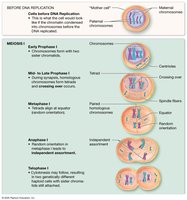
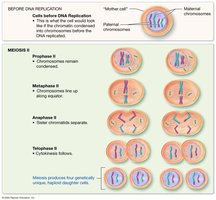
Importance: Meiosis introduces genetic variation and ensures the correct chromosome number in offspring.
Anatomy of the Male Reproductive System
The Testes
The testes are paired glands located in the scrotum, responsible for sperm production and hormone secretion. The cremaster muscle regulates their position and temperature, which is vital for spermatogenesis.
Seminiferous tubules: Site of sperm production.
Epididymis: Site of sperm maturation and storage.
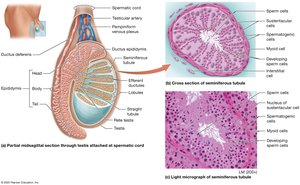
Support Structures: Scrotum and Spermatic Cord
The scrotum houses the testes and maintains optimal temperature for sperm development. The spermatic cord contains blood vessels, nerves, and the ductus deferens.
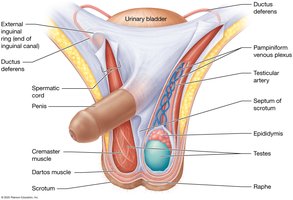
Duct System
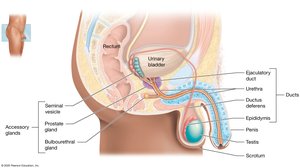
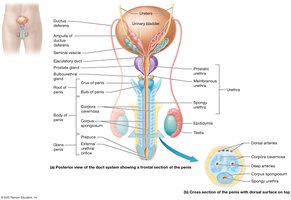
The male duct system transports sperm from the testes to the exterior.
Epididymis: Stores and protects sperm while they mature.
Ductus (Vas) Deferens: Transports sperm during ejaculation via peristalsis.
Ejaculatory Duct: Formed by the union of the ductus deferens and seminal vesicle duct; passes through the prostate and empties into the urethra.
Urethra: Shared passageway for urine and semen; divided into prostatic, membranous, and spongy regions.
The Penis
The penis is the male copulatory organ, delivering sperm into the female reproductive tract. It consists of the root, body (shaft), and glans penis. Erectile tissues (corpora cavernosa and corpus spongiosum) enable erection.
Accessory Sex Glands and Semen
Accessory glands produce seminal fluid, which nourishes and transports sperm.
Seminal Vesicles: Secrete fructose-rich fluid and prostaglandins.
Prostate Gland: Produces milky secretion containing citrate for sperm energy.
Bulbourethral Glands: Secrete alkaline mucus to neutralize urine and lubricate the urethra.
Semen: Contains 20–100 million sperm/mL, seminal fluid, and prostaglandins to aid sperm motility and fertilization.
Functions of the Male Reproductive Structures
Structure | Main Function |
|---|---|
Testes | Produce sperm and testosterone |
Epididymis | Sperm maturation and storage |
Ductus deferens | Transport sperm during ejaculation |
Seminal vesicles | Produce fructose-rich seminal fluid |
Prostate gland | Secretes citrate-rich fluid |
Bulbourethral glands | Secrete alkaline mucus |
Penis | Delivers sperm to female tract |
Spermatogenesis
Process of Spermatogenesis
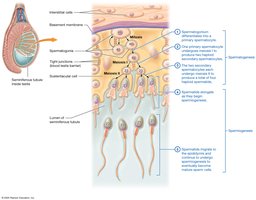
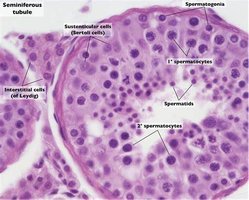
Spermatogenesis is the process of sperm cell development, beginning at puberty and continuing throughout life. It occurs in the seminiferous tubules and involves mitosis, meiosis, and spermiogenesis.
Spermatogonia: Stem cells divide by mitosis; one remains, the other becomes a primary spermatocyte.
Primary spermatocyte: Undergoes meiosis I to form two secondary spermatocytes.
Secondary spermatocytes: Undergo meiosis II to produce four spermatids (haploid).
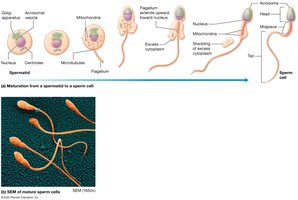
Spermiogenesis: Spermatids differentiate into mature spermatozoa.
Sperm Maturation
Spermatozoa produced in the testes are physically mature but not yet motile or capable of fertilization. They gain motility and fertilizing ability as they pass through the epididymis and other reproductive structures.
Hormonal Control of Male Reproduction
Testosterone is the primary male sex hormone, regulating spermatogenesis and the development of secondary sex characteristics such as increased muscle mass, body hair, and a deeper voice. It also increases bone density and erythropoietin production.
Anatomy of the Female Reproductive System
Ovaries
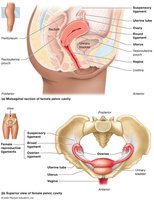
The ovaries are paired organs that produce oocytes and secrete estrogens and progesterone. They are supported by the broad, ovarian, and suspensory ligaments.
Oocyte production (oogenesis)
Hormone secretion: Estrogens and progesterone
Uterine Tubes (Fallopian Tubes)
The uterine tubes transport oocytes from the ovaries to the uterus. Fimbriae help capture the oocyte during ovulation.
Uterus
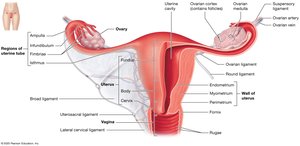
The uterus provides mechanical protection, nutritional support, and waste removal for the developing embryo and fetus. It consists of the body, fundus, and cervix. The uterine wall has three layers: the myometrium (muscular), endometrium (glandular), and perimetrium (serous membrane).
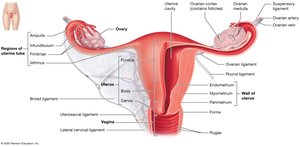
Myometrium: Thick muscle layer responsible for contractions during childbirth.
Endometrium: Glandular layer that undergoes cyclic changes in response to hormones.
Vagina
The vagina is the female organ of copulation, receiving the penis and semen during intercourse. It also serves as the birth canal and the exit for menstrual flow.
Female External Genitalia (Vulva)
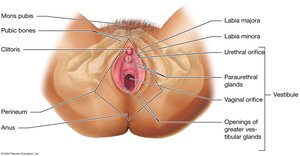
The vulva includes the mons pubis, labia majora, labia minora, and clitoris. These structures protect the internal genitalia and play a role in sexual arousal.
Functions of the Female Reproductive Structures
Structure | Main Function |
|---|---|
Ovaries | Produce oocytes and hormones |
Uterine tubes | Transport oocyte; site of fertilization |
Uterus | Supports embryo/fetus |
Vagina | Receives penis; birth canal |
External genitalia | Protection and sexual arousal |
Oogenesis
Process of Oogenesis
Oogenesis is the production of female gametes (ova). It begins before birth, pauses during fetal development, resumes at puberty, and continues in a monthly cycle until menopause.
Oogonia: Complete mitosis before birth, forming primary oocytes.
Primary oocytes: Begin meiosis I but pause until puberty.
At puberty, hormones stimulate some primary oocytes to complete meiosis I, forming a secondary oocyte and a polar body.
Meiosis II is completed only if fertilization occurs.
Uterine (Menstrual) Cycle
The uterine cycle begins with menses (shedding of the endometrium) due to decreased estrogen and progesterone. Menarche marks the first cycle at puberty, and menopause is the cessation of cycles in midlife.
Effects of Female Hormones
Estrogens and progesterone stimulate the development of secondary sex characteristics, including maturation of sex organs, breast development, and fat distribution. Estrogens also help maintain bone density by inhibiting osteoclasts.
