 Back
BackThe Skeletal System: Structure, Function, and Bone Physiology
Study Guide - Smart Notes
 Tailored notes based on your materials, expanded with key definitions, examples, and context.
The Skeletal System
Components of the Skeletal System
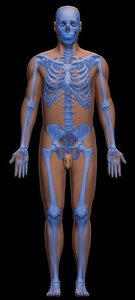
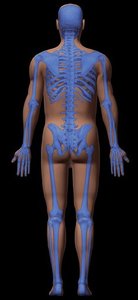
The skeletal system is primarily composed of connective tissues and serves as the structural framework for the human body. Its main components include bones, cartilage, ligaments, and tendons.
Bones: Provide support, protection, and leverage for movement.
Cartilage: Acts as a precursor to most bones and covers joint surfaces.
Ligaments: Dense connective tissue bands that connect bone to bone at joints.
Tendons: Dense connective tissue bands that attach muscle to bone.
Functions of the Skeleton
The skeleton performs several essential functions for the body:
Support: Provides structural support for the body and organs.
Protection: Shields vital organs (e.g., brain, heart, lungs).
Movement: Facilitates movement through muscle attachment.
Mineral Storage: Stores minerals such as calcium and phosphate.
Acid–Base Balance: Buffers blood pH by altering mineral levels.
Hemopoiesis: Produces blood cells in bone marrow.
Fat Storage: Yellow marrow stores fat in long bones.
Osseous Tissue: Structure and Cells
Bone Matrix
The matrix of osseous tissue is a composite material consisting of organic and inorganic components:
Organic Matter: Synthesized by osteoblasts; includes collagen and carbohydrate–protein complexes (glycosaminoglycans, proteoglycans, glycoproteins).
Inorganic Matter: Mainly hydroxyapatite (crystallized calcium phosphate), calcium carbonate, and other minerals.
This combination provides both strength and flexibility. Deficiencies in minerals or collagen can lead to diseases such as rickets or osteogenesis imperfecta.
Bone Cells
Four principal types of bone cells regulate bone formation and remodeling:
Osteogenic Cells: Stem cells found in endosteum and periosteum; give rise to other bone cells.
Osteoblasts: Bone-forming cells; secrete matrix and promote mineralization.
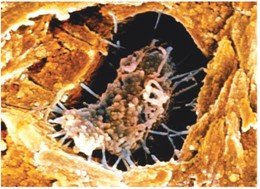
Osteocytes: Mature bone cells trapped in matrix; reside in lacunae and act as strain sensors.
Osteoclasts: Bone-dissolving cells; large, multinucleated, derived from white blood cells.
Bone Structure: Compact vs. Spongy Bone
Compact Bone
Compact bone forms the dense outer shell of bones and is organized into osteons (haversian systems):
Osteons: Cylindrical structures with concentric lamellae surrounding a central canal.
Lamellae: Layers of bone matrix.
Canaliculi: Small channels connecting lacunae for nutrient exchange.
Interstitial Lamellae: Fill spaces between osteons.
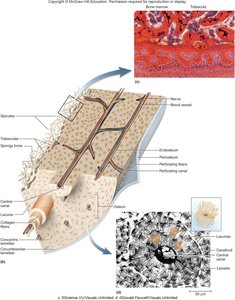
Spongy (Cancellous) Bone
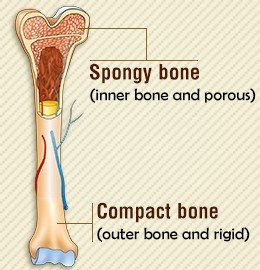
Spongy bone is found at the ends of long bones and in the interior of other bones. It consists of a lattice of trabeculae and spicules, with spaces filled by red bone marrow.
Trabeculae: Thin plates aligned along lines of stress.
Red Bone Marrow: Site of hemopoiesis.
Provides strength with minimal weight.
Bone Marrow
Types of Bone Marrow
Bone marrow is the soft tissue found in marrow cavities and spongy bone spaces:
Red Marrow: Hemopoietic tissue; produces blood cells; found in most bones of children and select bones in adults.
Yellow Marrow: Fatty tissue; does not produce blood cells but can revert to red marrow during chronic anemia.
Bone Development and Growth
Ossification Methods
Bone formation occurs via two primary methods:
Endochondral Ossification: Bone develops from a pre-existing hyaline cartilage model (e.g., long bones).
Intramembranous Ossification: Bone develops within a fibrous connective tissue membrane (e.g., flat bones of the skull).
Bone Growth in Length and Width
Bones grow in length via the epiphyseal plate (growth plate) and in width via appositional growth:
Epiphyseal Plate: Zone of hyaline cartilage where bone elongation occurs; replaced by bone as growth ends.
Appositional Growth: Osteoblasts deposit new bone at the surface, increasing diameter; osteoclasts enlarge the marrow cavity.
Bone Classification
By Texture
Compact Bone: Dense, strong, forms outer layer.
Spongy Bone: Porous, lightweight, forms inner layer.
By Development
Endochondral: From cartilage.
Intramembranous: From membrane.
By Shape and Size
Flat Bones: Thin, protect organs (e.g., skull).
Long Bones: Longer than wide, crucial for movement (e.g., femur).
Short Bones: Nearly equal in length and width (e.g., carpals).
Irregular Bones: Complex shapes (e.g., vertebrae).
Sutural Bones: Small bones within sutures of the skull.
Sesamoid Bones: Develop within tendons (e.g., patella).
General Features of Bones
Long Bone Anatomy
Long bones have distinct structural features:
Diaphysis: Shaft providing leverage.
Epiphyses: Enlarged ends for joint strength and attachment.
Medullary Cavity: Contains bone marrow.
Articular Cartilage: Covers joint surfaces.
Periosteum: External sheath with fibrous and osteogenic layers.
Endosteum: Lines marrow cavity; contains bone cells.
Epiphyseal Plate/Line: Growth plate in children; line in adults.
Flat Bone Anatomy
Flat bones have a sandwich-like structure:
Two layers of compact bone enclosing a middle layer of spongy bone (diploe).
Both surfaces covered with periosteum.
Diploe absorbs shock; marrow spaces lined with endosteum.
Bone Growth and Remodeling
Bone Remodeling
Bone remodeling is a continuous process involving absorption and deposition of bone tissue:
Repairs microfractures, releases minerals, and adapts bone shape to mechanical stress (Wolff’s law).
Involves coordinated activity of osteoblasts and osteoclasts.
Calcium Homeostasis and Hormonal Regulation
Calcium Regulation
Calcium homeostasis is vital for physiological functions and is regulated by three hormones:
Calcitriol: Most active form of vitamin D; increases calcium absorption in the intestine, resorption from bone, and weakly promotes kidney reabsorption.
Calcitonin: Secreted by the thyroid when blood calcium is high; inhibits osteoclasts and stimulates osteoblasts.
Parathyroid Hormone (PTH): Secreted when blood calcium is low; stimulates osteoclasts, increases kidney reabsorption, promotes calcitriol synthesis, and inhibits osteoblasts.
Normal blood calcium concentration: 9.2–10.4 mg/dL.
Calcium Disorders
Hypocalcemia: Deficient calcium; causes nervous system excitability and muscle spasms.
Hypercalcemia: Excess calcium; causes muscle weakness and cardiac issues.
Bone Disorders
Fractures
Fractures are breaks in bone and are treated by closed or open reduction, casting, traction, or electrical stimulation.
Osteoporosis
Osteoporosis is the most common bone disease, characterized by severe loss of bone density and increased risk of fractures. Estrogen maintains bone density; risk factors include age, gender, diet, and lifestyle. Treatments include hormone therapy, medications, and prevention through diet and exercise.
Summary Table: Bone Cell Types
Cell Type | Function | Location |
|---|---|---|
Osteogenic Cells | Stem cells; produce other bone cells | Endosteum, periosteum |
Osteoblasts | Bone formation; secrete matrix | Bone surface |
Osteocytes | Maintain bone tissue; sense strain | Lacunae within matrix |
Osteoclasts | Bone resorption; dissolve matrix | Bone surface |
Summary Table: Bone Classification
Classification | Description | Example |
|---|---|---|
Flat Bone | Thin, curved, protective | Skull, ribs |
Long Bone | Longer than wide, movement | Femur, humerus |
Short Bone | Equal length and width, glide | Carpals, tarsals |
Irregular Bone | Complex shape | Vertebrae |
Sutural Bone | Small, within sutures | Skull |
Sesamoid Bone | Develop in tendons | Patella |
Additional info: Academic context and expanded explanations were added to ensure completeness and clarity for college-level study.
