Back

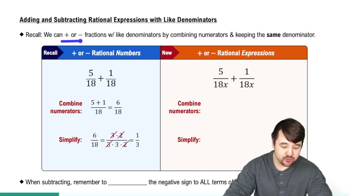
Adding and Subtracting Rational Expressions with Common Denominators definitions

Control buttons has been changed to "navigation" mode.
1/15
  • Rational Expression

    A fraction where both the numerator and denominator are polynomials, often involving variables.
  • Numerator

    The top part of a fraction or rational expression, representing the quantity being divided.
  • Denominator

    The bottom part of a fraction or rational expression, indicating the divisor or base.
  • Common Denominator

    A shared denominator among two or more rational expressions, allowing direct addition or subtraction.
  • Simplification

    The process of reducing an expression to its most basic or compact form by canceling common factors.
  • Factoring

    Breaking down a polynomial into products of simpler polynomials or numbers, often to reveal common factors.
  • Quadratic

    A polynomial of degree two, typically in the form ax² + bx + c, often requiring special factoring techniques.
  • Prime Factor

    A factor that cannot be broken down further except by one and itself, used to simplify expressions.
  • Standard Form

    An expression written in a conventional, simplified arrangement, often with terms ordered by degree.
  • Polynomial

    An algebraic expression made up of terms involving variables raised to whole-number powers and coefficients.
  • Coefficient

    A numerical factor multiplying a variable within a term of a polynomial or rational expression.
  • Term

    A single part of an expression, separated by plus or minus signs, which may include variables and coefficients.
  • Distribution

    Applying a sign or factor to each term within parentheses, such as spreading a negative across a sum.
  • Cancellation

    Eliminating common factors from the numerator and denominator to reduce a rational expression.
  • Variable

    A symbol, usually a letter, representing an unknown or changeable value within an expression.