Back

Adding and Subtracting Rational Expressions with Common Denominators quiz

Control buttons has been changed to "navigation" mode.
1/15
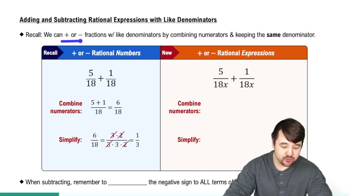
  • What is the first step when adding or subtracting rational expressions with common denominators?

    Combine the numerators over the common denominator.
  • When adding 5/18 and 1/18, what do you do with the numerators?

    Add the numerators (5 + 1) and keep the denominator the same.
  • Why is simplification important after adding or subtracting rational expressions?

    Simplification ensures the answer is in its simplest form, often by canceling common factors.
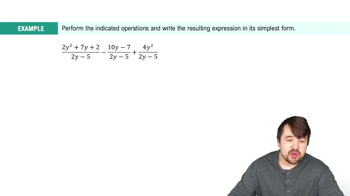
  • What must you remember to do when subtracting rational expressions?

    Distribute the negative sign to all terms in the numerator of the second fraction.
  • How do you simplify 6/18x?

    Factor both numerator and denominator, cancel common factors, and the answer is 1/3x.
  • What is the result of subtracting x^2/(x-1) - (-x+2)/(x-1)?

    The result is (x^2 + x - 2)/(x-1) after distributing the negative sign.
  • How do you factor x^2 + x - 2?

    Find two numbers that multiply to -2 and add to 1; the factors are (x-1)(x+2).
  • What happens to common factors in the numerator and denominator after factoring?

    Common factors cancel each other out.
  • After canceling common factors in (x-1)(x+2)/(x-1), what is the simplified answer?

    The simplified answer is x + 2.
  • What is a common denominator in rational expressions?

    A common denominator is the same denominator shared by all rational expressions being added or subtracted.
  • What is the purpose of factoring polynomials in rational expressions?

    Factoring helps identify and cancel common factors to simplify the expression.
  • What should you always do after combining numerators in rational expressions?

    Always simplify the final answer.
  • What is the equivalent process between adding rational numbers and rational expressions?

    Both involve combining numerators over a common denominator.
  • What do you do if the denominator is already prime when simplifying?

    Leave the denominator as is and focus on factoring the numerator.
  • Why is understanding terms, coefficients, and factoring techniques important in this topic?

    They ensure you can correctly combine and simplify rational expressions.