Beginning Algebra
My Course
Learn
AI Tutor
Study Guides
Flashcards
Try the app
My Course
Learn
AI Tutor
Study Guides
Flashcards
Try the app
Back
Adding and Subtracting Rational Expressions with Different Denominators quiz
You can tap to flip the card.
What is the first step when adding or subtracting rational expressions with different denominators?
You can tap to flip the card.
👆
What is the first step when adding or subtracting rational expressions with different denominators?
The first step is to find the least common denominator (LCD) by factoring the denominators.
Track progress
Control buttons has been changed to "navigation" mode.
1/15
Related flashcards
Recommended videos
Adding and Subtracting Rational Expressions with Different Denominators definitions
Adding and Subtracting Rational Expressions with Different Denominators
15 Terms
08:03
Adding and Subtracting Rational Expressions with Unlike Denominators Example 1
28
views
06:23
Adding and Subtracting Rational Expressions with Unlike Denominators
62
views
Terms in this set (15)
Hide definitions
What is the first step when adding or subtracting rational expressions with different denominators?
The first step is to find the least common denominator (LCD) by factoring the denominators.
How do you create equivalent rational expressions when adding or subtracting?
Multiply the numerator and denominator of each expression by the missing factor needed to reach the LCD.
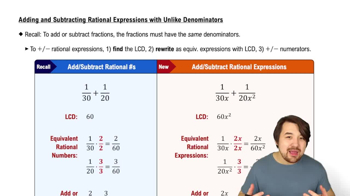
What is the LCD of the denominators 30 and 20?
The LCD is 60.
After finding the LCD, what is the next step in adding rational expressions?
Rewrite each rational expression with the LCD as the denominator by multiplying by the missing factors.
How do you combine the numerators once the denominators are the same?
Add or subtract the numerators and keep the common denominator.
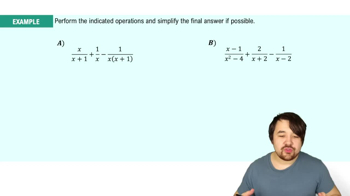
What is the LCD for the denominators x+4 and x-8?
The LCD is (x+4)(x-8).
How do you simplify the numerator after combining terms in rational expressions?
Distribute coefficients and combine like terms in the numerator.
What is the result of adding 2x over 60x^2 and 3 over 60x^2?
The result is (2x + 3) over 60x^2.
What do you multiply the numerator and denominator of 2/(x+4) by to get the LCD with x-8?
Multiply by (x-8).
What do you multiply the numerator and denominator of 7/(x-8) by to get the LCD with x+4?
Multiply by (x+4).
How do you write the subtraction of 2/(x+4) and 7/(x-8) as a single expression?
Write as [2(x-8) - 7(x+4)] over (x+4)(x-8).
What is the simplified numerator when you distribute and combine 2(x-8) - 7(x+4)?
The simplified numerator is -5x - 44.
What is the fully simplified rational expression for 2/(x+4) - 7/(x-8)?
It is (-5x - 44) over (x+4)(x-8).
Why is understanding terms, coefficients, and polynomial degrees important in these operations?
It helps in correctly distributing, combining like terms, and simplifying rational expressions.
What is the purpose of finding the LCD when adding or subtracting rational expressions?
The LCD allows you to rewrite expressions with a common denominator so you can combine them.