A set of two numbers representing a location on a graph, where the first is the horizontal value and the second is the vertical value.
Linear Equation
An algebraic statement in which each term is either a constant or the product of a constant and a single variable, forming a straight line when graphed.
Two Variables
A situation involving two unknowns, typically represented by x and y, whose values satisfy a given equation.
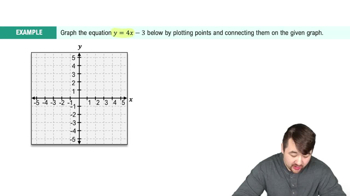
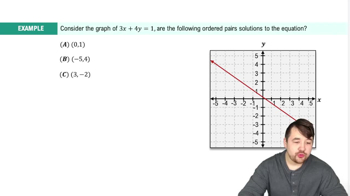
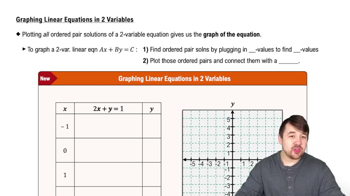
Graph
A visual representation showing all solutions to an equation by plotting points on a coordinate plane.
Coefficient
A numerical factor multiplying a variable in an algebraic expression, indicating how many times the variable is counted.
Standard Form
An arrangement of a linear equation as ax + by = c, where a, b, and c are constants.
Solution
A value or set of values for variables that make an equation true, often represented as a point on a graph.
Table
An organized chart listing chosen values for one variable and the corresponding calculated values for another.
Point
A specific location on a graph identified by an ordered pair, marking a solution to an equation.
Line
A straight path on a graph extending in both directions, representing all solutions to a linear equation.
Degree
The highest power of a variable in an equation, indicating the equation's type; for linear equations, this is one.
Polynomial
An expression consisting of variables and coefficients, combined using addition, subtraction, and multiplication.
Axis
A reference line on a graph, usually horizontal (x) or vertical (y), used to locate points.
Variable
A symbol, often x or y, representing an unknown value in an equation.
Arrows
Symbols placed at the ends of a line on a graph to indicate that the line extends infinitely in both directions.