Back

Graph Linear Equations in Two Variables quiz

Control buttons has been changed to "navigation" mode.
1/15
  • What is the general form of a linear equation in two variables?

    The general form is ax + by = c, where a, b, and c are constants.
  • How do you find ordered pair solutions for a linear equation in two variables?

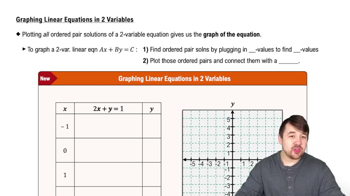
    You substitute chosen x-values into the equation and solve for the corresponding y-values.
  • What do you do after finding ordered pairs for a linear equation?

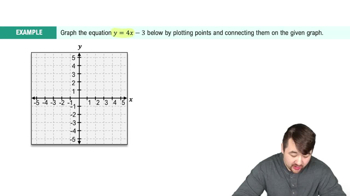
    You plot the ordered pairs on a graph and connect them with a straight line.
  • Why is it important to plot at least three points when graphing a linear equation?

    Plotting at least three points ensures the accuracy of the line and helps show the general trend.
  • What does the line you draw through the plotted points represent?

    The line represents all possible solutions to the linear equation in two variables.
  • If x-values are not given, what should you do?

    You should choose your own x-values, typically values like -1, 0, 1, and 2.
  • What is an ordered pair in the context of graphing equations?

    An ordered pair is a set of x and y values (x, y) that satisfy the equation.
  • How do you solve for y when given an x-value in the equation 2x + y = 1?

    Substitute the x-value into the equation, then solve for y by isolating it.
  • What does connecting the plotted points with a line indicate about the solutions?

    It shows that every point on the line is a solution to the equation, not just the plotted points.
  • What is the purpose of drawing arrows at the ends of the line on the graph?

    Arrows indicate that the line (and thus the solutions) extends infinitely in both directions.
  • What should you do if you want to see the general trend of a linear equation’s graph?

    Plot several ordered pairs and connect them with a line to visualize the trend.
  • What does the process of graphing a linear equation reinforce?

    It reinforces skills in solving equations and understanding linear functions graphically.
  • Why might you choose x-values like -1, 0, 1, and 2 when graphing?

    These values are typically close to the origin and make calculations and graphing easier.
  • What is the relationship between the equation ax + by = c and its graph?

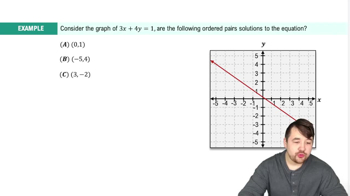
    The graph is a straight line showing all ordered pairs (x, y) that satisfy the equation.
  • Are the plotted points the only solutions to the equation?

    No, every point on the line, including those between and beyond the plotted points, is a solution.