Back

Introduction to Complex Numbers quiz

Control buttons has been changed to "navigation" mode.
1/15
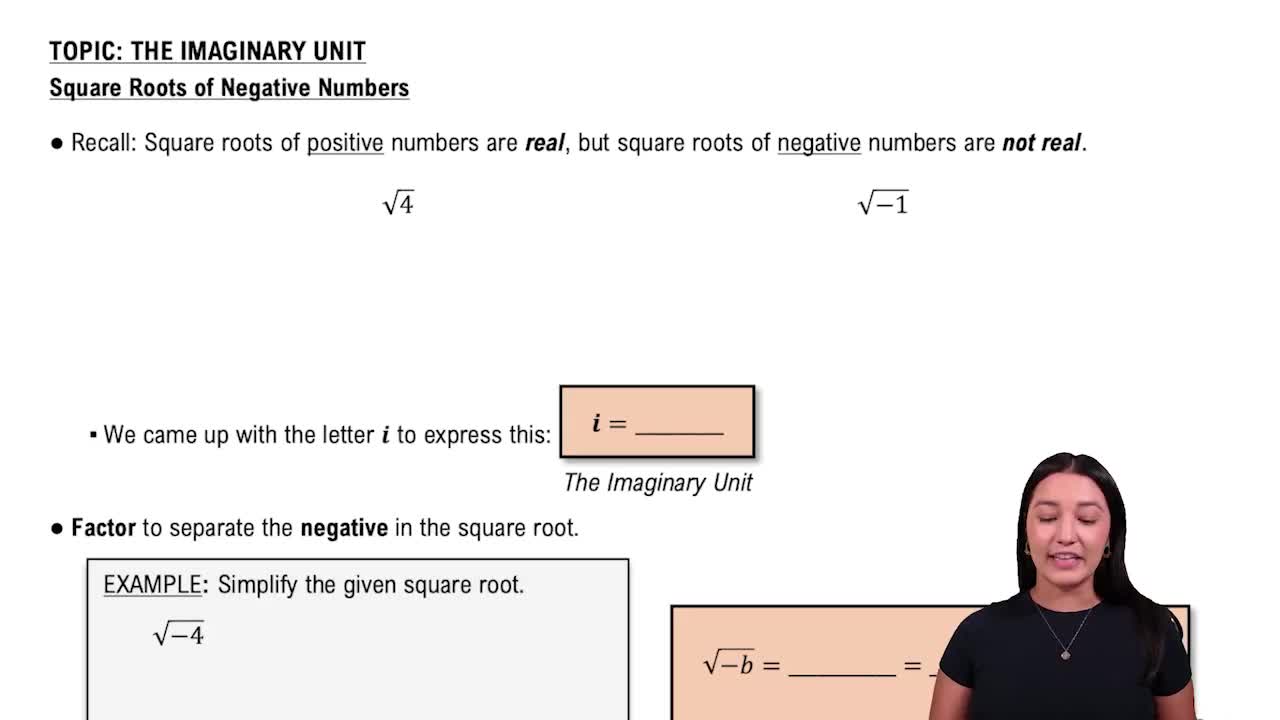
  • What is the imaginary unit 'i' defined as?

    The imaginary unit 'i' is defined as the square root of negative one (√-1).
  • How do you simplify the square root of a negative number, such as √-4?

    You factor out the negative as √-1, which is i, so √-4 = 2i.
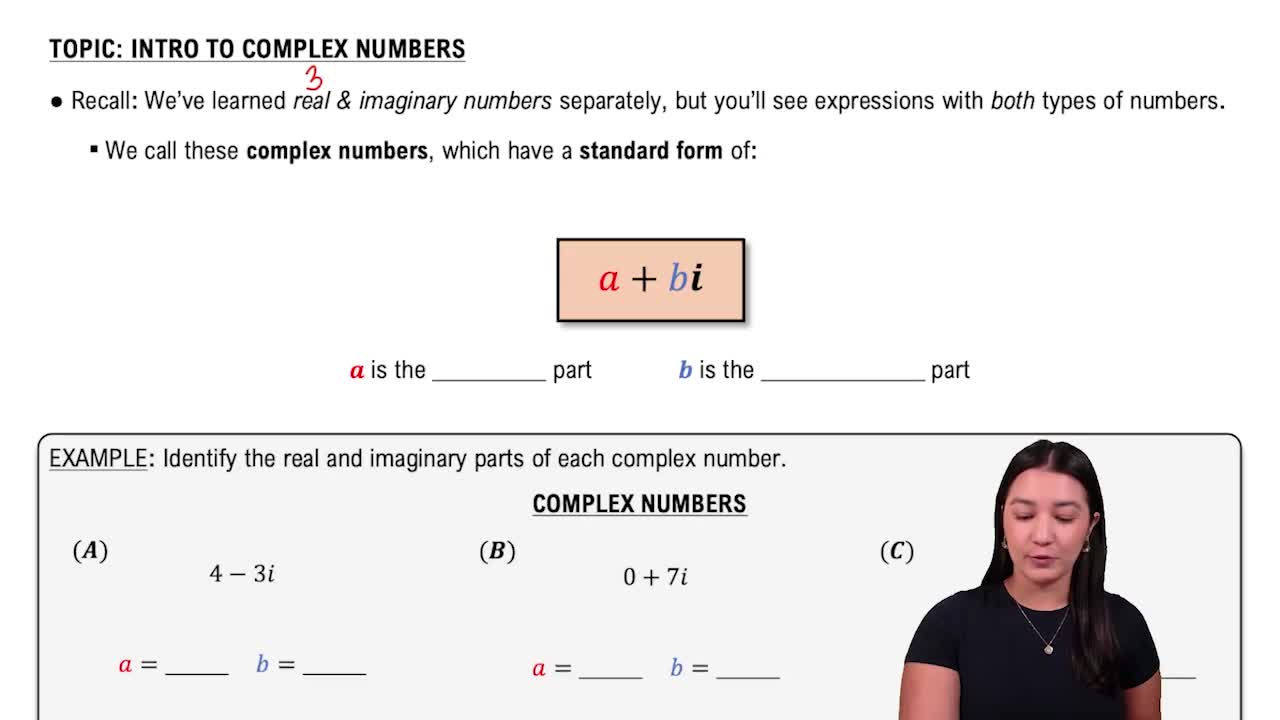
  • What is the standard form of a complex number?

    The standard form of a complex number is a + bi, where a is the real part and b is the coefficient of i.
  • In the complex number 3 + 2i, what are the real and imaginary parts?

    The real part is 3, and the imaginary part is 2.
  • How should you write the answer for √-17?

    You write it as i√17, with i before the radical to avoid confusion.
  • What is the result of simplifying √-32?

    The result is 4i√2, with the whole number first, then i, then the radical.
  • What do you call numbers like 2i, i√17, and 4i√2?

    These are called imaginary numbers because they include the imaginary unit i.
  • What is the real part of the complex number 4 - 3i?

    The real part is 4.
  • What is the imaginary part of the complex number 4 - 3i?

    The imaginary part is -3.
  • What is the real part of the complex number 0 + 7i?

    The real part is 0.
  • What is the imaginary part of the complex number 0 + 7i?

    The imaginary part is 7.
  • What is the real part of the complex number 2 + 0i?

    The real part is 2.
  • What is the imaginary part of the complex number 2 + 0i?

    The imaginary part is 0.
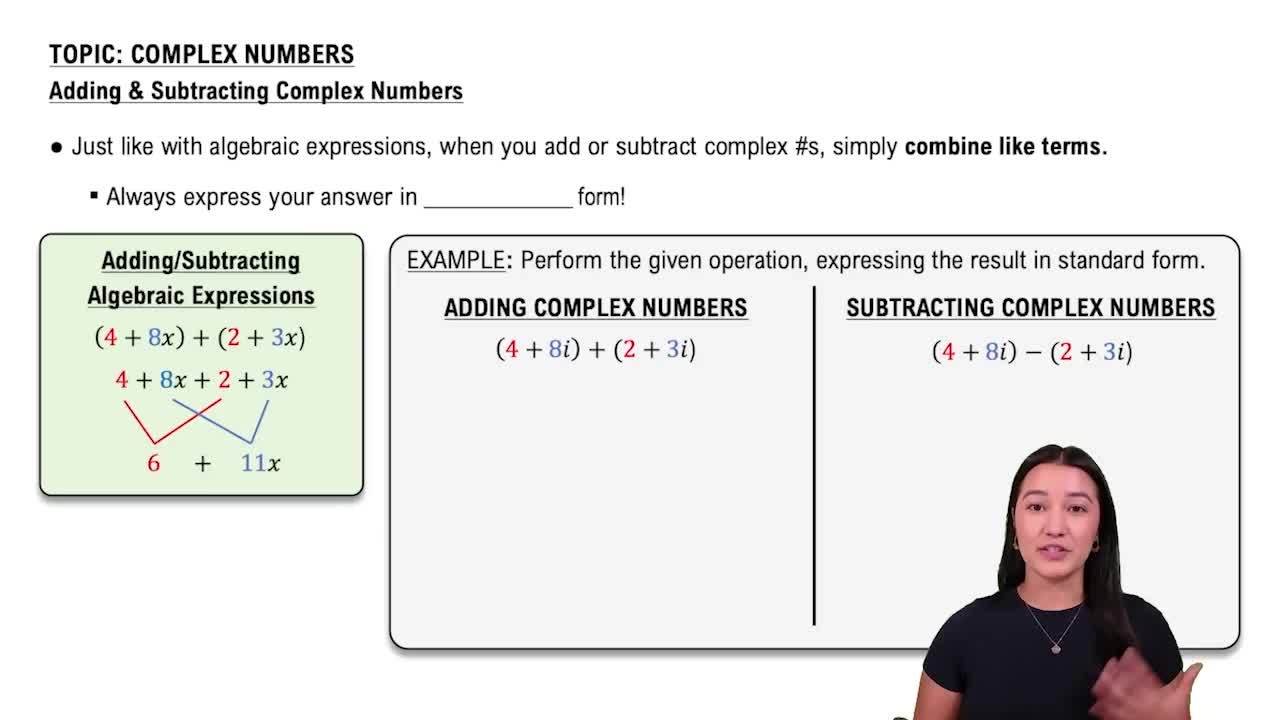
  • How do you add complex numbers like 4 + 8i and 2 + 3i?

    Combine the real parts (4 + 2 = 6) and the imaginary parts (8i + 3i = 11i) to get 6 + 11i.
  • How do you subtract complex numbers like 4 + 8i minus 2 + 3i?

    Subtract the real parts (4 - 2 = 2) and the imaginary parts (8i - 3i = 5i) to get 2 + 5i.