Beginning Algebra
My Course
Learn
AI Tutor
Study Guides
Flashcards
Try the app
My Course
Learn
AI Tutor
Study Guides
Flashcards
Try the app
Back
Least Common Denominators quiz
You can tap to flip the card.
What is the first step in finding the least common denominator (LCD) for rational expressions?
You can tap to flip the card.
👆
What is the first step in finding the least common denominator (LCD) for rational expressions?
The first step is to factor each denominator completely into its prime factors and variables.
Track progress
Control buttons has been changed to "navigation" mode.
1/15
Related flashcards
Recommended videos
Least Common Denominators definitions
Least Common Denominators
15 Terms
05:30
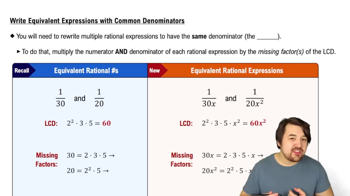
Write Equivelant Expressions With Common Denominators
32
views
03:28
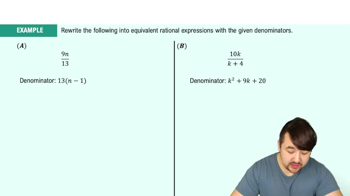
Write Equivelant Expressions With Common Denominators Example 2
27
views
06:33
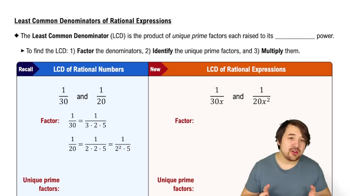
Least Common Denominators of Rational Expressions
67
views
2
rank
Terms in this set (15)
Hide definitions
What is the first step in finding the least common denominator (LCD) for rational expressions?
The first step is to factor each denominator completely into its prime factors and variables.
When listing unique prime factors for the LCD, which exponent do you use if a factor appears with different exponents?
You use the highest exponent of each unique factor when forming the LCD.
How do you find the LCD of 30x and 20x^2?
Factor both denominators, list all unique factors with their highest powers, and multiply them: LCD = 60x^2.
Why do we multiply the numerator and denominator by missing factors when writing equivalent expressions?
Multiplying by missing factors ensures each fraction has the LCD as its denominator, allowing for addition or subtraction.
What is the LCD of 30 and 20, and how is it found?
The LCD is 60, found by multiplying the unique prime factors with their highest exponents: 2^2 × 3 × 5.
How do you handle variables when finding the LCD for rational expressions?
Include each variable in the LCD with the highest exponent that appears in any denominator.
What is the LCD of x + 5 and (x + 2)(x + 5)?
The LCD is (x + 2)(x + 5), since both factors must be included.
What is the purpose of finding a common denominator when adding or subtracting rational expressions?
A common denominator allows you to combine the expressions into a single rational expression.
How do you factor the denominator x^2 + 7x + 10?
It factors into (x + 2)(x + 5) because 2 and 5 multiply to 10 and add to 7.
If a denominator is already factored, such as x + 5, what should you do?
Leave it as is and include it as a unique factor when finding the LCD.
What do you do after finding the LCD for two rational expressions?
Multiply the numerator and denominator of each expression by the missing factors needed to reach the LCD.
How do you determine the missing factor for a denominator when matching it to the LCD?
Compare the denominator's factors to the LCD and identify which factors (and exponents) are missing.
What is the LCD of 130x and 120x^2?
The LCD is 60x^2, found by factoring both denominators and multiplying the highest powers of all unique factors.
Why is finding the LCD for rational expressions similar to finding it for rational numbers?
Both processes involve factoring denominators and using the highest powers of each unique factor.
What is the final step after rewriting rational expressions with the LCD as the denominator?
You can now add or subtract the expressions since they have a common denominator.