Back

Multiplying Polynomials definitions

Control buttons has been changed to "navigation" mode.
1/15
  • Polynomial

    An algebraic expression made up of terms added or subtracted, each with variables raised to whole number exponents.
  • Monomial

    A single term consisting of a number, a variable, or a product of numbers and variables with non-negative exponents.
  • Binomial

    An algebraic expression containing exactly two terms, typically separated by a plus or minus sign.
  • Distributive Property

    A rule allowing multiplication of a term across each term inside parentheses, ensuring all terms are included.
  • FOIL Method

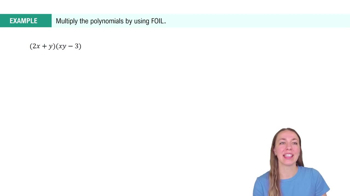
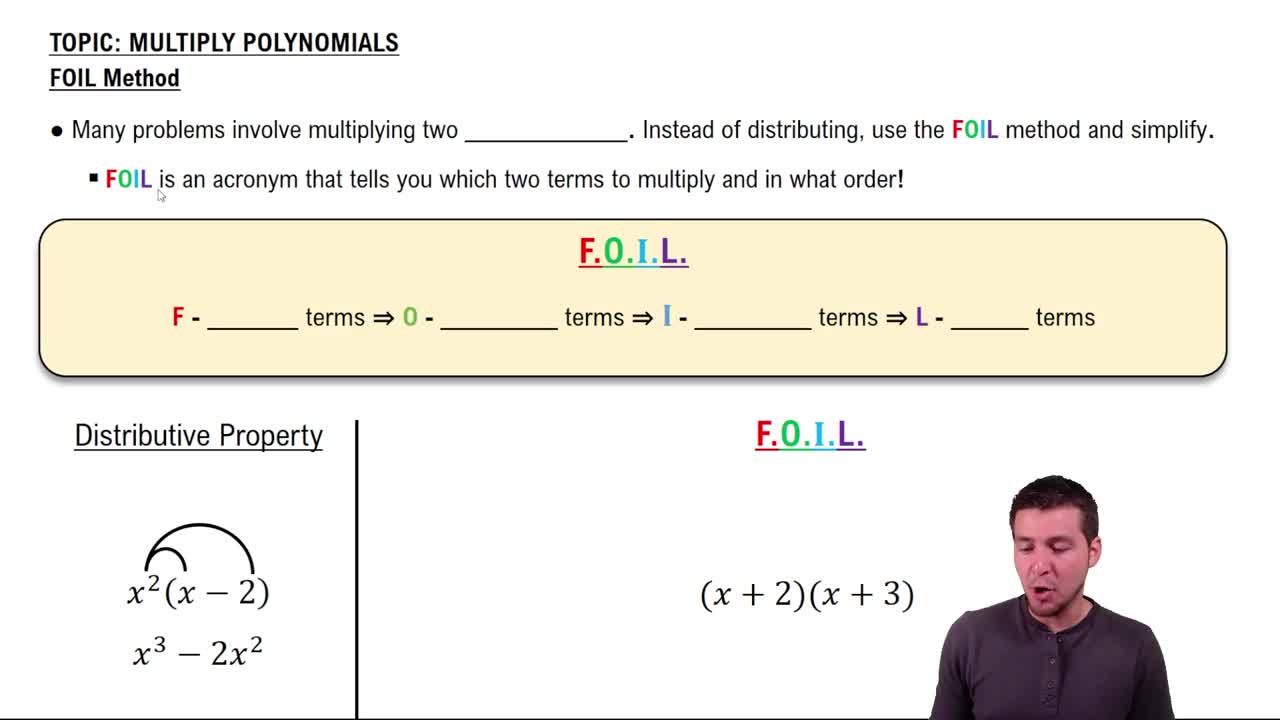
    A process for multiplying two binomials by multiplying First, Outer, Inner, and Last pairs of terms in order.
  • Term

    A part of an expression separated by plus or minus signs, made up of numbers, variables, or both.
  • Coefficient

    The numerical factor in a term, indicating how many times the variable part is counted.
  • Exponent

    A small raised number showing how many times a variable is multiplied by itself in a term.
  • Like Terms

    Terms with identical variable parts and exponents, which can be combined during simplification.
  • Simplification

    The process of combining like terms and performing arithmetic to write an expression in its shortest form.
  • Product

    The result obtained after multiplying two or more expressions together.
  • Expression

    A combination of terms using addition, subtraction, and multiplication, but without an equals sign.
  • Parentheses

    Curved symbols used to group terms, indicating which operations should be performed first.
  • Pattern

    A predictable structure or sequence observed in the arrangement or results of multiplying polynomials.
  • Variable

    A symbol, usually a letter, representing an unknown or changeable value in an expression.