Skip to main content
Beginning Algebra
My Course
Learn
Exam Prep
AI Tutor
Study Guides
Flashcards
Try the app
My Course
Learn
Exam Prep
AI Tutor
Study Guides
Flashcards
Try the app
Back
Simplifying Radical Expressions quiz
You can tap to flip the card.
What does the product rule for radicals state?
You can tap to flip the card.
👆
What does the product rule for radicals state?
The product rule states that the square root of a times the square root of b equals the square root of a times b.
Track progress
Control buttons has been changed to "navigation" mode.
1/15
Related flashcards
Related practice
Recommended videos
Simplifying Radical Expressions definitions
Simplifying Radical Expressions
15 Terms
Simplifying Radical Expressions
9. Roots and Radicals
5 problems
Topic
ErnestBlazevic
Adding and Subtracting Radicals
9. Roots and Radicals
5 problems
Topic
David-PaigeMcFarlane
9. Roots and Radicals
4 topics
12 problems
Chapter
ErnestBlazevic
Guided course
07:33
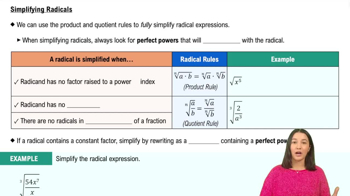
Simplifying Radicals
46
views
Guided course
04:43
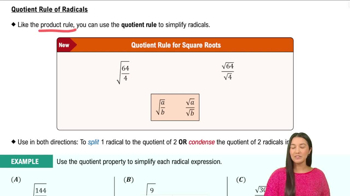
Quotient Rule of Radicals
83
views
1
rank
Guided course
01:55
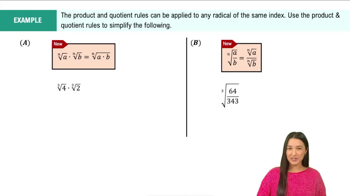
Product & Quotient Rules for Higher Roots Example 1
71
views
Terms in this set (15)
Hide definitions
What does the product rule for radicals state?
The product rule states that the square root of a times the square root of b equals the square root of a times b.
How can you use the product rule to condense two radicals into one?
Multiply the numbers under the radicals and place the product under a single radical sign.
How can you use the product rule in reverse?
You can expand a single radical into the product of two radicals whose multiplication equals the original value under the radical.
What is the simplified form of √3 × √11 using the product rule?
The simplified form is √33.
How do you simplify √2 × √8 using the product rule?
First, combine under one radical to get √16, then simplify to 4.
How can you simplify √50 using the product rule?
Rewrite 50 as 25 × 2, then expand to √25 × √2, which simplifies to 5√2.
When is a radical expression considered simplified?
A radical is simplified when the number under the radical cannot be factored to include a perfect square other than 1.
What does the quotient rule for radicals state?
The quotient rule states that the square root of a divided by b equals the square root of a divided by the square root of b.
How can you use the quotient rule to split a single radical into two?
Rewrite the radical as the quotient of two separate radicals, one for the numerator and one for the denominator.
How can you use the quotient rule in reverse?
You can condense the quotient of two radicals into a single radical containing the division of the two numbers.
What is the simplified form of √144/25 using the quotient rule?
It simplifies to √144 divided by √25, which is 12/5.
How do you simplify √9/49 using the quotient rule?
Rewrite as √9 divided by √49, which simplifies to 3/7.
How do you simplify √300 ÷ √3 using the quotient rule in reverse?
Combine under one radical as √(300/3) = √100, which simplifies to 10.
Why might you use the product or quotient rule in both directions?
Using the rules in both directions helps either condense or expand radicals to make simplification easier.
What is a perfect square, and why is it useful in simplifying radicals?
A perfect square is a number whose square root is an integer, and recognizing them helps break down radicals for easier simplification.
 BackBack

 07:33
07:33