What is the slope-intercept form of a linear equation?
The slope-intercept form is y = mx + b, where m is the slope and b is the y-intercept.
In the equation y = mx + b, what does the 'm' represent?
The 'm' represents the slope of the line, which is the rise over run between two points.
What does the 'b' represent in the equation y = mx + b?
The 'b' is the y-intercept, the point where the line crosses the y-axis (when x = 0).
How do you find the slope from a graph?
You find the slope by calculating the rise (change in y) over the run (change in x) between two points on the line.
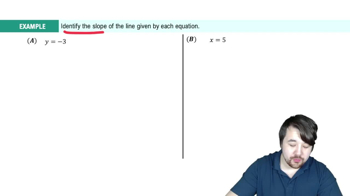
If a line crosses the y-axis at -3, what is the value of b in its equation?
The value of b is -3, since that's the y-intercept.
How do you write the equation of a line with slope 2 and y-intercept 3 in slope-intercept form?
The equation is y = 2x + 3.
What is the simplified form of y = 1x - 3?
The simplified form is y = x - 3.
When should you use the point-slope form instead of slope-intercept form?
Use point-slope form when you know the slope and a point on the line that is not the y-intercept.
What is the point-slope form of a line?
The point-slope form is y - y1 = m(x - x1), where m is the slope and (x1, y1) is a point on the line.
How can you convert point-slope form to slope-intercept form?
Distribute the slope and solve for y to rewrite the equation in the form y = mx + b.
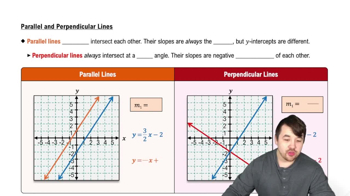
What is the relationship between the slopes of parallel lines?
Parallel lines have the same slope but different y-intercepts.
How do the slopes of perpendicular lines relate to each other?
The slopes of perpendicular lines are negative reciprocals of each other.
If one line has a slope of 2/3, what is the slope of a line perpendicular to it?
The perpendicular slope is -3/2, the negative reciprocal of 2/3.
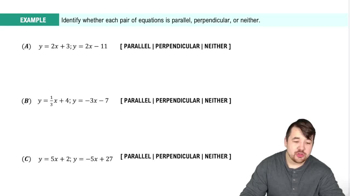
How do you determine if two lines are parallel, perpendicular, or neither using their equations?
Put both equations in slope-intercept form and compare their slopes: same slopes mean parallel, negative reciprocals mean perpendicular, otherwise neither.
If a line has the equation y = 1/3x + 2 and another has y = -3x + 6, are they parallel, perpendicular, or neither?
They are perpendicular because their slopes (1/3 and -3) are negative reciprocals.