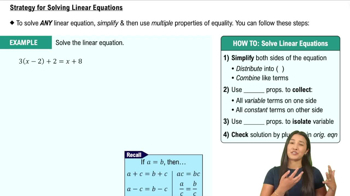
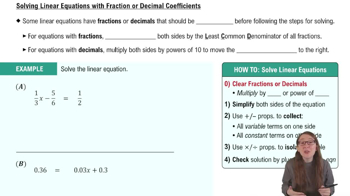
An algebraic statement where variable terms and constants are combined using addition, subtraction, multiplication, or division, and the variable has an exponent of one.
Variable
A symbol, often x, representing an unknown value that can be solved for in an equation.
Coefficient
A numerical factor that multiplies a variable in an algebraic expression.
Constant
A fixed value in an equation that does not contain a variable.
Like Terms
Terms in an expression that have identical variable parts and can be combined by addition or subtraction.
Distributive Property
A rule allowing multiplication to be applied across terms inside parentheses, such as a(b + c) = ab + ac.
Property of Equality
A rule stating that performing the same operation on both sides of an equation keeps the equation balanced.
Solution Set
All values for the variable that make the equation a true statement when substituted.
Identity
An equation that is always true for any value of the variable, resulting in infinite solutions.
Contradiction
An equation that is never true, regardless of the variable's value, resulting in no solutions.
Conditional Equation
An equation that is true only for specific values of the variable, resulting in exactly one solution.
Least Common Denominator
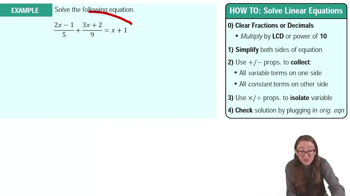
The smallest shared multiple of denominators in an equation, used to clear fractions.
Set Builder Notation
A way to describe a set by stating the properties that its members must satisfy, often used for solution sets.
Empty Set
A set containing no elements, representing no solutions to an equation.
Multiplication Property of Equality
A rule stating that multiplying both sides of an equation by the same nonzero number keeps the equation balanced.
 Back
Back
 06:00
06:00