Beginning Algebra
My Course
Learn
AI Tutor
Study Guides
Flashcards
Try the app
My Course
Learn
AI Tutor
Study Guides
Flashcards
Try the app
Back
Solving Linear Equations quiz
You can tap to flip the card.
What is the first step when solving a linear equation?
You can tap to flip the card.
👆
What is the first step when solving a linear equation?
The first step is to simplify both sides by distributing and combining like terms.
Track progress
Control buttons has been changed to "navigation" mode.
1/15
Related flashcards
Recommended videos
Solving Linear Equations definitions
Solving Linear Equations
15 Terms
06:00
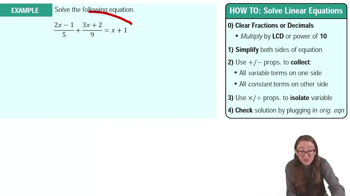
Solving Linear Equations with Fraction or Decimal Coefficients Example 1
64
views
Guided course
06:21
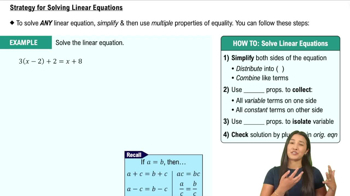
Strategy for Solving Linear Equations
110
views
3
rank
06:25
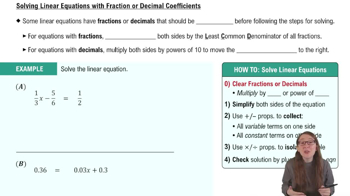
Solving Linear Equations with Fraction or Decimal Coefficients
78
views
3
rank
Terms in this set (15)
Hide definitions
What is the first step when solving a linear equation?
The first step is to simplify both sides by distributing and combining like terms.
How do you combine like terms in a linear equation?
Combine terms with the same variable or constants by adding or subtracting them.
What property is used to move variable terms to one side of the equation?
The addition or subtraction property of equality is used to move variable terms.
How do you isolate the variable in the final step of solving a linear equation?
Use multiplication or division properties of equality to solve for the variable.
Why should you check your solution after solving a linear equation?
Checking ensures the solution makes the original equation a true statement.
What should you do if a linear equation contains fractions?
Multiply both sides by the least common denominator to clear the fractions.
How do you clear decimals from a linear equation?
Multiply both sides by a power of 10 based on the highest number of decimal places.
What is the solution to the equation 2x - 5 = 3 after clearing fractions?
The solution is x = 4.
What is the solution to the equation 36 = 3x + 30 after clearing decimals?
The solution is x = 2.
What is a conditional equation?
A conditional equation has exactly one solution that makes the equation true.
What is an identity equation?
An identity equation is always true and has infinite solutions; any value for x works.
What is a contradiction or inconsistent equation?
A contradiction equation is always false and has no solutions.
How can you represent the solution set of an identity equation?
The solution set is all real numbers, often written as ℝ or in set builder notation.
What symbol represents the empty set for a contradiction equation?
The empty set is represented by {} or a zero with a line through it (∅).
What are the four main steps for solving a linear equation after clearing fractions or decimals?
Simplify, collect variable and constant terms, isolate the variable, and check the solution.