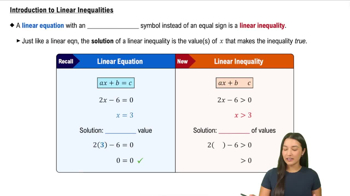
An algebraic statement using an inequality symbol instead of an equal sign, representing a range of possible solutions.
Inequality Symbol
A sign such as >, <, ≥, or ≤ used to compare two expressions, indicating their relative size or order.
Solution Set
All values that make an inequality true, often represented as a range rather than a single number.
Set Builder Notation
A method using curly brackets and a vertical line to describe all values satisfying a given condition.
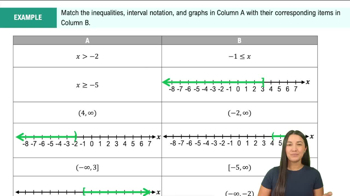
Interval Notation
A concise way to express all numbers between two endpoints, using parentheses or brackets to show inclusion or exclusion.
Number Line
A visual representation where solutions are shown as arrows, brackets, or circles to indicate included or excluded values.
Parenthesis
A symbol used in interval notation or graphs to show that a boundary value is not included in the solution.
Bracket
A symbol used in interval notation or graphs to indicate that a boundary value is included in the solution.
Open Circle
A notation on a graph showing that a specific value is not part of the solution set.
Closed Circle
A notation on a graph indicating that a specific value is included in the solution set.
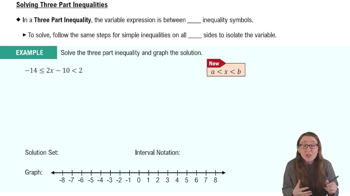
Three Part Inequality
An inequality with a variable expression between two inequality symbols, representing values between two bounds.
Variable Isolation
The process of rearranging an inequality to get the variable alone on one side or in the center.
Addition Property of Inequality
A rule stating that adding the same value to each side of an inequality keeps the relationship true.
Multiplication Property of Inequality
A rule stating that multiplying each side of an inequality by a positive value keeps the relationship true, but by a negative value reverses the symbol.
Coefficient
A numerical factor multiplying a variable in an algebraic expression, affecting the solution when isolating the variable.
 Back
Back
 05:13
05:13