Skip to main content
Beginning Algebra
My Course
Learn
Exam Prep
AI Tutor
Study Guides
Flashcards
Try the app
My Course
Learn
Exam Prep
AI Tutor
Study Guides
Flashcards
Try the app
Back
Solving Linear Inequalities quiz
You can tap to flip the card.
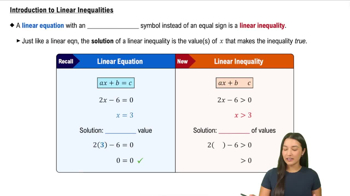
What is the main difference between a linear equation and a linear inequality?
You can tap to flip the card.
👆
What is the main difference between a linear equation and a linear inequality?
A linear equation uses an equal sign and has a single solution, while a linear inequality uses an inequality symbol and has a range of solutions.
Track progress
Control buttons has been changed to "navigation" mode.
1/15
Related flashcards
Related practice
Recommended videos
Solving Linear Inequalities definitions
Solving Linear Inequalities
15 Terms
Solving Linear Inequalities
2. Linear Equations and Inequalities
5 problems
Topic
ErnestBlazevic
Solving Linear Equations
2. Linear Equations and Inequalities
5 problems
Topic
ErnestBlazevic
2. Linear Equations and Inequalities
4 topics
12 problems
Chapter
ErnestBlazevic
Guided course
05:13
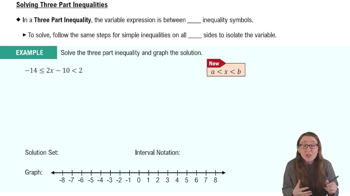
Solving Three Part Inequalities
85
views
2
rank
Guided course
03:43
Introduction to Linear Inequalities
191
views
6
rank
Guided course
07:09
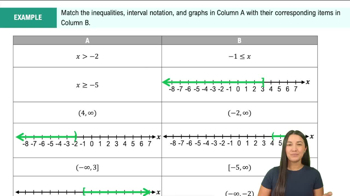
Introduction to Linear Inequalities Example 1
109
views
2
rank
Terms in this set (15)
Hide definitions
What is the main difference between a linear equation and a linear inequality?
A linear equation uses an equal sign and has a single solution, while a linear inequality uses an inequality symbol and has a range of solutions.
What are the four common inequality symbols used in linear inequalities?
The four common symbols are greater than (>), less than (<), greater than or equal to (≥), and less than or equal to (≤).
How is the solution to a linear inequality typically represented?
The solution is a range of values, not just a single value, and can be shown using set builder notation, interval notation, or a number line.
What does set builder notation look like for the inequality x > 3?
Set builder notation is written as {x | x > 3}, meaning the set of x such that x is greater than 3.
How do you indicate that a boundary value is not included in interval notation?
You use parentheses, for example (3, ∞) means values greater than 3 but not including 3.
What notation is used to show that a boundary value is included in interval notation?
Square brackets are used, for example [3, ∞) means values greater than or equal to 3.
How do you graphically represent the exclusion of a value on a number line?
You use a parenthesis or an open circle at the boundary value to show it is not included.
What is the interval notation for x < 3?
The interval notation is (-∞, 3), using parentheses to show neither boundary is included.
What is the interval notation for x ≤ 3?
The interval notation is (-∞, 3], with a square bracket at 3 to show it is included.
What must you do to the inequality symbol when multiplying or dividing both sides by a negative number?
You must flip the inequality symbol to maintain a true statement.
How do you solve the inequality x - 3 > 11?
Add 3 to both sides to isolate x, resulting in x > 14.
What is the solution to the inequality -7x ≥ 21?
Divide both sides by -7 and flip the inequality, giving x ≤ -3.
What is a three-part (compound) inequality?
It is an inequality where the variable expression is between two inequality symbols, such as -14 ≤ 2x - 10 < 2.
When solving a three-part inequality, what must you do with each operation?
You must perform the operation on all three sides of the inequality.
How is the solution to -2 ≤ x < 6 written in interval notation?
It is written as [-2, 6), with a bracket at -2 and a parenthesis at 6.
 BackBack
 05:13
05:13