Beginning Algebra
My Course
Learn
AI Tutor
Study Guides
Flashcards
Try the app
My Course
Learn
AI Tutor
Study Guides
Flashcards
Try the app
Back
The Distributive Property definitions
You can tap to flip the card.
Distributive Property
You can tap to flip the card.
👆
Distributive Property
A rule connecting multiplication with addition or subtraction, allowing multiplication to be applied to each term inside parentheses.
Track progress
Control buttons has been changed to "navigation" mode.
1/15
Related flashcards
Recommended videos
The Distributive Property quiz
The Distributive Property
15 Terms
Guided course
02:09
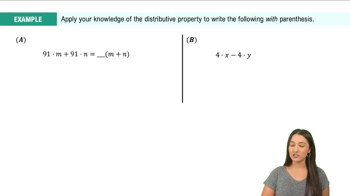
The Distributive Property Example 2
67
views
5
rank
Guided course
02:26
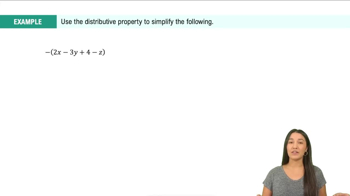
The Distributive Property Example 1
93
views
1
rank
Guided course
05:53
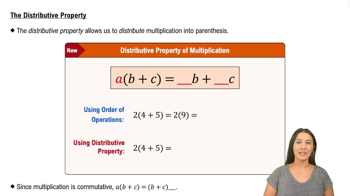
The Distributive Property
90
views
1
rank
Terms in this set (15)
Hide definitions
Distributive Property
A rule connecting multiplication with addition or subtraction, allowing multiplication to be applied to each term inside parentheses.
Parentheses
Symbols used to group terms in an expression, indicating operations inside should be considered together.
Variable
A symbol, often a letter, representing an unknown or changeable value in an algebraic expression.
Constant
A fixed value that does not change within an expression or equation.
Term
A single part of an expression, separated by plus or minus signs, which may include numbers, variables, or both.
Coefficient
A numerical factor multiplied by a variable in an algebraic term.
Expression
A mathematical phrase combining numbers, variables, and operations, but lacking an equals sign.
Subtraction
An operation that can be viewed as adding a negative value, often used within parentheses in algebraic expressions.
Addition
An operation combining values or terms, often grouped inside parentheses for distribution.
Multiplication
An operation that can be distributed over addition or subtraction within parentheses according to a specific property.
Order of Operations
A set of rules determining the sequence in which calculations are performed in an expression.
Simplification
The process of rewriting an expression in a more concise or standard form, often by removing parentheses.
Standard Form
An arrangement of an expression where like terms are combined and written in a conventional order.
Polynomial
An expression consisting of variables, coefficients, and constants combined using addition, subtraction, and multiplication.
Commutative Property
A rule stating that the order of multiplication does not affect the result, allowing flexibility in distributing factors.