Beginning Algebra
My Course
Learn
AI Tutor
Study Guides
Flashcards
Try the app
My Course
Learn
AI Tutor
Study Guides
Flashcards
Try the app
Back
The Distributive Property quiz
You can tap to flip the card.
What does the distributive property allow you to do with multiplication and parentheses?
You can tap to flip the card.
👆
What does the distributive property allow you to do with multiplication and parentheses?
It allows you to distribute multiplication to each term inside the parentheses.
Track progress
Control buttons has been changed to "navigation" mode.
1/15
Related flashcards
Recommended videos
The Distributive Property definitions
The Distributive Property
15 Terms
Guided course
02:09
The Distributive Property Example 2
67
views
5
rank
Guided course
02:26
The Distributive Property Example 1
93
views
1
rank
Guided course
05:53
The Distributive Property
90
views
1
rank
Terms in this set (15)
Hide definitions
What does the distributive property allow you to do with multiplication and parentheses?
It allows you to distribute multiplication to each term inside the parentheses.
How does the distributive property work with subtraction inside parentheses?
You distribute the multiplication to both terms, treating subtraction as adding a negative, so a(b - c) = ab - ac.
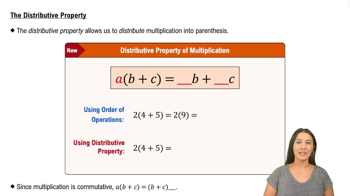
What is the result of applying the distributive property to 2 × (4 + 5)?
It becomes 2 × 4 + 2 × 5, which simplifies to 8 + 10 = 18.
Why is the distributive property useful when variables are involved?
Because you can't combine variables and numbers directly, so you must distribute multiplication to each term.
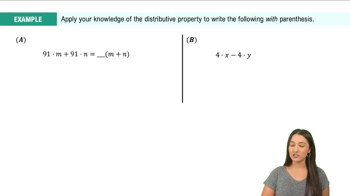
How do you write 4(x - 8) without parentheses using the distributive property?
It becomes 4x - 32.
If you have a constant on the right side of the parentheses, can you still use the distributive property?
Yes, because multiplication is commutative, so the order does not matter.
What is the simplified form of (4x + 2y - 7z) × 3 using the distributive property?
It is 12x + 6y - 21z.
Does the distributive property work with more than two terms inside the parentheses?
Yes, you distribute the multiplication to every term inside the parentheses.
What is the general form of the distributive property for addition?
a(b + c) = ab + ac.
What is the general form of the distributive property for subtraction?
a(b - c) = ab - ac.
Why can't you simplify 4(x - 8) by combining x and 8?
Because x is a variable and its value is unknown, so you can't perform the subtraction.
What property of multiplication allows you to distribute a constant from either side of the parentheses?
The commutative property of multiplication.
How do you distribute 3 to each term in (4x + 2y - 7z)?
Multiply 3 by each term: 3 × 4x, 3 × 2y, and 3 × (-7z).
What is the result of distributing 3 to -7z?
It is -21z.
What does the distributive property help you do with algebraic expressions?
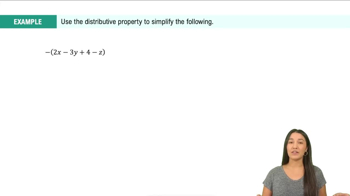
It helps you simplify expressions by removing parentheses and combining like terms.