Back

Adding and Subtracting Radicals definitions

Control buttons has been changed to "navigation" mode.
1/15
  • Radical

    A mathematical expression involving a root, such as a square root or cube root, indicated by a radical symbol.
  • Radicand

    The value or expression inside the radical symbol that is being rooted, such as the 7 in square root of 7.
  • Index

    The small number written above and to the left of the radical symbol, indicating the degree of the root.
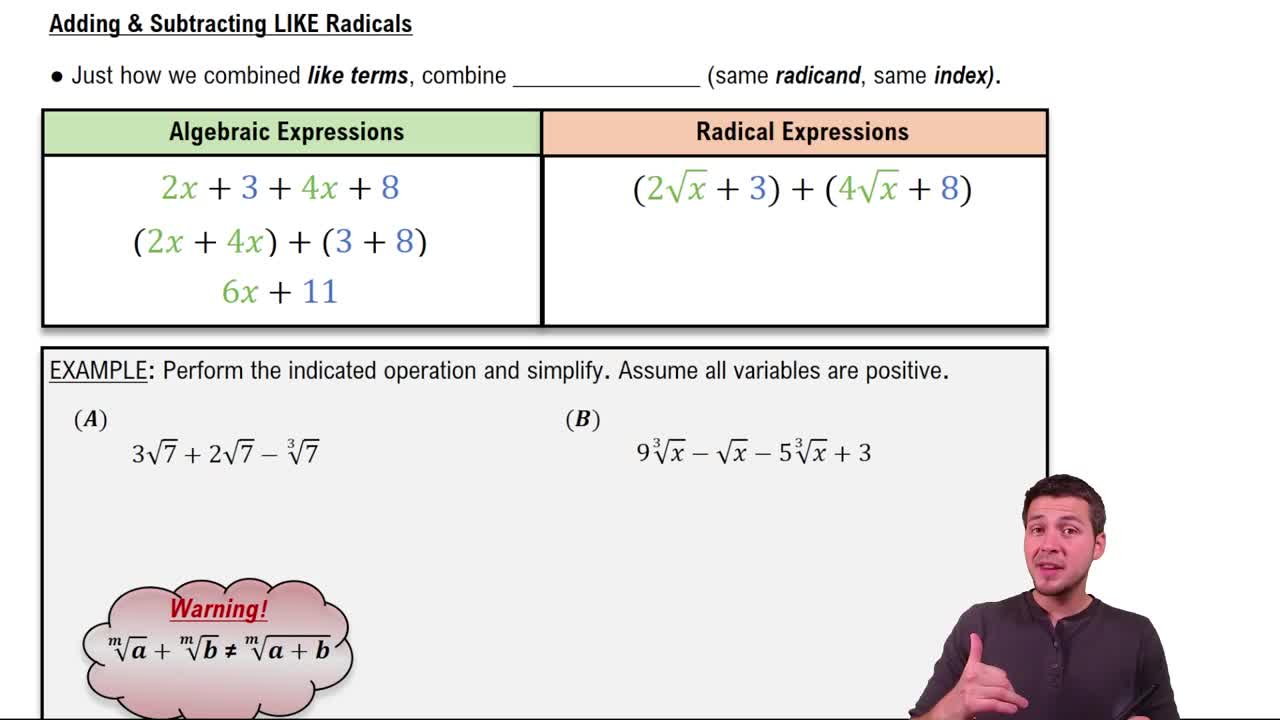
  • Like Radicals

    Radical expressions with identical radicands and indexes, allowing them to be combined through addition or subtraction.
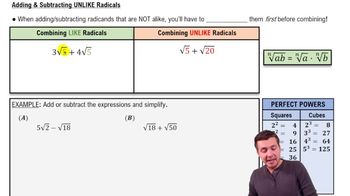
  • Unlike Radicals

    Radical expressions with different radicands or indexes, which cannot be directly combined.
  • Perfect Power

    A number that can be expressed as an integer raised to an exponent matching the radical's index, such as 4 for square roots.
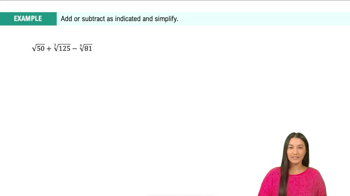
  • Simplification

    The process of rewriting a radical expression by factoring out perfect powers to make combining possible.
  • Square Root

    A radical with an index of 2, representing a value that, when multiplied by itself, gives the radicand.
  • Cube Root

    A radical with an index of 3, representing a value that, when used three times in multiplication, gives the radicand.
  • Constant

    A fixed numerical value in an expression, often appearing as a coefficient in front of a radical.
  • Coefficient

    The numerical factor placed in front of a radical, indicating how many times the radical is counted.
  • Product

    The result of multiplying two or more values, often used when breaking down radicands for simplification.
  • Expression

    A combination of numbers, variables, and mathematical operations, including radicals, that represents a value.
  • Addition

    The operation of combining values, only possible for like radicals by summing their coefficients.
  • Subtraction

    The operation of removing values, only possible for like radicals by subtracting their coefficients.