Skip to main content
Beginning & Intermediate Algebra
My Course
Learn
Exam Prep
AI Tutor
Study Guides
Flashcards
Explore
Try the app
My Course
Learn
Exam Prep
AI Tutor
Study Guides
Flashcards
Explore
Try the app
Back
Arithmetic Sequences definitions
You can tap to flip the card.
Arithmetic Sequence
You can tap to flip the card.
👆
Arithmetic Sequence
A list of numbers where each term increases or decreases by the same fixed amount between consecutive terms.
Track progress
Control buttons has been changed to "navigation" mode.
1/15
Related flashcards
Related practice
Recommended videos
Arithmetic Sequences quiz
Arithmetic Sequences
15 Terms
Arithmetic Sequences
15. Sequences, Series, and the Binomial Theorem
5 problems
Topic
ZacharyFrye
Geometric Sequences
15. Sequences, Series, and the Binomial Theorem
5 problems
Topic
ZacharyFrye
15. Sequences, Series, and the Binomial Theorem
4 topics
12 problems
Chapter
ErnestBlazevic
01:42
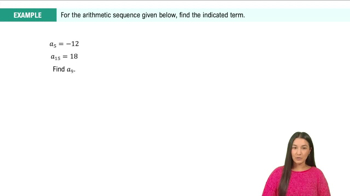
General Term of an Arithmetic Sequences Example 2
89
views
02:45
General Term of an Arithmetic Sequences Example 1
84
views
06:51
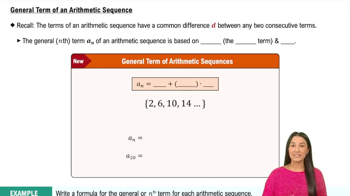
General Term of an Arithmetic Sequences
86
views
Terms in this set (15)
Hide definitions
Arithmetic Sequence
A list of numbers where each term increases or decreases by the same fixed amount between consecutive terms.
Common Difference
The fixed value added or subtracted between any two consecutive terms, often represented by the letter d.
General Term
A formula that allows calculation of any term in the sequence using its position, the first term, and the common difference.
First Term
The initial value in the sequence, often labeled as a1, which serves as the starting point for calculations.
Consecutive Terms
Two terms that appear one after the other in the sequence, used to determine the common difference.
Index
The position number of a term in the sequence, usually denoted by n, indicating which term is being referenced.
Formula
An algebraic expression used to find specific terms or properties of the sequence, such as an=a1+(n-1)×d.
Pattern
A recognizable regularity in the sequence, often based on the repeated addition or subtraction of the common difference.
Sequence
An ordered list of numbers arranged according to a specific rule or relationship.
Term
An individual value in the sequence, identified by its position and calculated using the general term formula.
Variable
A symbol, often n or d, used in formulas to represent unknown or changing values within the sequence.
Simplification
The process of rewriting a formula or expression in a more concise or manageable form, such as combining constants.
Negative Common Difference
A situation where the fixed value between terms is less than zero, causing the sequence to decrease.
Algebra
A branch of mathematics used to manipulate formulas and solve for unknowns within the sequence context.
Nth Term
The value at a specific position in the sequence, calculated using the general term formula and the index n.
 BackBack

 01:42
01:42