Skip to main content
Beginning & Intermediate Algebra
My Course
Learn
Exam Prep
AI Tutor
Study Guides
Flashcards
Explore
Try the app
My Course
Learn
Exam Prep
AI Tutor
Study Guides
Flashcards
Explore
Try the app
Back
Completing the Square definitions
You can tap to flip the card.
Quadratic Equation
You can tap to flip the card.
👆
Quadratic Equation
An expression involving a variable squared, a linear term, and a constant, often solved for variable values.
Track progress
Control buttons has been changed to "navigation" mode.
1/15
Related flashcards
Related practice
Recommended videos
Completing the Square quiz
Completing the Square
15 Terms
Completing the Square
12. Quadratic Equations and Functions
5 problems
Topic
AllySteele
The Quadratic Formula
12. Quadratic Equations and Functions
5 problems
Topic
ErnestBlazevic
12. Quadratic Equations and Functions
4 topics
12 problems
Chapter
ErnestBlazevic
08:50
Complete the Square Example 1
106
views
07:06
Complete the Square
151
views
1
rank
02:40
Complete the Square Example 2
100
views
Terms in this set (15)
Hide definitions
Quadratic Equation
An expression involving a variable squared, a linear term, and a constant, often solved for variable values.
Perfect Square Trinomial
A three-term polynomial formed by squaring a binomial, resulting in a specific quadratic structure.
Square Root Property
A principle allowing solutions of equations where a squared quantity equals a constant by taking square roots.
Binomial
An algebraic expression consisting of two terms, often used in forming squared expressions.
Constant Term
A value in a polynomial that does not contain any variables and affects the equation's balance.
Coefficient
A numerical factor multiplying a variable in a polynomial, crucial for splitting terms during the process.
Standard Form
A way of writing a quadratic equation as ax² + bx + c, organizing terms by degree.
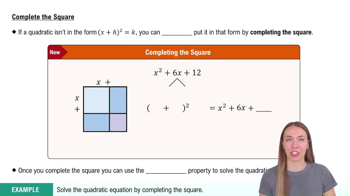
Area Model
A visual representation using squares and rectangles to illustrate polynomial terms and their relationships.
Side Length
A measure used in the area model to represent variable and constant values in geometric diagrams.
Difference
The value needed to adjust constant terms when transforming a quadratic into a perfect square trinomial.
Solution
A value for the variable that satisfies the quadratic equation, often found after completing the square.
Equality
A balanced equation showing two expressions are equivalent, essential for solving quadratics.
Rectangle
A geometric shape used in the area model to represent linear terms split during the process.
Practice Problems
Exercises designed to reinforce understanding and application of completing the square.
Check
A step involving substituting solutions back into the original equation to verify correctness.
 BackBack

 08:50
08:50